By the Castleport Test Prep Editorial Team · Updated September 2026
Download this free ecomap template as a printable PDF, Word worksheet or editable PowerPoint. The pack has 6 worked examples and 36 explained connections. Castleport's September 2026 comparison of 15 guides found that a dashed line means weak in VCU's example but stressed in the CIS toolkit. So check the key before you draw.
Free downloads, no email: PDF (US Letter) · PDF (A4) · Word worksheet · Editable PowerPoint · Teaching pack (PDF)
Key ecomap facts and statistics
- Castleport Test Prep's September 2026 comparison recorded 11 explicit solid-or-thicker assignments for strong connections among 15 selected ecomap guides. VCU's solid positive line is not counted as a strong-line assignment. See the source rows.
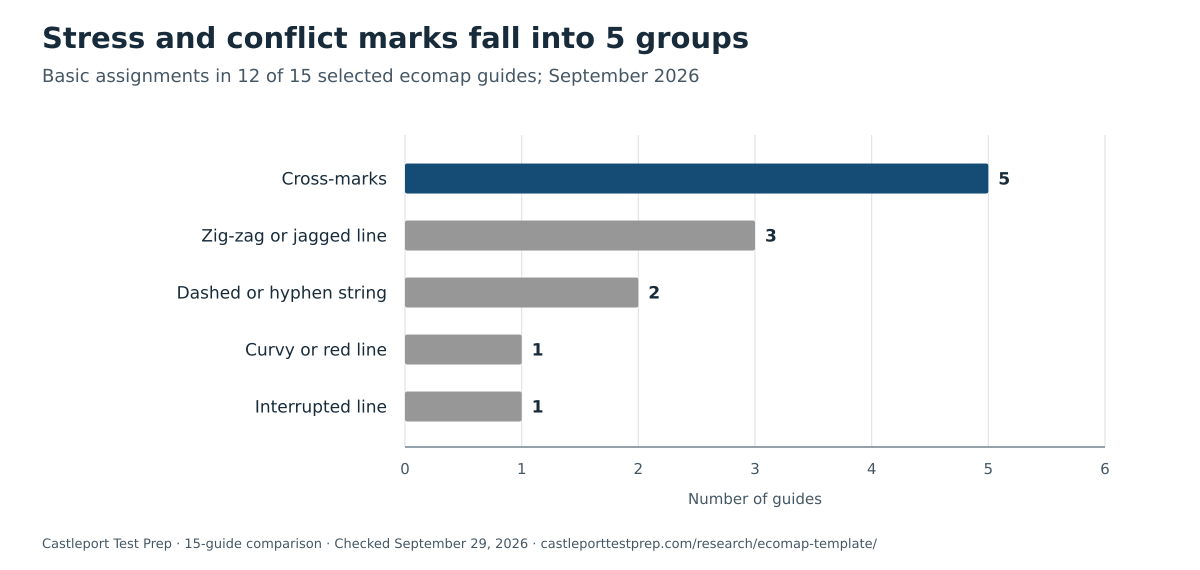
- The 12 readable basic stress or conflict assignments fall into 5 groups: cross-marks (5 guides), zig-zag or jagged (3), dashed or hyphen-string (2), curvy or red (1), and interrupted (1), in Castleport Test Prep's September 2026 comparison. These are grouped conventions, not five universal symbols. See the chart data.
- 10 of the 11 readable weak-line assignments use dots, dashes or broken strokes; 7 use dashes or spaced strokes (Castleport Test Prep comparison, September 2026). See the source rows.
- 11 of the 15 selected guides explicitly describe arrows for the flow of help, resources, energy or influence (Castleport Test Prep comparison, September 2026). See the source rows.
- 3 of the 15 selected guides explicitly suggest writing words beside connections, the option Ann Hartman's original form offered in place of line codes (Castleport Test Prep comparison, September 2026). See the sources.
- 5 of the 15 selected guides explicitly request a date or provide date fields, including Scotland's start and completion dates (Castleport Test Prep comparison, September 2026). See the source rows.
- Social worker Ann Hartman developed the eco-map in 1975 in the Child Welfare Learning Laboratory at the University of Michigan School of Social Work (Hartman, Social Casework, October 1978, p. 466, note 10).
- Hartman's original key used a solid or thick line for a strong connection, a dotted line for a tenuous one, jagged marks across the line for a stressful one, and arrows for the flow of resources, energy or interest (Hartman, 1978, p. 468).
- Hartman wrote that when workers drew the map with clients, the three-line code often felt "too constraining," and workers preferred writing a short description on the line (Hartman, 1978, pp. 468–469).
- Hartman reports that the eco-map was built for public child welfare workers and used with parents seeking their children's return from foster care in a Michigan Department of Social Services project (1978, pp. 467, 471). This was a report of practice, not a controlled outcomes trial.
- OpenStax's open nursing textbook Population Health for Nurses teaches the ecomap as a family assessment tool alongside the genogram (section 28.4).
- A kinship care training manual from the University of Illinois Chicago notes that an ecomap drawn with a child's parent will likely look different from one drawn with the child's grandmother (Bonecutter and Gleeson, p. 34).
On this page: Download the template · What the lines mean · Is there one standard key? · How to make one · 6 worked examples · Ecomap vs. genogram · Who uses ecomaps · Teaching pack · Who created it · How we built this · How to cite · Data · FAQ · Sources
Download the free ecomap template
The template comes in 4 formats, and every version uses the same 9-part key. Pick the blank version if you're drawing with someone, the guided version if you're learning, and the PowerPoint if you want to drag circles and lines on screen.
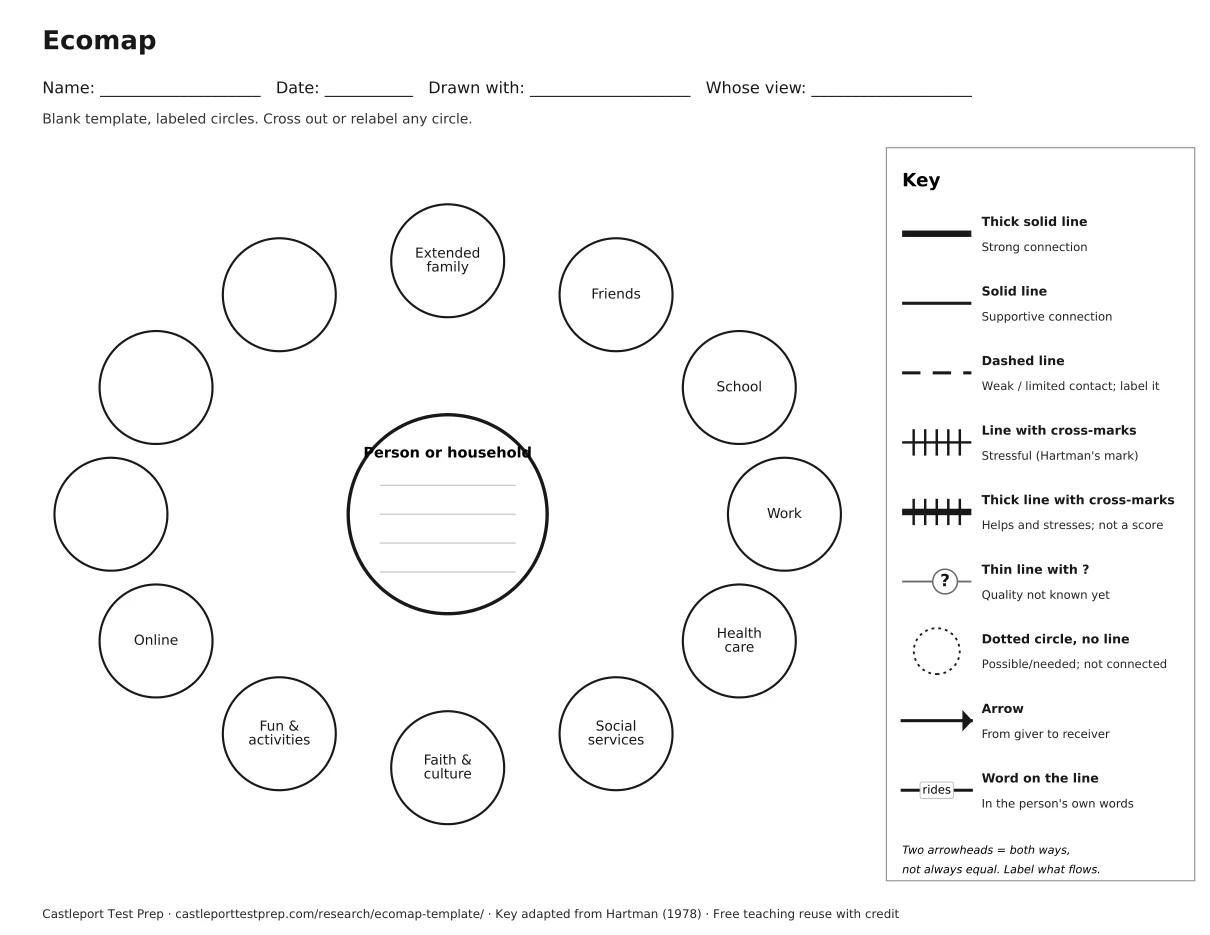
The blank ecomap template, page 1 of the PDF. Castleport Test Prep, September 2026.
Castleport ecomap template files
| File | Format | What's inside |
|---|---|---|
| Ecomap template, US Letter | PDF, 6 pages | Labeled blank map, guided map with questions, unlabeled blank map, connection worksheet, before-and-after comparison sheet, key card |
| Ecomap template, A4 | PDF, 6 pages | The same 6 pages sized for A4 paper |
| Word worksheet | Word (.docx), 3 pages | Printable map, a header and connection table you can type into, and the key |
| Editable ecomap | PowerPoint (.pptx), 3 slides | Circles you can type in and move, a line kit to copy and paste, and how-to steps; editable shapes, not a flattened picture |
| Teaching pack (Word version) | PDF, 16 pages | 45-minute lesson, 6 case cards, answer key for 36 connections, 6 questions, 10-point rubric |
| Key card | Image (PNG) | The Castleport Ecomap Key on one page |
Source: Castleport Test Prep. All files are free and need no sign-up. Every map carries the key; the documents also include a credit line.
A quick note on the Word file. The map in it is a picture that prints cleanly; the header and connection table are fully editable. If you want to move circles and lines around on screen, use the PowerPoint version instead.
What do the lines on an ecomap mean?
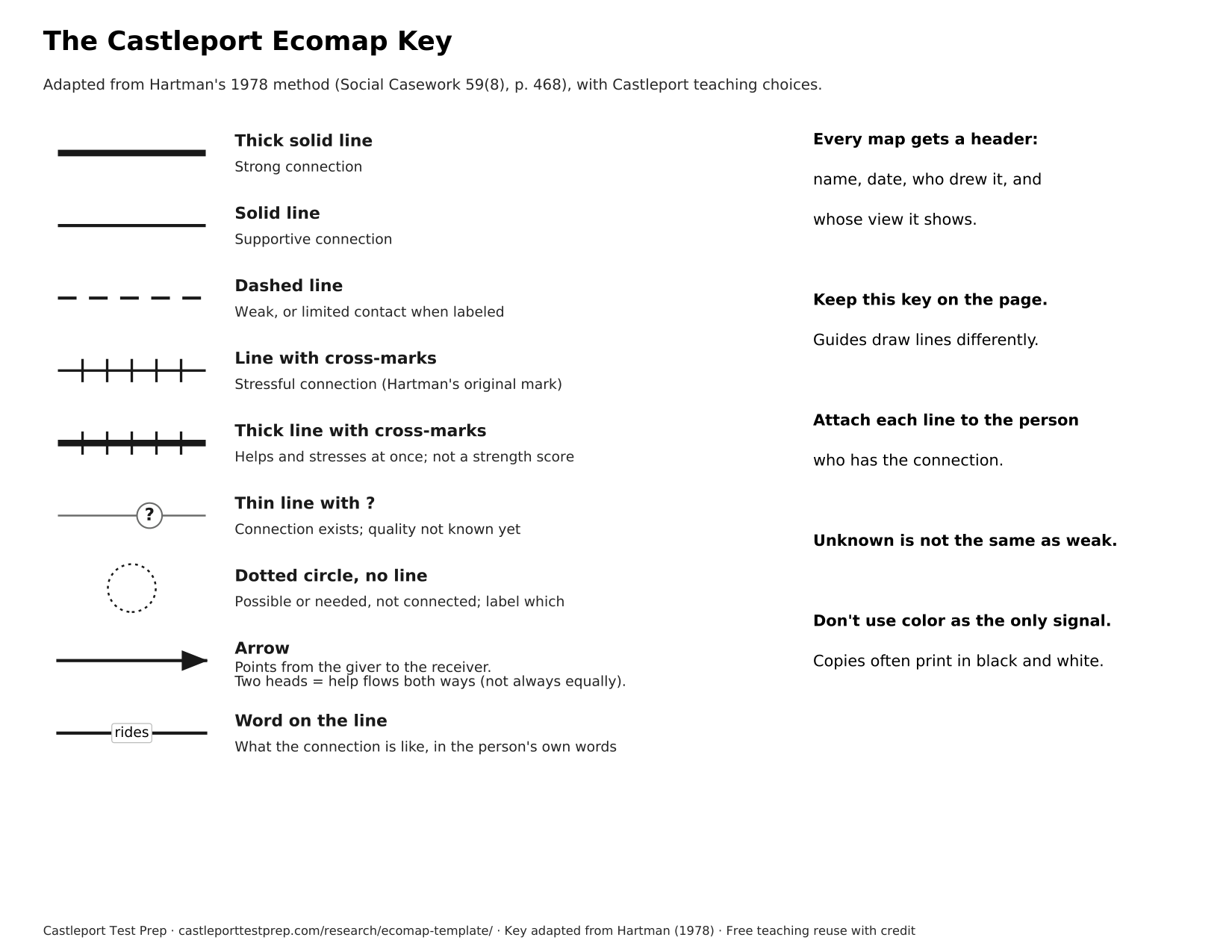
In this pack, a thick solid line means strong, a solid line means supportive, and a dashed line means weak or limited contact as labeled. Stress marks differ across the guides; Hartman's 1978 prose describes marks across a line. Arrows show which way help or resources flow.
Here's the key used on every Castleport file. It adapts Hartman's method and labels Castleport's teaching choices. Use the words on the line to separate contact frequency, closeness and practical help.
The Castleport Ecomap Key
| Mark | What it means | Where it comes from |
|---|---|---|
| Thick solid line | Strong connection | Hartman (1978): "a solid or thick line" means an important or strong connection |
| Solid line | Supportive connection | Castleport separates supportive from strong; Hartman did not define this separate tier |
| Dashed line | Weak connection, or limited contact when the words say so | Castleport convention; 7 of 11 readable weak-line assignments use dashes or spaced strokes. Contact frequency is not emotional closeness |
| Line with cross-marks | Stressful or conflicted connection | Hartman (1978): "jagged marks across the line" |
| Thick line with cross-marks | Helps and stresses at the same time | Castleport combined mark; it records both facts, not a separate strength score |
| Thin line with ? | The connection exists; nobody has said what it's like yet | Castleport addition |
| Dotted circle, no line | Possible or needed resource, not connected yet; say which | Castleport drawing choice. The UIC manual, p.37, supports showing an unmet need but does not prescribe this dotted circle |
| Arrow | Points from the giver to the receiver; two heads = help flows both ways, not always equally | Hartman (1978): arrows show "the flow of resources, energy, or interest" |
| Word on the line | What the connection is like, in the person's own words | Hartman's blank form: describe connections "with a descriptive word" |
Sources: Hartman (1978), pp. 468–469; Bonecutter and Gleeson, p. 37; Castleport Test Prep review of 15 guides, September 2026.
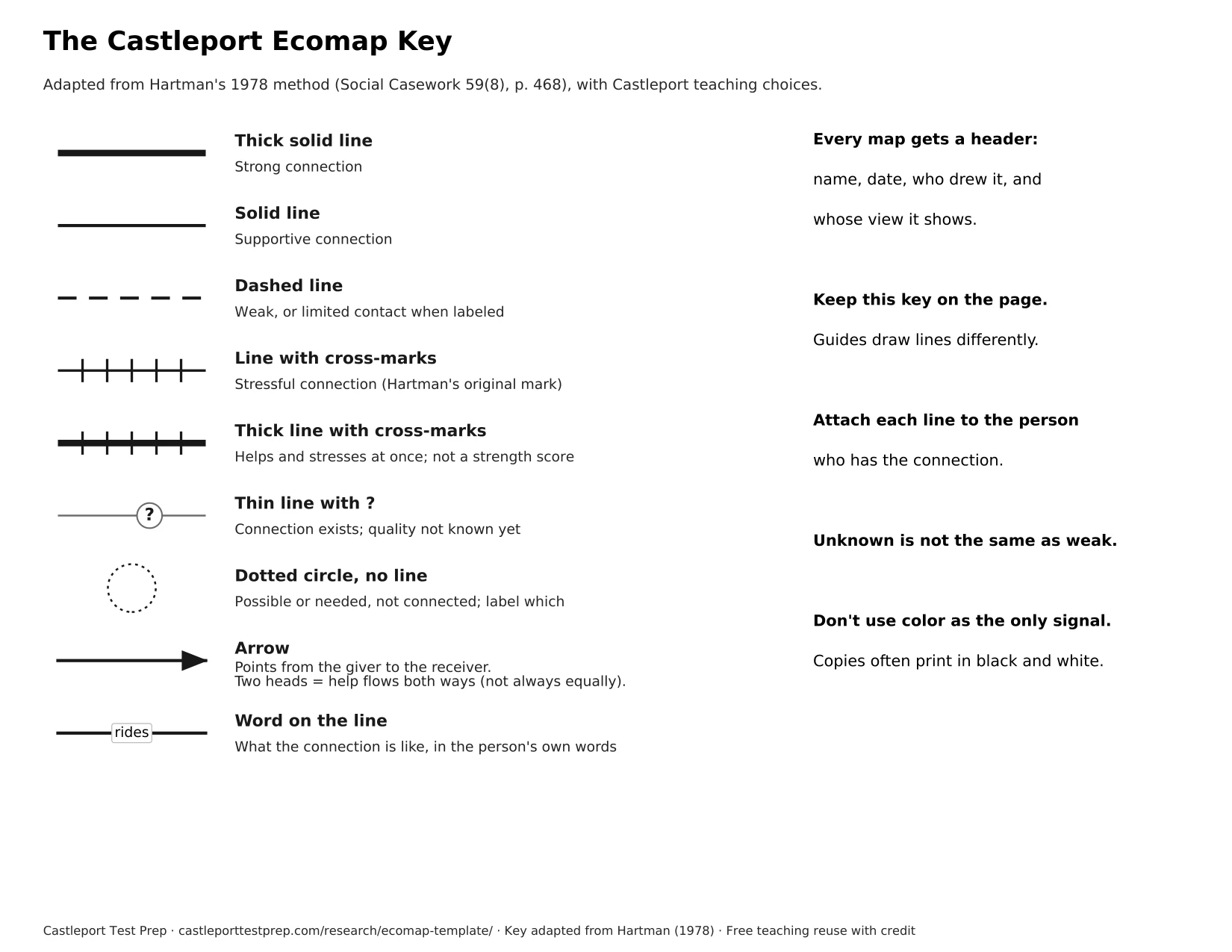
Why dashed instead of Hartman's dotted? It's the convention chosen for this pack, not a safer or universal rule. VCU uses dashed for weak, while CIS uses dashed for stressed. Scotland's dotted line with cross-marks is a different complete symbol from a plain dotted line. Read the whole mark and its key.
How do arrows work on an ecomap?
An arrow points from the person or group giving help to the one receiving it. Hartman used arrows for "the direction of the flow of resources, energy, or interest" (1978, p. 468), and 11 of the 15 guides we reviewed use arrows too.
In this pack, two arrowheads mean help goes both ways. That's all they mean here; Social Workers Toolbox's step 5 instead describes equal support. We do not use arrowheads to measure amounts. Say a grandmother watches the kids every afternoon and gets Sunday dinner in return. Both arrows are true, but nobody's claiming the trade is even. Write what flows on the line ("child care / Sunday dinner") and let the words carry the detail.
Is there one standard ecomap key? What 15 guides show
The selected guides do not use one shared key. Castleport's September 2026 comparison found 11 explicit solid-or-thicker assignments for strong connections. The 12 readable basic stress or conflict assignments fall into 5 groups; 5 use cross-marks. A dashed line means weak in VCU's example but stressed in the CIS toolkit.
That matters more than it sounds. Three guides describe their symbols as standard: the Scottish Government template says the ecomap "uses standard symbols," JRank's encyclopedia entry says "standard symbols are used," and Safeguarding Network calls its key the "generally accepted common standard." That wording does not make the keys identical. The strong-line assignments we could classify agree, but VCU calls its solid line positive rather than strong, and some picture keys remain unclassified.
How 15 ecomap guides draw the key, compared with Hartman's 1978 original
| Guide | Publisher | Strong | Weak | Stressful | Arrows | Words on lines |
|---|---|---|---|---|---|---|
| Hartman (1978), the original | Journal article (baseline) | Solid or thick | Dotted | Jagged marks across the line | Yes | Yes, instead of line codes |
| Doorways Eco-Map Template | Washington State Coalition Against Domestic Violence | Solid | Dashed | Plus signs (+++) | Yes | Yes |
| Ecomaps guide | Social Workers Toolbox (UK) | Solid or thick | Broken | Line with crosses | Yes | Yes |
| Genograms and Ecomaps | Bonecutter and Gleeson, University of Illinois Chicago | Solid | Dotted | Hash marks through the line | Yes | Not stated |
| Editable ecomap template | Scottish Government | Solid | Broken | Dotted line crossed by hash marks | Yes | Not stated |
| Benefits of Using an Ecomap | VCU School of Social Work | Solid = positive, not explicitly strong | Dashed | Jagged line | Not stated | Not stated |
| Systems and the Sociocybernetic Map | SWHelper | Solid | Dashed | Jagged line | Yes, plus +/− signs | Not stated |
| Ecomap Symbols & Legend | GenogramAI (software maker) | Thick solid | Dashed | Zig-zag (hash marks = "conflictual") | Yes | Not stated |
| Eco-map | Wikipedia | Thicker, darker | None listed | Curvy or red | Yes | Not stated |
| Family Diagrammatic Assessment: Ecomap | JRank Marriage and Family Encyclopedia | Solid | Diffused | Interrupted ("conflicted or broken") | Yes | Not stated |
| Ecomaps | Safeguarding Network (UK) | Solid; thicker = stronger | Dashed | Hash marks across a dashed base; image checked | Yes | Not stated |
| Ecomaps | Leeds Safeguarding Children Partnership | Solid | Spaced strokes | Hyphen string labeled Stressful | Not stated | Not stated |
| Ecomaps | Plymouth Safeguarding Children Partnership | Image not verified | Image not verified | Image not verified | Yes | Yes |
| Conducting a Family Nursing Assessment | OpenStax, Population Health for Nurses | Two-way arrows (line style not described) | Dashed arrows | "Strenuous" (style not described) | Yes | Not stated |
| Ecomap Toolkit | Communities In Schools of Mid-America | Solid; image checked | Uses "broken" instead | Dashed; image checked | Not stated | Not stated |
| Pointers for Practice: Genograms and Eco-Maps | Safeguarding Wales (Social Care Wales) | Solid, broken or coloured lines, not assigned to meanings | Not assigned | Not assigned | Not stated | Not stated |
Source: Castleport Test Prep comparison of the linked material, checked September 29, 2026. Picture-only is not treated as absent: CIS and Safeguarding Network images were read. Plymouth's image remains unverified; OpenStax's figure was opened but its key was too pixelated to assign more than the text supports. Scotland's full document text was read. Full coding and read depth: castleport-ecomap-key-crosswalk.csv.
Chart data: basic stress or conflict marks in 12 of the 15 guides
| Group | Guides | Source rows |
|---|---|---|
| Cross-marks | 5 | WSCADV, SWT, UIC-KINSHIP-MANUAL, GOV-SCOT, SAFEGUARDING-NETWORK |
| Zig-zag or jagged | 3 | VCU-MSW, SWHELPER, GENOGRAMAI-SYMBOLS |
| Dashed or hyphen string | 2 | CIS-MIDAMERICA, LEEDS-SCP |
| Curvy or red | 1 | WIKIPEDIA |
| Interrupted | 1 | JRANK-FAMILY |
Source: Castleport Ecomap Key Crosswalk, September 29, 2026. One basic assignment per guide; mixed symbols are recorded in row notes. “Curvy or red” preserves that source's alternatives. JRank's category is “conflicted or broken,” not a separate claim that it uses the word stressful.
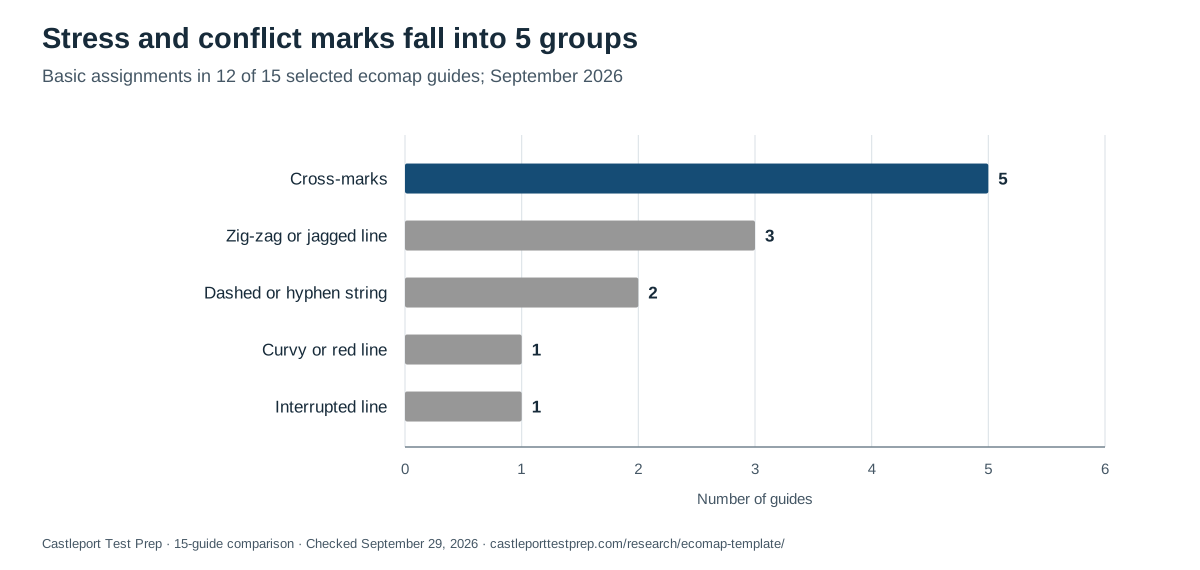
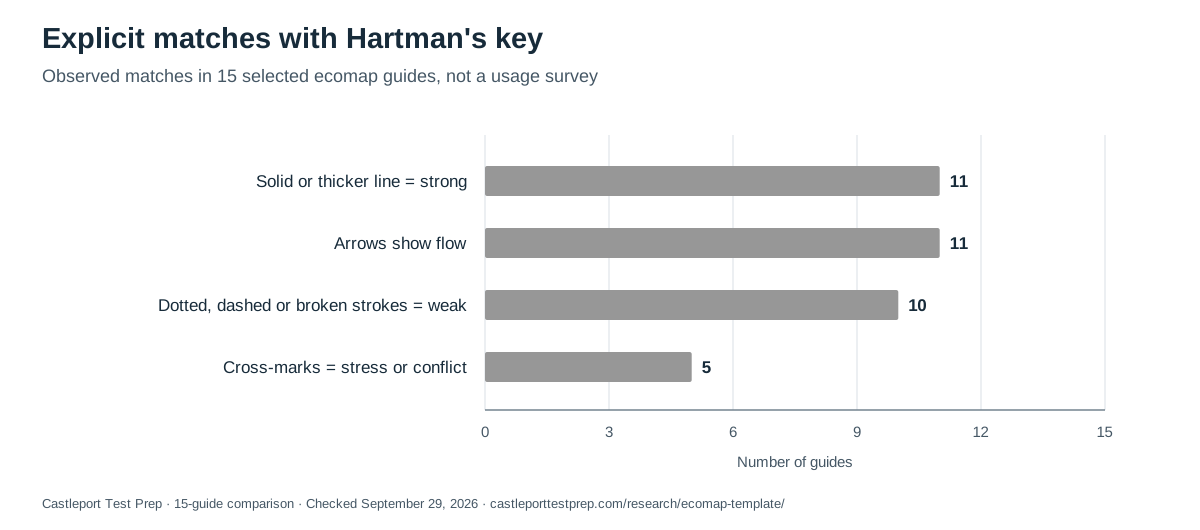
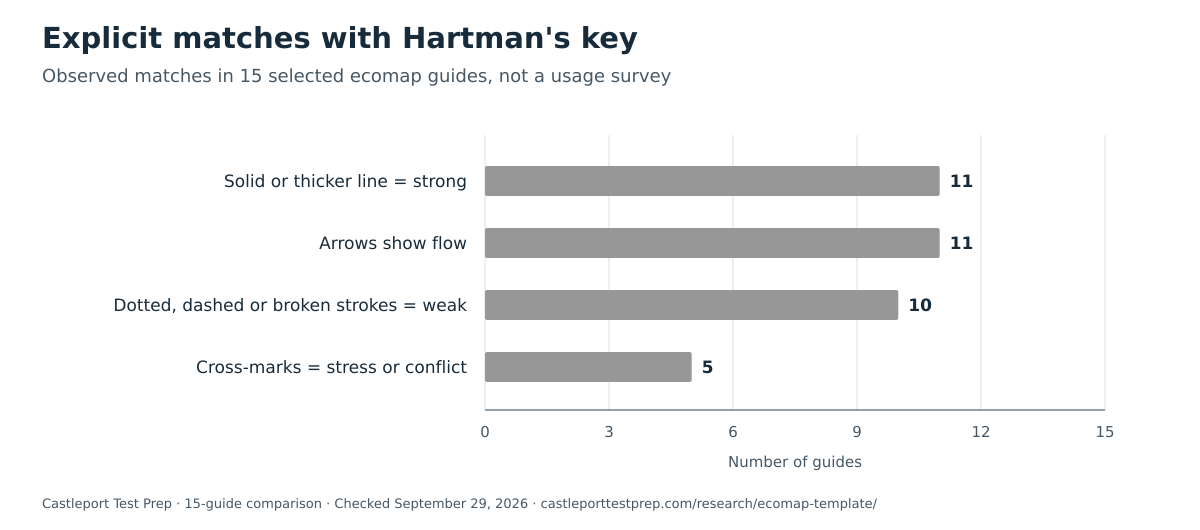
Chart data: explicit matches with the parts of Hartman's key
| Feature | Guides with an explicit match, out of 15 |
|---|---|
| Solid or thicker line = strong | 11 |
| Arrows show flow | 11 |
| Dotted, dashed or broken strokes = weak | 10 |
| Cross-marks = stress or conflict | 5 |
Source: Castleport Ecomap Key Crosswalk, September 29, 2026. The bars count explicit matches, not every guide's full practice. Unverified or unassigned meanings are not counted as matches and are not claimed to be absent.
Same line, different meaning
The bigger problem isn't that guides pick different lines. It's that the same line can mean different things.
Ecomap marks that mean different things in different guides
| Mark | Means this in one guide | Means this in another |
|---|---|---|
| Dashed line | Weak in VCU's individual example | Stressed in CIS, printed p.12 |
| Broken or interrupted line | "Less close or occasional relationships" (Social Workers Toolbox); "a weaker tie" (Scottish Government template) | A relationship "severed or estranged," drawn as a solid line interrupted with a cross (GenogramAI); "conflicted or broken relationships" (JRank) |
| Hash marks across a line | Stressful (Hartman, 1978; UIC kinship care manual) | "Conflictual," with a zig-zag used for stressful instead (GenogramAI) |
| Plain dotted line versus a dotted line with cross-marks | Plain dotted = tenuous (Hartman, 1978; UIC manual) | Dotted with cross-marks = stressful (Scottish Government template). These are different complete marks, not a same-symbol collision |
Source: the guides linked in each cell, checked September 29, 2026.
Here's how that plays out. Say your textbook taught you one key and your field agency uses another. You draw a broken line to Dad because they talk once a month. Your supervisor reads it as "cut off." Same map, two stories. A printed key and a few words on the line make the intended meaning clear.
The option many guides don't mention: words on the line
Hartman's blank form told workers to show each connection "with a descriptive word or by drawing different kinds of lines" (1978, p. 469). She also wrote that when workers drew the map with clients, the three-line code often felt "too constraining," so workers asked clients to describe each connection and wrote that on the line (p. 468).
In the 15 selected guides, 3 explicitly suggest writing words beside the connections: the Washington State Coalition Against Domestic Violence template, Social Workers Toolbox and Plymouth Safeguarding Children Partnership. Of those three, only the first explicitly keeps Hartman's "word or line" choice. This records the material checked, not a claim that other practitioners never use words.
That's why every Castleport example puts a few words on each line. "Texts sometimes" tells you more than a dashed line ever could.
How do you make an ecomap? 7 steps
Put the person or household in a center circle, add a circle for each person, group or service in their life, and connect them with lines from the key. Then add arrows, a few words on each line, and the date. Hartman's article lays out the same core steps (1978, pp. 467–469).
- Fill in the header. Name, date, who drew it with you, and whose view it shows. Two people in the same family can draw very different maps.
- Draw the center. Put the person, or the whole household, in the big middle circle. For a household, add a dot for each person so you can attach lines to them. Dots are this pack's simple teaching layout, not a full genogram notation.
- Add the circles. Ask who and what is in their life: family, friends, school, work, health care, services, faith, fun, online. Add a dotted circle for a needed or possible resource that is not connected yet, and label which it is.
- Write down what they say. Before you draw a line, jot their words for each connection. The connection worksheet in the template has a column for this.
- Draw one line per connection. Pick the line from the key. Attach it to the person who has that connection, not the whole household, when family members differ.
- Add arrows and words. Point arrows from the giver to the receiver. Write what flows ("rides," "rent," "advice") and a word or two on how it feels.
- Look at it together. Where's the support? The stress? What's missing? Date it and redraw later. Hartman suggested comparing a map made at the start of your work with one made at the end (p. 472).
Good questions to ask
- Who do you call first when something goes wrong?
- Who helps you with money, food, rides or housing?
- Who do you help?
- Who or what feels stressful right now?
- Where do you go when you're sick?
- Who do you see at school or work most days?
- Is there anyone you wish you were closer to?
- What help do you need that you don't have yet?
Draw it with the person, not about them
Hartman first used the eco-map as a thinking tool for the worker. It turned into an interview tool once workers saw clients get more involved when they drew it together, sometimes sitting side by side (1978, pp. 468–471). One 12-year-old looked at his map and said, "Gee, I never saw myself like that before!" (p. 468). Hartman describes one mother who hung her map on the kitchen wall (p. 471). That example does not tell us how often families want a copy.
It can also sting. Social Care Wales' practice guide warns that completing an eco-map can be upsetting for someone who realizes their support network is poor. Go at their pace.
Common mistakes
Common ecomap mistakes and fixes
| Mistake | Fix |
|---|---|
| No key on the page | Print the key on every map. Guides disagree on the lines. |
| Color is the only signal | Use line styles and words. Copies often print in black and white. |
| One line to the whole household when only one person has the connection | Attach the line to that person. |
| Guessing: an unknown connection drawn as weak | Use the thin line with ?. Unknown is not weak. |
| A job that pays and stresses drawn as only one or the other | Use the thick line with cross-marks and name both. |
| Far away drawn as weak | Distance isn't what the line measures. A daughter who calls every Sunday can be a strong tie. |
| No date, no "whose view" | Fill in the header so the next reader knows when and from whose eyes. |
Source: Castleport Test Prep, based on the guides compared above.
Ecomap examples: 6 worked maps with every line explained
Each example below is a made-up teaching case with a finished map and a table explaining all of its lines. Together they cover 36 connections across child welfare, schools, aging, recovery, refugee resettlement and a student's own map.
Every table follows the same order: what the story says, the mark it gets, why, and what not to read into it. None of these people are real. These are worked teaching choices, not the only valid drawings; a different mark needs a clear reason tied to the case and its key.
Example 1: The Rivera household
Fictional teaching case · Child welfare (in-home services)
Dana, 34, lives with her kids Leo, 9, and Mia, 6. A child welfare caseworker has started visiting. Dana's mom, Rosa, watches the kids after school, and Dana cooks Rosa Sunday dinner. Leo says he likes his teacher. The school's attendance office keeps calling Dana about Mia's missed days, and Dana says the calls stress her out. The rent just went up and repairs are late. Dana has met the caseworker twice but hasn't said how it's going. She needs an after-school program for the two days Rosa works, and hasn't found one yet.
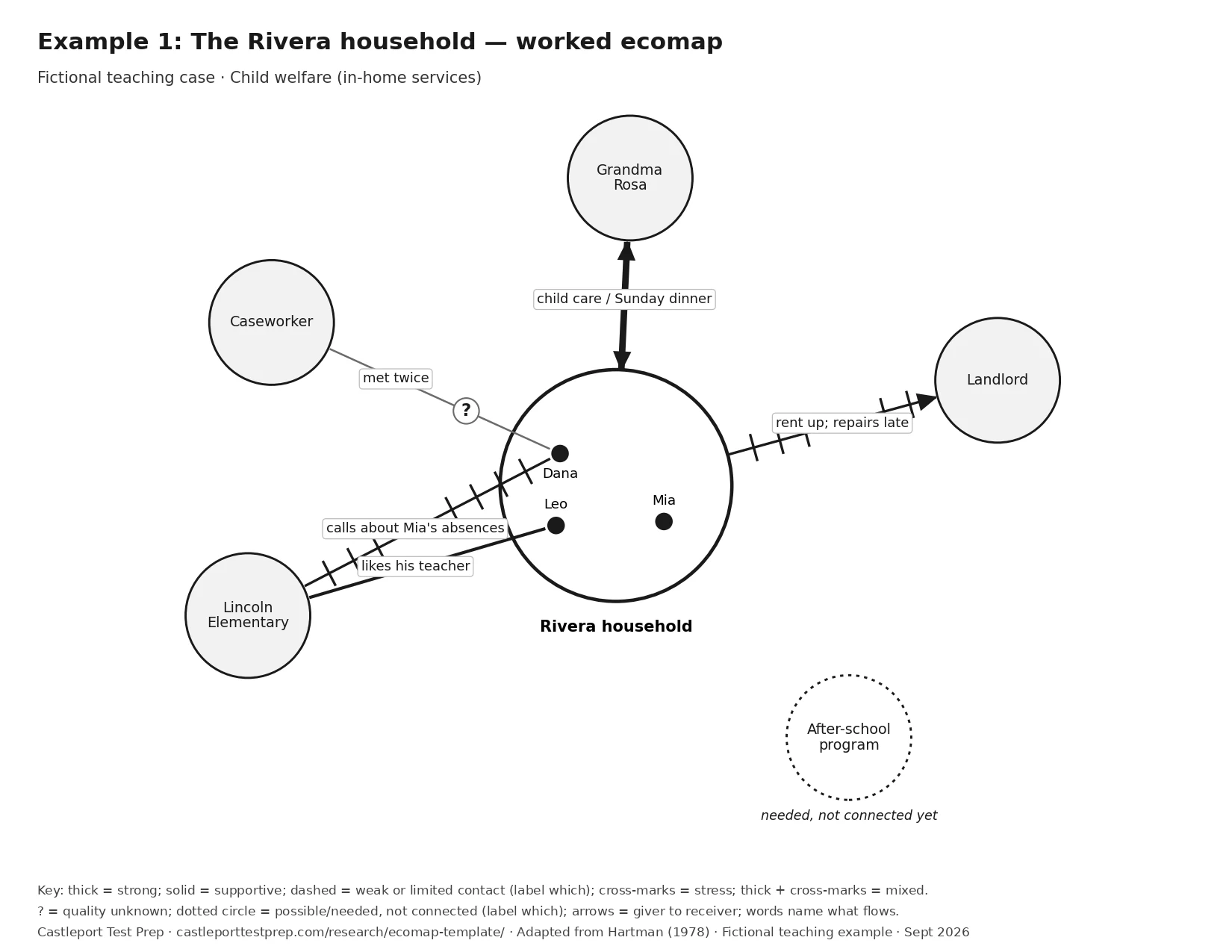
The Rivera household: every connection explained
| Connection | What the story says | How it's drawn | Why | Don't read in |
|---|---|---|---|---|
| Grandma Rosa — Whole household | Rosa watches the kids after school; Dana cooks her Sunday dinner. | Thick solid line (strong); arrow: Both ways: child care to the family; Sunday dinner to Rosa; words: “child care / Sunday dinner” | Regular after-school care is dependable practical help, and help goes both ways. This is a teaching interpretation of the stated routine, not an extra statement by Dana. | Two arrowheads do not mean the help is equal. They mean help flows both ways. |
| Lincoln Elementary (Leo's class) — Leo | Leo says he likes his teacher. | Solid line (supportive); words: “likes his teacher” | A positive connection, attached to Leo because it is his. | Don't draw one line from the school to the whole family. Leo's tie and Dana's tie are different. |
| Lincoln Elementary (attendance office) — Dana | The attendance office keeps calling Dana about Mia's missed days; Dana says the calls stress her. | Line with cross-marks (stressful); words: “calls about Mia's absences” | Dana names this connection as stressful, so it gets cross-marks, attached to Dana. | Don't label the school 'bad'. The same school has a good tie with Leo. |
| Landlord — Whole household | Rent went up and repairs are late. | Line with cross-marks (stressful); arrow: Household to landlord: rent; words: “rent up; repairs late” | The story names two strains, so the line gets cross-marks. The arrow shows rent going out. | Don't assume a legal or safety problem. The story only says rent rose and repairs are late. |
| Caseworker — Dana | They have met twice. Dana hasn't said how it's going. | Thin line with ? (quality not known yet); words: “met twice” | The connection exists, but no one has described its quality yet. | Unknown is not the same as weak. Don't use a dashed line here. |
| After-school program — Whole household | Dana needs care for the two days Rosa works and hasn't found a program yet. | No line; dotted circle (needed, not connected yet); words: “needed, not connected yet” | A dotted circle with no line shows a resource the family needs but doesn't have. | Don't draw a weak line. There is no connection yet. |
Source: Castleport Test Prep original fictional example, September 2026; key based on Hartman (1978). Data: castleport-ecomap-worked-examples.csv, rows E1-1–E1-6.
What the map shows: Dana describes stress from the school's calls, and the household has housing strain. Rosa provides dependable practical help. The open question is the caseworker. The clear gap is after-school care.
Example 2: Jaylen, 12
Fictional teaching case · School social work
Jaylen is in seventh grade. His older sister Keisha helps with homework most nights. He says his basketball coach, Reyes, 'gets me', and he shows up early to help set up. His dad lives in another state; they text sometimes. Some kids at his lunch table tease him. He plays online games with friends most nights and calls them 'fun but not real friends'. He met the school counselor once at orientation.
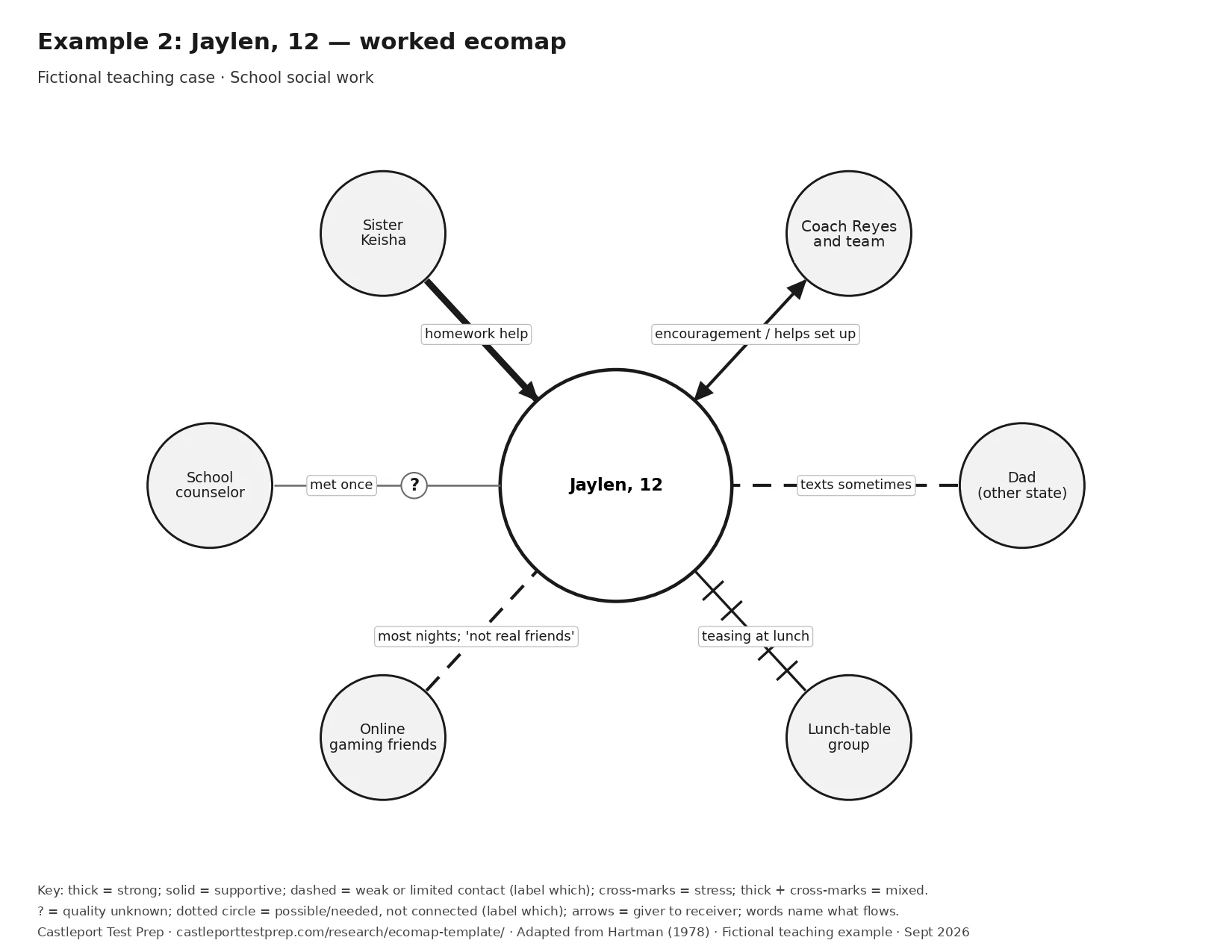
Jaylen, 12: every connection explained
| Connection | What the story says | How it's drawn | Why | Don't read in |
|---|---|---|---|---|
| Sister Keisha — Jaylen | Keisha helps with homework most nights. | Thick solid line (strong); arrow: Keisha to Jaylen: homework help; words: “homework help” | Help most nights is dependable practical support. The arrow points to Jaylen because he receives it. | Don't add an arrow back to Keisha unless the story says Jaylen gives something to her. |
| Coach Reyes and team — Jaylen | Jaylen says Coach 'gets me' and he comes early to help set up. | Solid line (supportive); arrow: Both ways: encouragement to Jaylen; set-up help to the team; words: “encouragement / helps set up” | A good connection with something flowing each way. | Giving time is not a burden unless the story says it is. |
| Dad — Jaylen | Dad lives in another state. They text sometimes. | Dashed line (limited contact; quality not rated); words: “texts sometimes” | The dashed line describes occasional contact here, not emotional closeness. The words keep that distinction clear. | Living far away and texting sometimes do not establish a weak emotional bond or conflict. Nothing in the story says they argue. |
| Lunch-table group — Jaylen | Some kids at his lunch table tease him. | Line with cross-marks (stressful); words: “teasing at lunch” | The teasing is the stated strain shown by the cross-marks; the story does not report how Jaylen rates the whole relationship. | Record the teasing without adding facts about its frequency, threats or Jaylen's feelings. |
| Online gaming friends — Jaylen | Plays most nights; calls them 'fun but not real friends'. | Dashed line (weak or distant); words: “most nights; 'not real friends'” | Frequent contact, but Jaylen himself rates the tie as light. His words decide the line. | Frequent does not automatically mean strong. |
| School counselor — Jaylen | Met once at orientation. | Thin line with ? (quality not known yet); words: “met once” | There is a connection, but no one knows yet what it's like. | Don't guess. Ask Jaylen about it. |
Source: Castleport Test Prep original fictional example, September 2026; key based on Hartman (1978). Data: castleport-ecomap-worked-examples.csv, rows E2-1–E2-6.
What the map shows: Jaylen's help comes from home and his coach, his stress sits at lunch, and the school counselor is a connection nobody has explored yet. If you're headed into school social work, Castleport's school social work licensure requirements by state shows what each state asks for.
Example 3: Ruth, 81
Fictional teaching case · Aging, home health and hospital discharge
Ruth came home last week after a hospital stay. Her neighbor Carl picks up her groceries, and she reads with his grandkids after school. Her daughter Anne lives 900 miles away and calls every Sunday; Ruth calls her 'my rock'. The pharmacy has made two billing mix-ups this month, and Ruth says it 'wears me out'. She went to the senior center twice last year. A home health nurse visits twice a week, and Ruth says the nurse is kind. Ruth can't drive yet, and no one has set up rides to her follow-up visits.
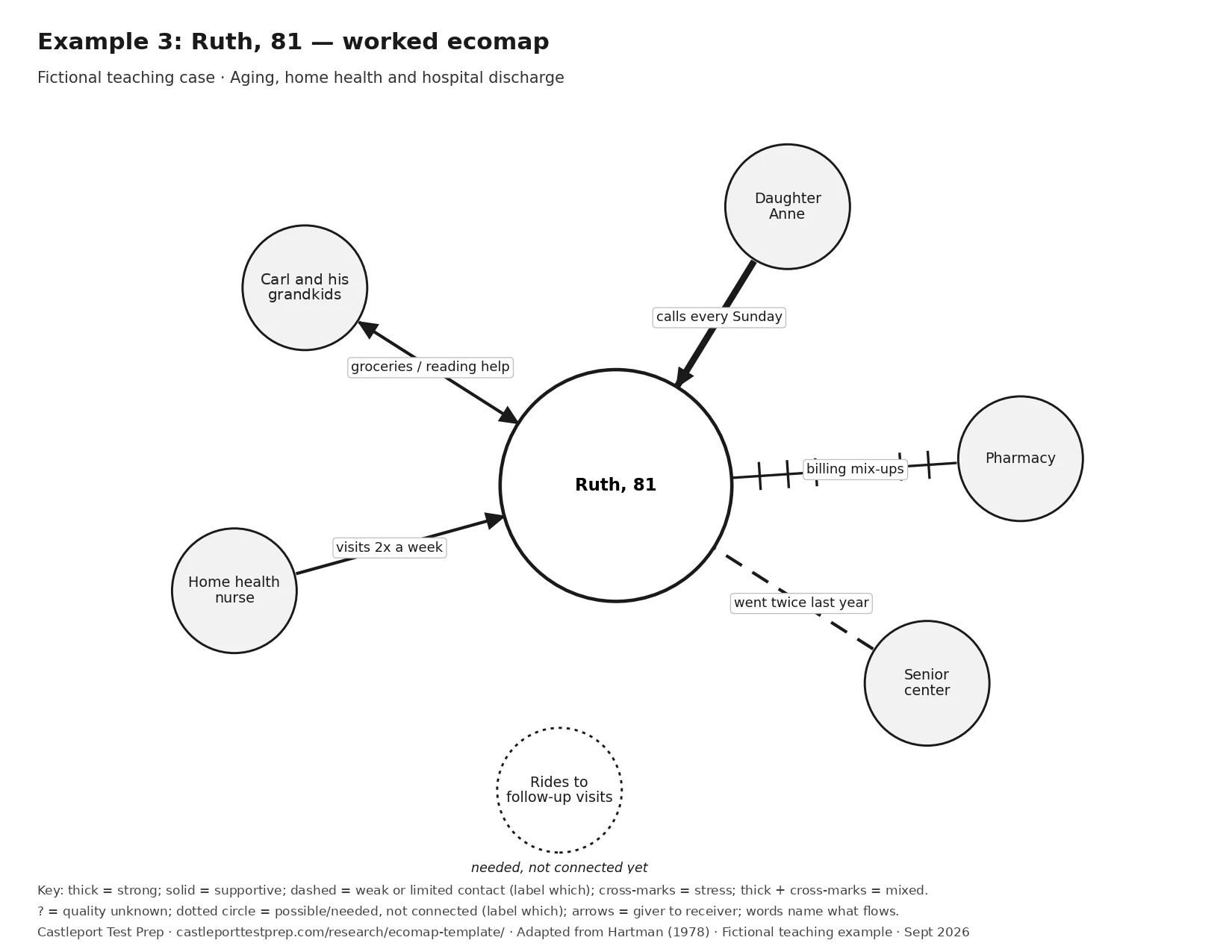
Ruth, 81: every connection explained
| Connection | What the story says | How it's drawn | Why | Don't read in |
|---|---|---|---|---|
| Carl and his grandkids — Ruth | Carl picks up groceries; Ruth reads with his grandkids. | Solid line (supportive); arrow: Both ways: groceries to Ruth; reading help to Carl's grandkids; words: “groceries / reading help” | A good tie where Ruth gives as well as gets. | Older adults are not only receivers. Show what Ruth gives. |
| Daughter Anne — Ruth | Anne lives 900 miles away, calls every Sunday; Ruth calls her 'my rock'. | Thick solid line (strong); arrow: Anne to Ruth: weekly calls; words: “calls every Sunday” | Ruth's own words mark this as a strong tie. She has not ranked it against her other connections. | Far away does not mean weak. Distance is not what the line measures. |
| Pharmacy — Ruth | Two billing mix-ups this month; Ruth says it 'wears me out'. | Line with cross-marks (stressful); words: “billing mix-ups” | Ruth describes the connection as draining. | Don't assume she can't get her medicine. The story is about billing. |
| Senior center — Ruth | Went twice last year. | Dashed line (limited contact; quality not rated); words: “went twice last year” | A light, occasional contact pattern. The story does not rate how helpful or close the connection feels. | Don't assume she dislikes it. Ask. |
| Home health nurse — Ruth | Visits twice a week; Ruth says the nurse is kind. | Solid line (supportive); arrow: Nurse to Ruth: visits; words: “visits 2x a week” | A supportive service, with care flowing to Ruth. | Don't make it strong just because it's frequent. Ruth said kind, not close. |
| Rides to follow-up visits — Ruth | Ruth can't drive yet; no rides are set up. | No line; dotted circle (needed, not connected yet); words: “needed, not connected yet” | A gap in help is its own circle, not a mark on another line. | The missing ride doesn't change how good the nurse or Carl is. Keep the gap separate. |
Source: Castleport Test Prep original fictional example, September 2026; key based on Hartman (1978). Data: castleport-ecomap-worked-examples.csv, rows E3-1–E3-6.
What the map shows: Ruth isn't only receiving care; she gives, too. A strong tie lives 900 miles away. Her one clear gap is transport, and that's a separate problem from how good her helpers are.
Example 4: Priya, 29
Fictional teaching case · Substance use recovery counseling
Priya is in early recovery. She goes to a peer support group three times a week, where she listens and shares her own story. Her sister Meera lets her stay with her and checks in every day. Her old friend group still invites her to parties, and Priya says saying no is hard. Her job gives her a steady paycheck, but her manager changes her shifts at the last minute. She has weekly counseling sessions but hasn't said how they feel. She and her mom haven't talked in a year; Priya says she misses her.
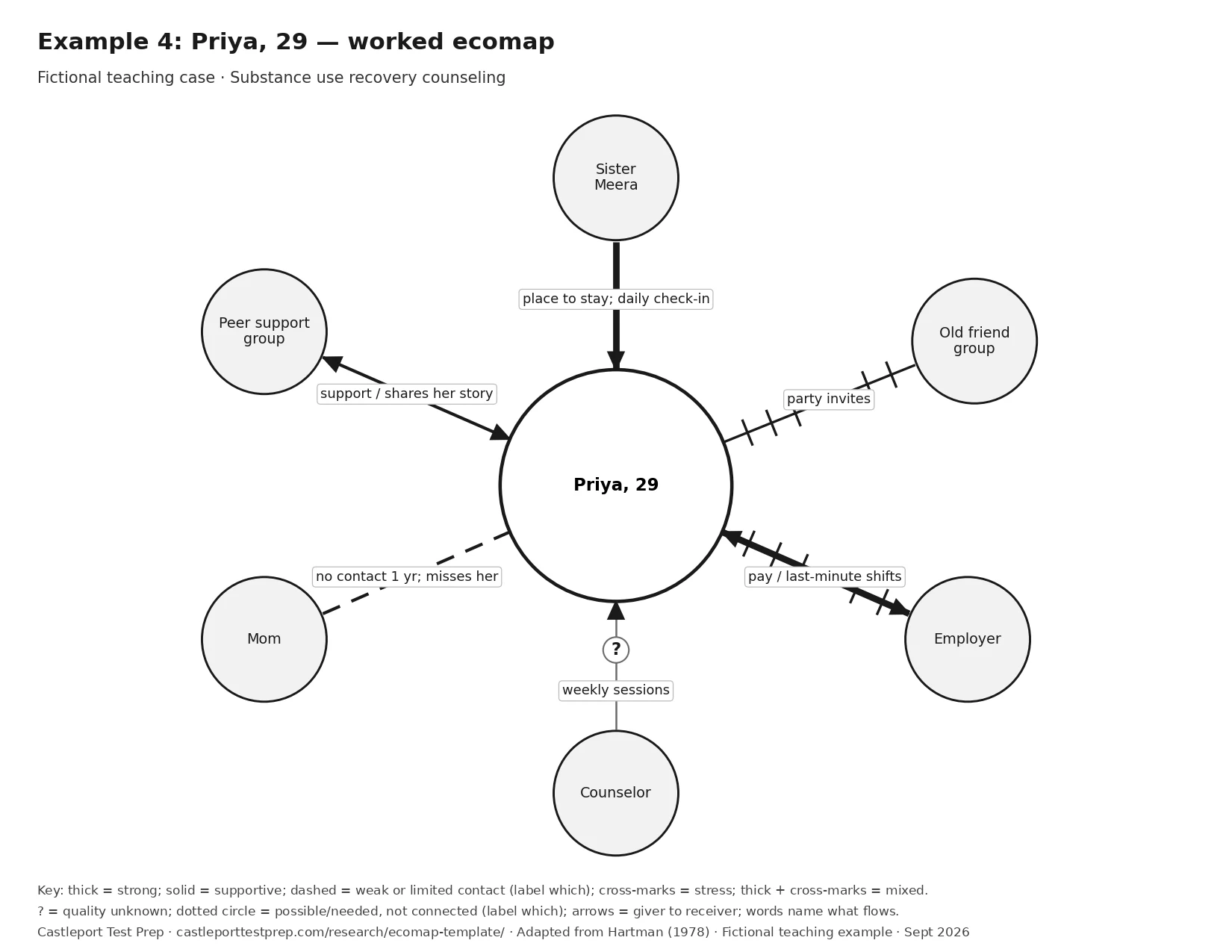
Priya, 29: every connection explained
| Connection | What the story says | How it's drawn | Why | Don't read in |
|---|---|---|---|---|
| Peer support group — Priya | Goes three times a week; listens and shares her story. | Solid line (supportive); arrow: Both ways: support to Priya; her story to the group; words: “support / shares her story” | A supportive tie where Priya also gives. | Don't assume the group is her strongest tie. She didn't rank it. |
| Sister Meera — Priya | Lets Priya stay with her; checks in every day. | Thick solid line (strong); arrow: Meera to Priya: a place to stay and daily check-ins; words: “place to stay; daily check-in” | Housing plus daily contact is strong, dependable help. | Don't add stress to this line. The story doesn't mention any. |
| Old friend group — Priya | They still invite her to parties; saying no is hard. | Line with cross-marks (stressful); words: “party invites” | Priya names the pull of this group as hard. | Write what she said. Don't label the friends on the map. |
| Employer — Priya | Steady paycheck; manager changes shifts at the last minute. | Thick solid line with cross-marks (helps and stresses); arrow: Both ways: pay to Priya; work to the employer; words: “pay / last-minute shifts” | The job helps and stresses at once, so both marks stay. | Don't erase the help because of the stress, or the stress because of the help. |
| Counselor — Priya | Weekly sessions; Priya hasn't said how they feel. | Thin line with ? (quality not known yet); arrow: Counselor to Priya: weekly sessions; words: “weekly sessions” | You can know which way help flows before you know how good it feels. | Unknown quality is not weak quality. |
| Mom — Priya | No contact in a year; Priya says she misses her. | Dashed line (no recent contact; quality not rated); words: “no contact 1 yr; misses her” | There has been no contact for a year. The dashed line records that contact gap, not a judgment about their bond; the words record that Priya misses her. | No contact is not the same as conflict. The story names no fight. |
Source: Castleport Test Prep original fictional example, September 2026; key based on Hartman (1978). Data: castleport-ecomap-worked-examples.csv, rows E4-1–E4-6.
What the map shows: Priya has support from her group and sister, and party invitations she finds hard to turn down. The job both helps and strains, and the counseling line is honest about what nobody knows yet.
Example 5: The Haddad household
Fictional teaching case · Refugee resettlement
Omar and Lina Haddad arrived three months ago with their kids Sami, 10, and Nour, 7. Their resettlement caseworker helped them find an apartment and sort out paperwork. Lina goes to English class four mornings a week and has made two friends there. The family video-calls relatives abroad every weekend and sends money home each month. Omar works night shifts at a warehouse; the pay covers rent, but he rarely sees the kids awake. At school, Sami and Nour are learning English fast. The school sends notes home only in English, which Omar and Lina can't yet read.
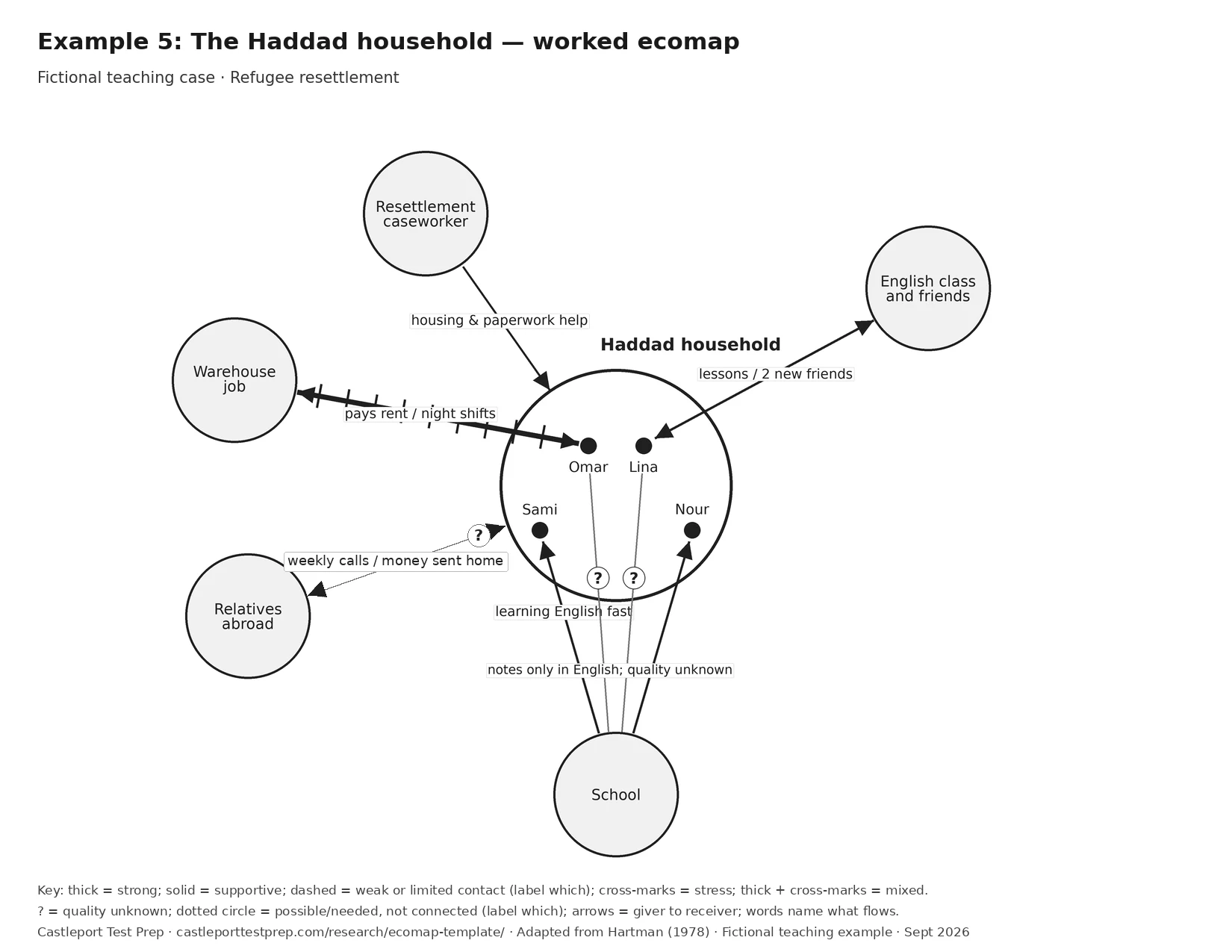
The Haddad household: every connection explained
| Connection | What the story says | How it's drawn | Why | Don't read in |
|---|---|---|---|---|
| Resettlement caseworker — Whole household | Helped find the apartment and sort out paperwork. | Solid line (supportive); arrow: Caseworker to family: housing and paperwork help; words: “housing & paperwork help” | A supportive service, with help flowing in. | Don't assume the tie is strong. The family didn't describe it that way. |
| English class and friends — Lina | Lina goes four mornings a week and made two friends. | Solid line (supportive); arrow: Both ways: lessons to Lina; friendship with classmates; words: “lessons / 2 new friends” | A good tie, and it's Lina's, so it attaches to her. | Don't attach it to the whole family. |
| Relatives abroad — Whole household | Video calls every weekend; the family sends money home each month. | Thin line with ? (quality not known yet); arrow: Both ways: calls both ways; money from family to relatives; words: “weekly calls / money sent home” | The calls and money transfers are stated, but no one describes how the relationship feels. Show the flows and leave the quality unknown. | Money going out is not automatically a burden. The story doesn't say it is. |
| Warehouse job — Omar | Night shifts; pay covers rent; he rarely sees the kids awake. | Thick solid line with cross-marks (helps and stresses); arrow: Both ways: pay to Omar; work to the employer; words: “pays rent / night shifts” | The job helps and strains at once, so both marks stay, attached to Omar. | Don't attach the job to Lina or the kids. |
| School (kids) — Sami and Nour | Sami and Nour are learning English fast. | Solid line (supportive); arrow: School to kids: lessons; words: “learning English fast” | A supportive tie for each child. | The kids' tie and the parents' tie are different. Keep both. |
| School (parents) — Omar and Lina | Notes come home only in English, which the parents can't yet read. | Thin line with ? (quality not known yet); words: “notes only in English” | The notes create a language-access barrier. That alone does not establish the quality of the parents' relationship with the school. | Do not turn a language-access barrier into a weak or conflicted relationship. Keep the barrier in the words on the line. |
Source: Castleport Test Prep original fictional example, September 2026; key based on Hartman (1978). Data: castleport-ecomap-worked-examples.csv, rows E5-1–E5-6.
What the map shows: The school has supportive lines to the kids and question-mark lines to the parents. The parents face a language-access barrier; their relationship quality is not stated. The job helps and strains Omar, and money flows out to family abroad, not only in.
Example 6: Alex, 24 (a student's own ecomap)
Fictional teaching case · Social work education: drawing your own map first
Alex is a first-year MSW student drawing a personal ecomap for class. Alex's partner, Sam, shares rent and cooking, and Alex calls Sam 'my person'. At Alex's field placement, weekly supervision is useful, but the caseload feels heavy. A coffee-shop job pays well and the manager is flexible about class times. A study group meets before exams to share notes and quiz each other. Monthly calls with Alex's parents keep turning into arguments about student loans. Alex has the campus counseling center's number but hasn't gone.
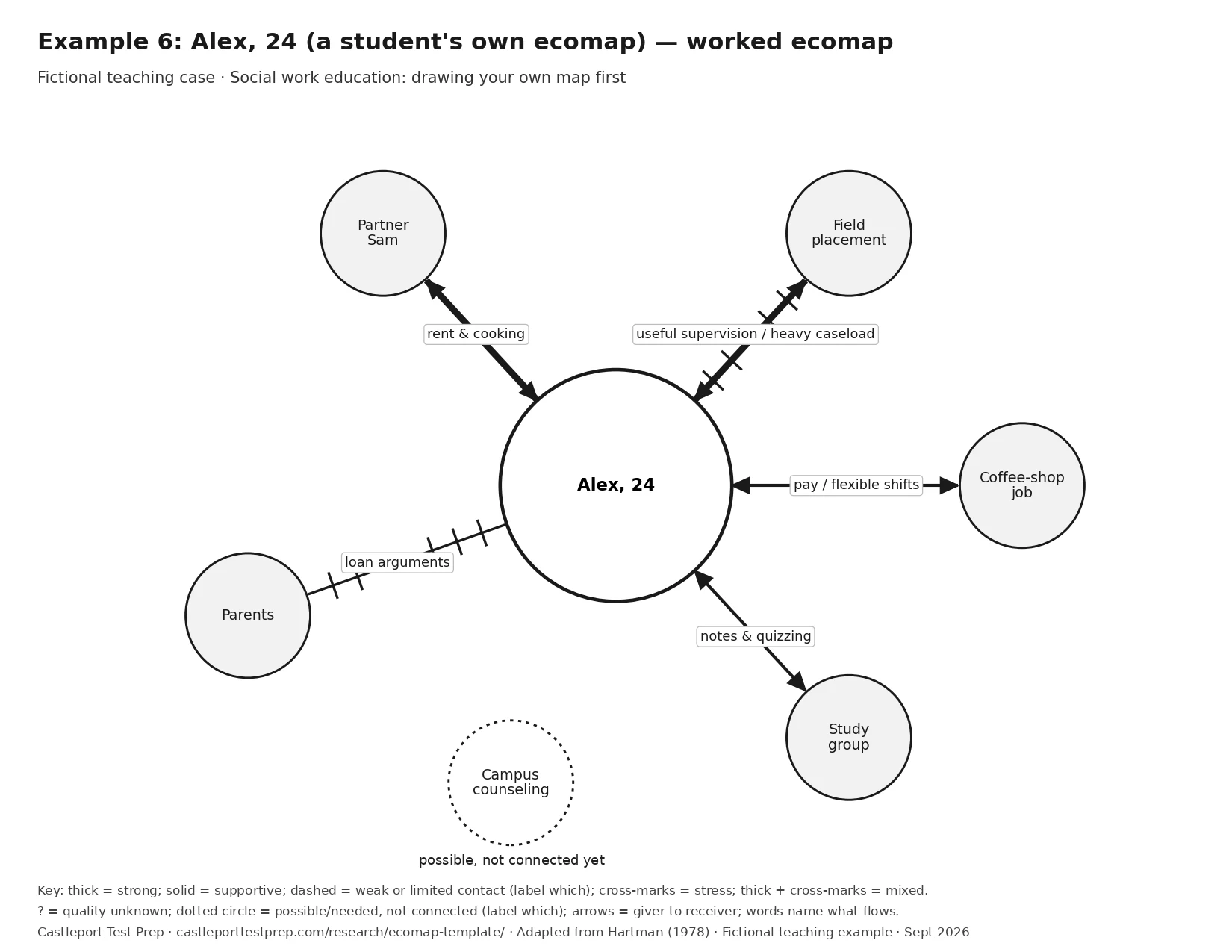
Alex, 24 (a student's own ecomap): every connection explained
| Connection | What the story says | How it's drawn | Why | Don't read in |
|---|---|---|---|---|
| Partner Sam — Alex | Shares rent and cooking; Alex calls Sam 'my person'. | Thick solid line (strong); arrow: Both ways: rent and cooking shared; words: “rent & cooking” | Alex's own words mark this as a strong tie, not necessarily the strongest one. | Two arrowheads don't mean perfectly equal. |
| Field placement — Alex | Weekly supervision is useful; the caseload feels heavy. | Thick solid line with cross-marks (helps and stresses); arrow: Both ways: supervision to Alex; work to the agency; words: “useful supervision / heavy caseload” | Help and strain in the same place. Keep both. | Don't average it into 'fine'. |
| Coffee-shop job — Alex | Pays well; manager is flexible about class times. | Solid line (supportive); arrow: Both ways: pay to Alex; work to the shop; words: “pay / flexible shifts” | A supportive tie with an exchange. | A job isn't stressful just because it's a job. |
| Study group — Alex | Meets before exams to share notes and quiz each other. | Solid line (supportive); arrow: Both ways: notes and quizzing; words: “notes & quizzing” | A useful two-way tie. | Don't make it strong. Alex didn't describe it as close. |
| Parents — Alex | Monthly calls turn into arguments about student loans. | Line with cross-marks (stressful); words: “loan arguments” | Alex names the calls as a source of conflict. | One stressful topic doesn't define the whole relationship. The word on the line keeps it specific. |
| Campus counseling center — Alex | Has the number; hasn't gone. | No line; dotted circle (possible, not connected yet); words: “has the number; not used yet” | A possible contact that Alex has not used. Having the number does not establish need, eligibility or available appointments. | Do not infer a need for counseling from an unused phone number. |
Source: Castleport Test Prep original fictional example, September 2026; key based on Hartman (1978). Data: castleport-ecomap-worked-examples.csv, rows E6-1–E6-6.
What the map shows: This is the map Hartman recommends drawing before you draw anyone else's. Alex's supports are solid, the field placement is mixed, and the counseling center is a possible contact Alex has not used.
What's the difference between an ecomap and a genogram?
A genogram maps a family across generations; Hartman described it as a map of "three, four, or more generations." An ecomap maps the connections between a person or family and the people, groups and services around them right now. Hartman described both tools in the same 1978 article.
Ecomap vs. genogram
| Genogram | Ecomap | |
|---|---|---|
| What it shows | Family relationships over time | Connections to the world around a person or family, right now |
| Time span | Often three or more generations; some guidance uses two or three | A snapshot of today; redraw to compare |
| Center | The family tree | The person or household, in a big circle |
| What the lines mean | Family ties: marriages, children, divorces | How strong, weak or stressful each connection is, and which way help flows |
| Best for | Spotting patterns passed down through a family | Spotting support, stress and gaps today |
Sources: Hartman (1978), pp. 467–475; Social Care Wales describes genograms covering two or three generations.
The two fit together, and many guides teach them side by side, including the UIC kinship care manual and Social Care Wales' practice guide. Hartman's own eco-map instructions start by drawing the household in the center the same way a family tree does (p. 467).
Who uses ecomaps, and for what?
Ecomaps started in child welfare in 1975. Among the 15 guides we reviewed, publishers include government and public bodies in Scotland and Wales, two local child safeguarding partnerships, two universities, a school-support nonprofit, a domestic violence coalition and an open nursing textbook.
- Child welfare. Hartman built the eco-map for public child welfare workers (1978, p. 467). A University of Illinois Chicago kinship care manual uses it with birth parents, relatives raising children and other kin. Scotland's 2012 National Risk Framework includes editable ecomap templates.
- Schools. Communities In Schools of Mid-America's Ecomap Toolkit asks every site coordinator to complete one for each student on their caseload at the start and end of the year. Its five-item matrix gives totals from 5 to 25 because students labeled relationships so differently (printed pp.8–10). Those are this toolkit's scores, not a universal ecomap scale.
- Nursing. OpenStax's Population Health for Nurses teaches nurses to use the ecomap in family assessment to find sources of stress and support (section 28.4).
- Domestic violence advocacy. The Washington State Coalition Against Domestic Violence publishes an eco-map template that keeps Hartman's original wording.
- UK safeguarding. Leeds and Plymouth safeguarding children partnerships include ecomaps in their practitioner guidance.
The teaching sources above place ecomaps in assessment and practice learning. If you're headed for licensing, Castleport's ASWB exam prep guide explains which of the five exams you'll take and what's on it.
How can teachers use this ecomap teaching pack?
The free pack gives you a 45-minute lesson, 6 case cards, an answer key for all 36 connections, 6 check questions and a 10-point rubric. Hand out the stories and the blank template first, and share the answer key after students draw.
A 45-minute ecomap lesson
| Minutes | What happens |
|---|---|
| 0–5 | Hand out the key. Show that guides draw the stressful line in different ways, so every map needs its key. |
| 5–15 | Everyone sketches their own ecomap. Hartman suggested learning the tool on yourself first (1978, p. 468). Keep it private; anyone may use a made-up person. |
| 15–30 | Pairs pick a case card, fill in the worksheet, then draw the map. |
| 30–40 | Swap maps and score each other with the rubric, using the answer key. |
| 40–45 | Debrief: What did the map show that a list wouldn't? Which line did you argue about? |
Source: Castleport Test Prep teaching pack, September 2026. Timing is a plan, not a tested completion time.
Feedback rubric: 5 criteria, 0–2 points each, 10 points total
| Criterion | 2 points looks like |
|---|---|
| Right endpoints | Every line attaches to the person who has the connection |
| Evidence for each line | Every mark matches the stated facts; teaching interpretations are labeled |
| Key and header | Key printed and used the same way throughout; header has name, date, drawn with and whose view |
| Arrows | Point from giver to receiver and name what flows |
| Honest gaps | Unknowns marked ?, mixed ties keep both marks, possible or needed resources shown as dotted circles and labeled |
Source: Castleport Test Prep teaching pack. This is classroom feedback, not a clinical score or a measure of exam readiness.
Use these fictional case cards for shared classwork. Do not require students to share personal maps. NASW Code of Ethics 1.07(u) addresses identifying client information used in teaching or training; these exercises need none.
Six questions to check understanding
- Jaylen met the school counselor once and hasn't said more. Which mark fits? A thin line with a question mark. The connection exists, but no one has described it, and unknown isn't the same as weak.
- Grandma Rosa watches the kids and gets Sunday dinner. What do two arrowheads tell you? That help flows both ways. They say nothing about the amounts being equal.
- Leo likes his teacher, but the attendance office's calls stress his mom. How should the school appear? As two lines: a supportive one to Leo and a stressful one to Dana.
- Priya's job pays steadily but changes her shifts at the last minute. Which mark fits? A thick line with cross-marks and arrows both ways. Keep both the help and the stress.
- Ruth has no ride to her follow-up visits. What happens to her nurse's line? Nothing. Draw the rides as their own dotted "needed" circle.
- Which tool best shows a family's current connections to people and services around them? An ecomap. A genogram maps family relationships across generations.
If you're learning ecomaps as part of social work study, practice reading a situation for what's actually stated, then test yourself. This pack is not an official ASWB resource or a claim about exam frequency. Castleport's free ASWB Masters practice test has 25 questions with an instant score and no email required, and there's a free ASWB Bachelors practice test too.
Who created the ecomap?
Social worker Ann Hartman developed the eco-map in 1975 as part of the Child Welfare Learning Laboratory at the University of Michigan School of Social Work. She described it in Social Casework in October 1978, in the article "Diagrammatic Assessment of Family Relationships" (Hartman, 1978, p. 466, note 10).
She built it to help public child welfare workers see a family's needs. It was then tested with parents working to bring their children home from foster care, through the Temporary Foster Care Project of the Michigan Department of Social Services (p. 471). Hartman reports that workers saw some parents who were angry and defensive after a placement become engaged by the map. She does not present that observation as a controlled outcomes trial.
Two dates get mixed up online. 1975 is when the tool was developed; 1978 is when the article came out. The article was reprinted in 1995 in Families in Society, the later name of Social Casework.
How to cite Hartman: Hartman, A. (1978). Diagrammatic assessment of family relationships. Social Casework, 59(8), 465–476. Publisher record. Reprinted in Families in Society, 76(2), 111–122 (1995), publisher record.
How we built this
We compared 15 published ecomap guides against Hartman's 1978 original and recorded, for each, how it draws a strong, weak and stressful connection, and whether it uses arrows, words on lines and a date.
- Which guides: the fixed 15-source list in the CSV spans a government template, safeguarding guidance, university and textbook teaching, practitioner resources, an encyclopedia and a software reference. It is a selected comparison, not a random or complete sample. Some guides reuse or link to others; each publication is a row, not an independent practitioner observation.
- How we counted: record an assignment only where the inspected words or a readable picture connect a mark to a meaning. Keep VCU's “positive” separate from “strong.” A match means the stated meaning fits the listed category; dots, dashes and broken strokes are grouped together for weak ties, not treated as identical drawings. For stress/conflict, use the basic stress entry, or the closest combined conflict entry when no separate stress entry is given. Keep extra compound entries in notes. The 5 groups are cross-marked; zig-zag/jagged; dashed/hyphen string; curvy or red; and interrupted. The last two labels preserve JRank's combined category and Wikipedia's alternatives rather than inventing one universal notation.
- How deep: the CSV records the exact material checked. CIS's printed page 12 and Safeguarding Network's embedded key were visually checked. Scotland's full Word-document text was read. Plymouth's image could not be inspected. OpenStax's original figure was opened, but its key was too pixelated for further assignments. Hartman's and the UIC manual's line meanings come from explicit prose; their figure screenshots could not be retrieved. “Not verified” does not mean “not present.”
- When: the cited material was checked on September 29, 2026. This is a check date, not a claim that all guides were published in 2026.
- The math: exclude HARTMAN-1978 from the 15 comparison rows. Count
yesinmatches_hartman_strong: 11 explicit matches. The 12 classified stress/conflict rows group as 5 + 3 + 2 + 1 + 1. Countyesinmatches_hartman_tenuous: 10 of 11 readable weak assignments, or 91% rounded. Count values beginningyesinarrows_show_flow: 11/15 = 73% rounded;words_on_lines: 3/15 = 20%;tells_you_to_date_map: 5/15 = 33% rounded. These percentages describe recorded evidence, not practitioner behavior. - A robustness check: excluding Leeds's literal hyphen-string key leaves 11 classified stress/conflict assignments in the same 5 groups (5 + 3 + 1 + 1 + 1). The central dashed-line conflict between VCU and CIS does not depend on Leeds, Plymouth or the unreadable OpenStax legend.
- The examples: all 6 are fictional cases written by Castleport Test Prep for teaching, with 6 records each: 6 × 6 = 36. Some household records have more than one endpoint and are drawn as separate segments. The cases are not real people, clients or survey answers. A mark selected from the story is a teaching interpretation, not a clinical rating.
- Tools: AI tools assisted with reading, drafting and editing. Source passages and available images were checked, and the CSV counts were recomputed. This is source checking, not named professional review or validation of the teaching pack.
What this review does and doesn't show
It records what could be verified in 15 selected published guides, with unresolved picture details kept visible. It doesn't show how practitioners actually draw ecomaps, which key is "correct," or whether ecomaps change outcomes. It isn't a survey of people, and it isn't every guide in existence.
How to cite this page
Castleport Test Prep. "Ecomap Template: Free Printable, Symbol Key and 6 Worked Examples." Castleport Research, updated September 29, 2026. https://castleporttestprep.com/research/ecomap-template/
Reuse: Castleport's original templates, key graphic, fictional cases, explanations and teaching pack are free to copy, print and adapt for teaching with credit to Castleport Test Prep. Keep credit to Ann Hartman (1978) for the underlying method. Source material and its rights stay with its owners; this permission does not relicense it or require a link. The crosswalk records our comparison, not ownership of the compared guides.
Download the data
Two data files come with this page. The key comparison is the research data; the worked-examples file is fictional teaching material, labeled that way on every row.
- castleport-ecomap-key-crosswalk.csv: 16 rows (Hartman's original plus 15 guides), 23 columns, with source URL, read depth and check date on every row.
- castleport-ecomap-worked-examples.csv: 36 rows, one per connection in the 6 worked examples, with the story fact, mark, arrow, reason and what not to read in.
Ecomap FAQ
What is an ecomap used for? An ecomap shows a person's or family's connections to the people, groups and services around them, and whether each one helps, strains or barely exists. Ann Hartman built it in 1975 for child welfare work. Today it's used in social work, schools, nursing and advocacy to spot support, stress and gaps.
What's the difference between a genogram and an ecomap? A genogram maps family relationships across generations—often three or more, though some guidance uses two or three. An ecomap maps current connections between a person or family and the world around them. Hartman discussed both in her 1978 article.
How do I create an ecomap? Put the person or household in a center circle, add a circle for each person, group or service, and use this pack's key: thick solid for strong, solid for supportive, dashed for weak or limited contact as labeled, and cross-marks for stressful. Add arrows from giver to receiver, a word on each line, and the date.
What is an ecomap in nursing? It's a family assessment tool nurses use to see a family's sources of stress and support and to plan referrals. OpenStax's open textbook Population Health for Nurses teaches it alongside the genogram in section 28.4.
What do the lines on an ecomap mean? In Hartman's 1978 key, a solid or thick line is strong, a dotted line is tenuous, and jagged marks across a line mean stressful. Arrows show which way help flows. The selected guides use different stress marks, so print your key.
Is there one official ecomap key? The selected guides do not use one identical key. In Castleport's September 2026 comparison, the 12 readable basic stress/conflict assignments fell into 5 groups. VCU uses dashed for weak, while CIS uses dashed for stressed; this does not establish that no organization has its own official key.
Who created the ecomap? Ann Hartman, a social work professor at the University of Michigan, developed it in 1975 and published it in Social Casework in October 1978.
Can I make an ecomap in Word or Google Docs? Yes. Our Word worksheet has an editable header and connection table with a printable map. To move circles and lines on screen, use the editable PowerPoint version, with editable shapes. These files were rendered with LibreOffice; Google Docs and Google Slides were not tested here.
Should the person draw the ecomap with me? Hartman reported clients getting more involved when they built the map with the worker, and many workers let clients describe each connection in their own words. Go at their pace; a sparse map can be upsetting.
How often should I update an ecomap? Redraw it when life changes, or at the start and end of your work together, then compare the two. Hartman suggested this comparison as a way to see and measure change (1978, p. 472).
Sources
- Hartman, A. (1978). Diagrammatic assessment of family relationships. Social Casework, 59(8), 465–476. Publisher record (SAGE); full text copy, History of Social Work project. Checked September 29, 2026.
- Hartman, A. (1995). Diagrammatic assessment of family relationships (reprint). Families in Society, 76(2), 111–122. Publisher record (SAGE). Checked September 29, 2026.
- Washington State Coalition Against Domestic Violence. Doorways Eco-Map Template. Checked September 29, 2026.
- Social Workers Toolbox. Ecomaps: Guide for Social Workers, Examples and Templates. Checked September 29, 2026.
- Bonecutter and Gleeson. Genograms and Ecomaps: Tools for Developing a Broad View of Family, from Achieving Permanency for Children in Kinship Foster Care: A Training Manual, pp. 33–40 (Jane Addams College of Social Work, University of Illinois Chicago; copy hosted by tnchildren.org). Checked September 29, 2026.
- Scottish Government. Editable template: ecomaps, National Risk Framework to Support the Assessment of Children and Young People (2012). Full document text read directly; checked September 29, 2026.
- VCU School of Social Work. Benefits of Using an Ecomap in Social Work. Checked September 29, 2026.
- SWHelper. Ecological Systems Theory and Practice: Systems and the Sociocybernetic Map. Checked September 29, 2026.
- GenogramAI. Ecomap Symbols & Legend. Checked September 29, 2026.
- Wikipedia. Eco-map. Checked September 29, 2026.
- Scales, T. L., and Blanchard, R. H. Family Diagrammatic Assessment: Ecomap, Marriage and Family Encyclopedia (JRank). Checked September 29, 2026.
- Safeguarding Network. Ecomaps. Checked September 29, 2026.
- Leeds Safeguarding Children Partnership. Ecomaps. Checked September 29, 2026.
- Plymouth Safeguarding Children Partnership. Ecomaps. Checked September 29, 2026.
- OpenStax. Population Health for Nurses, 28.4 Conducting a Family Nursing Assessment (original publisher; Figure 28.6 is credited CC BY-NC-SA 4.0). Checked September 29, 2026.
- Communities In Schools of Mid-America. Ecomap Toolkit. Checked September 29, 2026.
- Social Care Wales. Pointers for Practice: Genograms and Eco-Maps, Wales Safeguarding Procedures. Checked September 29, 2026.
More source-led data from the same team is in Castleport Research.
Castleport Research is a public reference section for reporters, analysts, policy staff, and anyone who needs a source.