Free RBT Practice Exam: 85 Questions, Built to the 2026 Blueprint
This free RBT practice exam contains 85 original, unofficial questions for Registered Behavior Technician candidates, aligned to the RBT Test Content Outline (3rd ed.) used for examinations from January 1, 2026.
Question 1. During a 45-minute session, an RBT records 18 instances of hand biting. The supervisor's data sheet asks for responses per minute.
- A. 0.4 per minute
- B. 2.5 per minute
- C. 18 per session
- D. 24 per hour
Answer and explanation
Correct: A. Rate is count divided by observation time in the unit the data sheet asks for: 18 ÷ 45 minutes = 0.4 responses per minute.
B inverts the division (45 ÷ 18). C reports the session total, not the requested rate per minute; session totals alone do not standardize observations of different lengths. D is a correct rate — 18 ÷ 0.75 hours = 24 per hour — but it answers a question that wasn't asked. Watch the unit in the request, not just the arithmetic.
Review takeaway: Rate is a count divided by time, in the unit the data sheet asks for.
Content area A · Data Collection and Graphing · Task A.6 · Item RBT-A01
Sources: IRIS: Behavior Assessment—Frequency and Interval Recording, pp. 1–2; operational definitions, rate formula, whole/partial interval rules; BACB RBT Test Content Outline (3rd ed.), A.6; calculation shown in the explanation.
Running this as a timed practice? Set aside 90 minutes, work straight through, and don’t open any explanation until you’ve finished. All 85 questions count for practice feedback here; this is not an official score or a pass prediction.
Question 2. A client whines during math worksheets. Each time the client whines, the RBT takes the worksheet away for 30 seconds. Over the next two weeks, whining during worksheets increases.
Which process describes what happened to whining?
- A. Positive reinforcement
- B. Negative reinforcement
- C. Positive punishment
- D. Negative punishment
Answer and explanation
Correct: B. Something was removed after the behavior (the worksheet), and the behavior increased. Removal plus an increase is negative reinforcement.
A would require adding something. C and D are both ruled out by the outcome: punishment means the behavior decreases, and whining went up. The "positive/negative" half of the label describes whether a stimulus was added or removed; the "reinforcement/punishment" half describes what happened to the behavior. Decide the second half first — it's the half people get backwards.
Review takeaway: Settle whether the behavior went up or down first — that half of the label decides reinforcement versus punishment.
Content area C · Behavior Acquisition · Task C.1 · Item RBT-C01
Sources: OpenStax Psychology 2e: Operant Conditioning, Reinforcement and punishment; Shaping; Primary and Secondary Reinforcers; Reinforcement Schedules.
Question 3. An RBT receives an email from a former clinic employee asking for a current client’s progress notes. The former employee is not on the client’s team, and no authorization to receive the records has been established.
What should the RBT do?
- A. Send a short summary instead of the full notes
- B. Send the notes after removing the client’s name
- C. Do not release the records; refer the request through the supervisor and the organization’s authorized records process
- D. Send the notes because the person previously worked at the clinic
Answer and explanation
Correct: C. The RBT Ethics Code (2.0) requires RBTs to protect client confidentiality and privacy under BACB, employer, and legal requirements (2.08), and to share client information only under the supervisor’s direction or where the law allows it for a valid reason (2.10). Past employment does not establish current authorization.
A still releases clinical information to an unauthorized recipient. B does not establish permission to release the record, and removing a name alone does not establish that a record is nonidentifying. D treats past access as a permanent entitlement. Route the request through the authorized process rather than deciding on disclosure yourself.
Review takeaway: Verify authorization before releasing client information. A familiar name is not authorization.
Content area F · Ethics · Task F.5 · Item RBT-F01
Sources: BACB RBT Ethics Code (2.0), §§2.08–2.10.
Question 4. A client screams whenever a peer is given a toy the client was playing with. The screaming stops within seconds of the toy being returned, and it does not occur when the client is alone with preferred items.
Which function is the most reasonable hypothesis to bring to the supervisor from these observations?
- A. Escape from demands
- B. Access to tangibles
- C. Automatic reinforcement
- D. Attention
Answer and explanation
Correct: B. The behavior starts when a specific item is removed and stops when it is returned. That pattern supports an access-to-tangibles hypothesis; it does not establish the function by itself.
A is less supported because no demand was described. C is not established by these observations. D is possible because adults also respond, but the clearest described change is the item being removed and returned. Record that pattern for the supervisor; the fact that screaming stops when an item returns does not, by itself, prove what maintains it.
Review takeaway: Look for the consequence associated with the behavior, and distinguish a hypothesis from a demonstrated function.
Content area D · Behavior Reduction · Task D.1 · Item RBT-D01
Sources: EBIP: Challenging Behavior as Communication, ABC descriptions and hypothesis discussion; BACB RBT Test Content Outline (3rd ed.), D.1; B.3.
Question 5. An RBT uses 10-second partial-interval recording for a 5-minute observation of vocal stereotypy. The client makes one brief sound in each of 12 intervals and several sounds in three more.
What can the RBT report from this data sheet?
- A. The exact number of vocalizations
- B. The total duration of vocalizations
- C. The percentage of intervals in which vocalization occurred at least once
- D. The average time between vocalizations
Answer and explanation
Correct: C. Partial-interval recording scores an interval the same whether the behavior happened once or ten times, so the only summary it supports is the percentage of intervals containing at least one occurrence — here, 15 of 30 intervals, or 50%.
A is information this interval sheet does not retain; the "several sounds" intervals are scored identically to the single-sound ones. B requires duration recording. D requires interresponse-time data. Do not read 50% of intervals as 50% of observation time: even a brief occurrence counts for a whole interval. With equal intervals, that substitution can overestimate the proportion of time occupied by the behavior.
Review takeaway: Partial-interval data give a percentage of intervals, not an exact count or percentage of time.
Content area A · Data Collection and Graphing · Task A.2 · Item RBT-A02
Sources: IRIS: Behavior Assessment—Frequency and Interval Recording, p. 2, partial-interval rule and percentage calculation.
Question 6. A skill-acquisition plan says to use a least-to-most prompting hierarchy when teaching a client to put on a jacket.
The hierarchy begins with an independent opportunity and a supervisor-specified wait. What should the RBT do at the start of each trial?
- A. Physically guide the client through the full response, then fade
- B. Deliver the instruction and wait briefly for an independent response before providing any prompt
- C. Deliver the instruction together with a partial physical prompt every time
- D. Give a verbal prompt at the same moment as the instruction
Answer and explanation
Correct: B. Least-to-most starts with the least assistance — none — and adds progressively more intrusive prompts when a correct response does not occur, following the plan’s hierarchy.
A describes most-to-least. C and D both deliver a prompt before the independent opportunity required by this plan. Immediate prompting can be part of an error-minimizing procedure, but timing alone does not define a complete errorless-teaching plan. Neither is wrong as a procedure; both are wrong as an answer to "the plan says least-to-most." Run the hierarchy the plan specifies rather than the one you find easier.
Review takeaway: Least-to-most starts with no prompt. Run the hierarchy the plan names, not the one you prefer.
Content area C · Behavior Acquisition · Task C.7 · Item RBT-C02
Sources: EBIP: System of Least Prompts, Overview and prompting sequence.
Question 7. Which session-note entry is written so that another person could tell exactly what happened?
- A. Client was defiant and refused most of the session
- B. Client had a rough day, likely because of a poor night's sleep
- C. Client completed 3 of 12 presented trials and pushed materials off the table 4 times
- D. Client seemed frustrated and unmotivated during work time
Answer and explanation
Correct: C. It reports countable events anyone watching would score the same way.
A, B, and D report conclusions about the client's inner state or the cause of the behavior. "Defiant," "rough day," "frustrated," and "unmotivated" can't be observed, and B adds a cause the RBT did not witness. Sleep information can and should be documented — as something the caregiver reported, not as the reason for the session. Objective documentation is a requirement of the role, not a writing preference.
Review takeaway: Write what another observer could score the same way you did.
Content area E · Documentation and Reporting · Task E.4 · Item RBT-E01
Sources: UNL: Data Without Tears Summary, p. 1, measurable descriptions; p. 2, measurement flowchart; BACB RBT Ethics Code (2.0), §2.02.
Question 8. An RBT is running a multiple-stimulus-without-replacement (MSWO) preference assessment with six items. The client selects the blue car on the first trial.
After the client receives the brief access specified in the assessment protocol, what does the RBT do before the next selection trial?
- A. Present the same six items again in the same arrangement
- B. Remove the blue car, rearrange the remaining items, and present the array again
- C. Return the blue car to the array and rotate all six positions
- D. End the assessment because a preferred item has been identified
Answer and explanation
Correct: B. "Without replacement" means the chosen item does not come back. The remaining items are rearranged and presented again, and the sequence of selections produces a ranking.
A and C return the selected item, which conflicts with “without replacement” in this round. D stops after one trial, which gives you one selection instead of a hierarchy — and a single selection tells you little, since the client may simply have grabbed what was closest. Rearranging positions helps the team detect and reduce position effects; persistent side bias still needs the supervisor’s attention.
Review takeaway: In multiple stimulus without replacement, the chosen item does not come back.
Content area B · Behavior Assessment · Task B.1 · Item RBT-B01
Sources: EBIP: Multiple Stimulus without Replacement, Overview and numbered procedure: access, removal, subsequent array and positions.
Question 9. A plan directs the RBT to reinforce a client for keeping both hands flat on the table, because the client's target behavior is picking at a healing scab on their arm.
Which is the most specific name for this procedure?
- A. Differential reinforcement of alternative behavior (DRA)
- B. Differential reinforcement of incompatible behavior (DRI)
- C. Differential reinforcement of other behavior (DRO)
- D. Differential reinforcement of low rates (DRL)
Answer and explanation
Correct: B. Hands flat on the table physically cannot happen at the same time as picking at the arm. Reinforcing a response that is physically incompatible with the target is DRI.
A is the broader category — any appropriate alternative — and DRI is the subtype that adds the incompatibility requirement, so DRI is the more precise answer here. C would reinforce the absence of picking regardless of what the client did instead. D reinforces a lower rate of a behavior you want to keep, which does not describe skin picking.
Review takeaway: DRI is DRA with one extra requirement: the reinforced response physically cannot co-occur with the target.
Content area D · Behavior Reduction · Task D.3 · Item RBT-D02
Sources: EBIP: Differential Reinforcement, Types: DRA, DRI and DRO; interval versus momentary DRO; UNL ASD Network: Differential Reinforcement, How To Use: differential reinforcement of low rates (DRL) definition.
Question 10. A task analysis for hand washing has seven steps. The RBT completes steps 1 through 6, and the client independently completes step 7 and earns reinforcement. Once step 7 is mastered, the client will be taught steps 6 and 7.
Which chaining procedure is in use?
- A. Forward chaining
- B. Backward chaining
- C. Total-task presentation
- D. Shaping
Answer and explanation
Correct: B. Teaching begins at the last step and works backward, so the client completes the last step and receives the reinforcement specified in this plan.
A starts at step 1. C has the client attempt all seven steps each trial with prompts wherever they're needed. D isn't chaining at all — shaping reinforces closer and closer approximations of one response, not a sequence of different responses.
Review takeaway: Backward chaining ends every trial with the learner completing the task.
Content area C · Behavior Acquisition · Task C.5 · Item RBT-C03
Sources: AFIRM: Task Analysis evidence-based practice packet, PDF pp. 6–8; especially p. 7, Step 2.2.
Question 11. A supervisor wants to know how long it takes a client to begin a task after being asked.
Which measure should the RBT record?
- A. Duration
- B. Interresponse time
- C. Latency
- D. Rate
Answer and explanation
Correct: C. Latency is the time from the antecedent event — here, the instruction — to the start of the response.
A measures how long the response lasts once it starts. B measures the gap between successive responses, rather than the instruction-to-response interval asked for here. D measures how often, not how quickly. All four are continuous measures; the question is which one answers the supervisor's actual question.
Review takeaway: Latency starts at the antecedent. Duration starts at the response.
Content area A · Data Collection and Graphing · Task A.1 · Item RBT-A03
Sources: UNL: Data Without Tears Summary, p. 1, measurable descriptions; p. 2, measurement flowchart; BACB RBT Test Content Outline (3rd ed.), A.1.
Question 12. At the end of a session, a client's grandmother hands the RBT a $25 gift card "for being so patient with him."
What should the RBT do?
- A. Accept it, since it is a one-time thank-you rather than payment
- B. Accept it and disclose it to the supervisor afterward
- C. Decline it, explain why briefly, and tell the supervisor about the offer
- D. Accept it and give it to the clinic to share among staff
Answer and explanation
Correct: C. The RBT Ethics Code (2.0) standard 1.11 sets a specific ceiling: RBTs do not give or accept gifts from clients, stakeholders, or supervisors with a value of more than $10 US (or equivalent purchasing power). A $25 card is over that line. The same standard says that where an employer's policy is stricter, the RBT follows the employer's policy.
A is the trap — being a thank-you does not make an over-limit gift acceptable. Gifts worth $10 or less are not automatically acceptable either: they must meet the code’s conditions, and repeated gifts and stricter employer rules can matter. B and D still accept an over-limit gift; passing it to coworkers or the clinic doesn't change what was accepted. Declining warmly, and briefly saying why, protects the relationship and the rule at the same time.
Review takeaway: The code's line is $10, and a stricter employer policy overrides it.
Content area F · Ethics · Task F.8 · Item RBT-F02
Sources: BACB RBT Ethics Code (2.0), §1.11.
Question 13. A client's token board holds five tokens, and the written plan says the fifth token is immediately exchanged for three minutes with a tablet. Today the client earns the fifth token with 10 minutes left in the session.
What should the RBT do?
- A. Deliver the three minutes of tablet time as written
- B. Hold the exchange until the end of the session so work continues
- C. Raise the requirement to seven tokens, since the client is earning quickly
- D. Give the tablet for the remaining 10 minutes as a bonus
Answer and explanation
Correct: A. The client has met the written exchange requirement. Delivering the agreed exchange now follows both the amount and timing specified in the plan.
B breaks the contingency at the moment it matters most. C changes the schedule, which is a program decision for the supervisor, not a mid-session adjustment for the RBT. D is generous and still wrong: it hands over far more than the plan specifies. If the client is earning faster than expected, that's information to report — not a reason to redesign the plan on the spot.
Review takeaway: Deliver the token exchange at the amount and time the plan specifies.
Content area C · Behavior Acquisition · Task C.11 · Item RBT-C04
Sources: OpenStax Psychology 2e: Operant Conditioning, Reinforcement and punishment; Shaping; Primary and Secondary Reinforcers; Reinforcement Schedules; BACB RBT Ethics Code (2.0), §2.02; fictional exchange rule supplied in the stem.
Question 14. A supervisor’s assessment identified brief adult comments as the reinforcer for a client’s noninjurious table tapping. The RBT is trained on a plan that withholds those comments after tapping, while still responding to the client’s communication and safety needs.
Which observation shows that the extinction component was implemented as written?
- A. The RBT says “Stop tapping” after each occurrence
- B. Table tapping no longer produces the adult comments that previously followed it
- C. The RBT removes the worksheet after each occurrence
- D. The RBT withholds all interaction, including responses to requests for help
Answer and explanation
Correct: B. Extinction means the behavior no longer produces its maintaining reinforcer. Here, the specified consequence is the adult comment, and B describes withholding that consequence after tapping.
A still delivers the attention identified in the assessment, even though the comment is corrective. C changes a different consequence and does not describe the written attention-extinction component. D goes beyond the plan: extinction for one response is not an instruction to ignore communication or safety needs. Raise uncertainty with the supervisor before improvising, and follow applicable safety procedures immediately when needed.
Review takeaway: Name the maintaining consequence. Extinction stops that consequence for the specified response, not care for the person.
Content area D · Behavior Reduction · Task D.4 · Item RBT-D03
Sources: AFIRM: A Case for EXT, Written introductory definition; BACB RBT Ethics Code (2.0), §§1.06, 2.01, 2.07.
Question 15. A caregiver mentions at the door that the client started a new medication two days ago and has been sleeping about four hours a night since.
What should the RBT do with that information?
- A. Note it only if the session data look unusual
- B. Document it and report it to the supervisor promptly
- C. Advise the caregiver to change the medication schedule and note the recommendation
- D. Leave it out of the record, because medication is medical information
Answer and explanation
Correct: B. Reporting and documenting variables that might affect client progress — illness, medication, schedule changes — in a timely way is part of the RBT's job. The supervisor needs it to interpret the data correctly; without it, a bad week looks like a failing program.
A waits for a problem that the information is supposed to explain, and by then the data are already ambiguous. C asks the RBT to make a medication recommendation outside the role. D confuses confidentiality with recordkeeping: the information belongs in the clinical record and goes to the supervisor, not into conversation with anyone else.
Review takeaway: Context goes into the record the day you hear it, not after the data look strange.
Content area E · Documentation and Reporting · Task E.3 · Item RBT-E02
Sources: BACB RBT Test Content Outline (3rd ed.), E.3; BACB RBT Ethics Code (2.0), §§1.06, 2.02, 2.06.
Question 16. A supervisor asks the RBT to help tighten the definition of "aggression" because two staff are scoring it differently.
Which definition would produce the most consistent scoring?
- A. Any behavior that could hurt someone
- B. Acting out toward staff or peers when upset
- C. Aggressive contact made on purpose
- D. Any closed-hand contact with another person's body, and any throwing of an object toward a person within arm's reach
Answer and explanation
Correct: D. It names the specific movements that count and sets a boundary another observer can apply without guessing.
A requires predicting harm. B requires reading the client's emotional state. C requires inferring intent, which nobody can observe. Each of those puts a judgment call inside the definition, and that judgment is exactly where two observers drift apart. A definition is doing its job when two people watching the same minute produce the same number.
Review takeaway: A good operational definition removes the judgment call from the observer.
Content area A · Data Collection and Graphing · Task A.5 · Item RBT-A04
Sources: IRIS: Behavior Assessment—Frequency and Interval Recording, pp. 1–2; operational definitions, rate formula, whole/partial interval rules; UNL: Data Without Tears Summary, p. 1, measurable descriptions; p. 2, measurement flowchart.
Question 17. Which sequence describes one discrete trial?
- A. Instruction, prompt if needed, client response, consequence, brief pause before the next trial
- B. Client initiates, RBT follows the client's interest, reinforcement is the activity itself
- C. Reinforcer delivered on a timer regardless of what the client is doing
- D. Reinforcement of each successive approximation toward a target response
Answer and explanation
Correct: A. A discrete trial is a structured unit: a clear instruction, a prompt where the procedure calls for one, the client's response, the programmed consequence, then a short intertrial interval before the next one.
B describes naturalistic teaching. C describes noncontingent reinforcement. D describes shaping. Note that the intertrial interval isn't dead time — it's what marks the end of one opportunity and the start of the next.
Review takeaway: Instruction, response, planned consequence, pause — then the next trial.
Content area C · Behavior Acquisition · Task C.3 · Item RBT-C05
Sources: AFIRM: A Case for DTT, Written introductory definition.
Question 18. A plan calls for the RBT to deliver 30 seconds of attention every two minutes on a timer, regardless of what the client is doing, to reduce attention-maintained disruption.
Which procedure is this?
- A. DRO
- B. Extinction
- C. Response cost
- D. Noncontingent reinforcement
Answer and explanation
Correct: D. Reinforcement delivered on a time-based schedule and not contingent on any particular response is noncontingent reinforcement. In this plan, attention is available independently of disruption; the schedule is intended to reduce the value of obtaining it through disruption.
A makes reinforcement depend on an absence criterion; this plan makes delivery independent of the target behavior. Some DRO schedules reset a timer, but not all do. B discontinues the maintaining consequence after the target response; it does not mean withholding that consequence under every circumstance. C removes an earned reinforcer after a behavior. The giveaway phrase is "regardless of what the client is doing."
Review takeaway: “Regardless of what the client is doing” is the phrase that identifies noncontingent delivery.
Content area D · Behavior Reduction · Task D.2 · Item RBT-D04
Sources: National Center on Intensive Intervention: Reinforcement Strategies, Printed p. 5, Non-Contingent Reinforcement—Purpose and Overview; EBIP: Differential Reinforcement, Types: DRA, DRI and DRO; interval versus momentary DRO; AFIRM: A Case for EXT, Written introductory definition.
Question 19. A supervisor asks the RBT to collect ABC data during three 20-minute classroom observations and to avoid intervening.
Why does the "avoid intervening" instruction matter?
- A. ABC data is only valid if collected by a certified supervisor
- B. Intervening would violate the client's rights
- C. The purpose is to record the antecedents and consequences that normally occur, and intervening replaces them
- D. The client's behavior must be at zero for the observation to count
Answer and explanation
Correct: C. Descriptive assessment documents the environment as it usually operates. If the observer starts delivering consequences, the data describe the observer instead of the classroom.
A is false — RBTs participate in components of functional assessment procedures, including collecting descriptive data. B misapplies a real principle; ordinary intervention isn't a rights violation, it's a measurement problem here. D describes nothing. If a safety issue arises mid-observation, you act — safety outranks data every time — and you report that the observation was interrupted.
Review takeaway: Descriptive assessment records the environment as it normally runs — which is why the observer stays out of it.
Content area B · Behavior Assessment · Task B.3 · Item RBT-B02
Sources: EBIP: Challenging Behavior as Communication, ABC descriptions and hypothesis discussion; BACB RBT Test Content Outline (3rd ed.), B.3; BACB RBT Ethics Code (2.0), §2.07.
Question 20. An RBT is assigned a new client whose plan includes a feeding protocol the RBT has never been trained on. The supervisor is out sick and the session starts in an hour.
What should the RBT do?
- A. Run the protocol carefully and ask about it at the next supervision meeting
- B. Ask an experienced RBT to explain the protocol before the session
- C. Run everything in the plan except the feeding protocol, without telling anyone
- D. Contact the supervisor or another appropriate person at the workplace before the session, explain that the protocol is outside their demonstrated competence, and document that communication
Answer and explanation
Correct: D. The RBT Ethics Code (2.0) says RBTs provide services only after their supervisor confirms they have demonstrated competence (1.06), and do not use unfamiliar interventions without proper training (2.04). When asked to do something beyond that, the code says to inform the supervisor or other appropriate individuals at the workplace immediately and document it.
A performs an untrained procedure on a client, which is the risk the standard exists to prevent. B is well-intentioned but a peer explanation isn't the supervisor's verification of competence, and feeding protocols carry real safety risk. C quietly drops part of a plan and hides it, which also violates the requirement to implement services accurately and report honestly (2.02, 3.02). The supervisor being unavailable doesn't remove the requirement — it just changes who you escalate to.
Review takeaway: Competence is something your supervisor verifies, not something willingness supplies.
Content area F · Ethics · Task F.2 · Item RBT-F03
Sources: BACB RBT Ethics Code (2.0), §§1.06, 2.04.
Question 21. A client says nothing that resembles "more." The plan says to reinforce any vocalization at first, then only sounds beginning with "m," then "muh," then "more."
Which procedure is this?
- A. Shaping
- B. Forward chaining
- C. Discrimination training
- D. Stimulus fading
Answer and explanation
Correct: A. Reinforcement moves to successively closer approximations of one target response. That is shaping.
B teaches a sequence of different responses linked together, not refinements of a single one. C teaches responding in the presence of one stimulus and not another. D gradually removes an added feature of the teaching stimulus. The tell for shaping is that the criterion for reinforcement keeps moving while the response stays the same response, only better.
Review takeaway: Shaping moves the criterion while the response stays one response.
Content area C · Behavior Acquisition · Task C.10 · Item RBT-C06
Sources: OpenStax Psychology 2e: Operant Conditioning, Reinforcement and punishment; Shaping; Primary and Secondary Reinforcers; Reinforcement Schedules; AFIRM: Task Analysis evidence-based practice packet, PDF pp. 6–8; especially p. 7, Step 2.2.
Question 22. A graph of daily percentage-correct data reads: 20, 25, 22, 34, 41, 39, 52, 58.
How should the RBT describe this in a report to the supervisor?
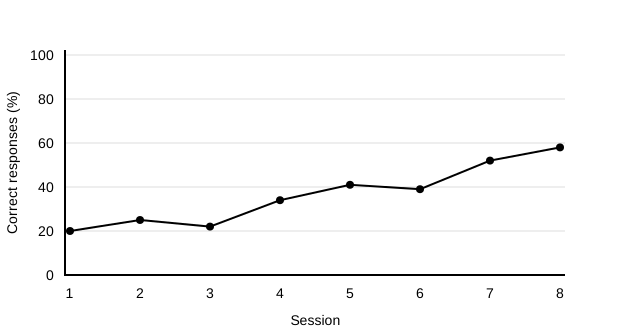
| Session | Correct responses (%) |
|---|---|
| 1 | 20 |
| 2 | 25 |
| 3 | 22 |
| 4 | 34 |
| 5 | 41 |
| 6 | 39 |
| 7 | 52 |
| 8 | 58 |
- A. Stable, with no trend
- B. Highly variable, with no trend
- C. A decreasing trend
- D. An increasing trend
Answer and explanation
Correct: D. The path moves upward across sessions despite two small dips. Trend is the overall direction, not a requirement that every point be higher than the one before it.
A would require the points to hover around one level. B mistakes ordinary bounce for variability; the data range widely, but they range widely in one direction. C reverses the direction. The RBT's task is to name what the data are doing and report it; deciding what to change about the program is the supervisor's call.
Review takeaway: Trend is the direction across sessions, not a requirement that every point rise.
Content area A · Data Collection and Graphing · Task A.7 · Item RBT-A05
Sources: BACB RBT Test Content Outline (3rd ed.), A.7; original graph and data shown with the question.
Question 23. Three days into an extinction procedure for attention-maintained screaming, the client begins screaming longer and louder than before, and also starts slapping the table — something not seen in baseline.
How should the RBT describe this to the supervisor?
- A. Possible secondary effects of extinction: increased target behavior and new response forms, documented with data
- B. Evidence that the function was misidentified
- C. Spontaneous recovery
- D. Evidence that the plan needs a punishment component
Answer and explanation
Correct: A. The current outline includes extinction bursts and response variation among possible secondary effects to recognize. The observed change should be reported as a possible effect, not as proof of its cause or that it will be temporary. Describing them accurately, with the data, is what the supervisor needs.
B jumps to a conclusion the data don't support yet. C refers to a behavior reappearing after it had already dropped off, which hasn't happened here. D proposes a program change that is not the RBT's to make. Two things are worth knowing: the observations do not show whether the change will subside, and a behavior escalating in intensity is a safety question the supervisor needs to hear about now, not at the next scheduled meeting.
Review takeaway: Report secondary effects with the data. Escalating intensity is a safety message, not a status update.
Content area D · Behavior Reduction · Task D.6 · Item RBT-D05
Sources: BACB RBT Test Content Outline (3rd ed.), D.6: extinction burst and response variation; documentation/safety response supported by the Ethics Code; BACB RBT Ethics Code (2.0), §§2.06–2.07.
Question 24. Mid-session, an RBT realizes the written plan's prompting instructions don't cover a situation the client keeps producing, and the RBT has been improvising a response for two sessions.
What is the appropriate action?
- A. Keep improvising consistently so the data stay comparable
- B. Contact the supervisor for clinical direction, describe what has been happening, and follow the direction given
- C. Ask the caregiver how they would like it handled
- D. Stop running the program until the next scheduled supervision meeting
Answer and explanation
Correct: B. Seeking and prioritizing clinical direction from a supervisor in a timely way is a defined part of the role, and two sessions of improvisation is already a delay worth closing today.
A makes the improvisation permanent and quietly turns it into the program. C puts a clinical decision on a caregiver, who is not the supervisor. D delays needed direction until a scheduled meeting. The RBT should not continue an unsafe or unfamiliar procedure while waiting; use the appropriate clinical and safety chain promptly. The honest version of the message includes what you already did, not just what you're unsure about.
Review takeaway: Two sessions of improvising is already late.
Content area E · Documentation and Reporting · Task E.2 · Item RBT-E03
Sources: BACB RBT Test Content Outline (3rd ed.), E.2; BACB RBT Ethics Code (2.0), §§1.06, 2.04, 2.06–2.07.
Question 25. A client reliably labels ten community signs when the RBT presents laminated cards at the table, but does not respond to any of them on a walk past the same signs.
Which change is most directly aimed at this problem?
- A. Increase reinforcement for correct responses at the table
- B. Return to errorless teaching for all ten signs
- C. Add a maintenance probe in two weeks
- D. Teach with varied real examples across settings and people, per the plan's generalization procedures
Answer and explanation
Correct: D. The skill exists under one narrow set of conditions. Generalization is programmed by deliberately varying the stimuli, settings, and people, not assumed to appear on its own.
A strengthens responding in the setting that already works. B treats an acquisition problem the client doesn't have — they know the signs. C measures whether the skill lasts over time, which is maintenance, a different question from whether it transfers. Choose the procedure aimed at the gap you actually observed.
Review takeaway: Generalization is programmed, not hoped for.
Content area C · Behavior Acquisition · Task C.8 · Item RBT-C07
Sources: Stokes and Baer: An Implicit Technology of Generalization, Abstract; named programming approaches including sufficient exemplars and natural maintaining contingencies; BACB RBT Test Content Outline (3rd ed.), C.8–C.9.
Question 26. An RBT's cousin is hired at the same clinic and is assigned as the RBT's supervisor.
What should the RBT do?
- A. Report the relationship to the appropriate person at the organization right away, ask that supervision be reassigned, and document the communication
- B. Accept the assignment and keep supervision strictly professional
- C. Accept it but ask a different supervisor to sign the documentation
- D. Say nothing unless a conflict actually arises
Answer and explanation
Correct: A. The RBT Ethics Code (2.0) standard 1.10 requires RBTs to avoid multiple relationships with clients, coworkers, and supervisors, and — when one develops — to inform the supervisor immediately, work to resolve it, and document the actions taken. When the multiple relationship involves the supervisor, the code directs the RBT to report it to that supervisor's manager or another appropriate entity, such as human resources.
B assumes good intentions solve a structural problem; they do not remove the conflict created by a family and supervisory relationship. C creates a paperwork fiction, with someone attesting to supervision they didn't provide. D waits for damage before acting. Raising it early is the low-drama version of this problem.
Review takeaway: Raise a multiple relationship before it has cost anyone anything.
Content area F · Ethics · Task F.7 · Item RBT-F04
Sources: BACB RBT Ethics Code (2.0), §1.10.
Question 27. A client completes handwriting worksheets independently at a desk while the RBT runs a different program with a second client nearby. The supervisor wants data on handwriting accuracy.
Which recording method fits this situation?
- A. Momentary time sampling every 60 seconds
- B. Duration recording
- C. Latency recording
- D. Permanent product recording of the completed worksheets
Answer and explanation
Correct: D. The behavior leaves a lasting result the RBT can score afterward. Permanent product recording can capture the accuracy of the completed work without continuous observation. It does not reveal every attempt, how long the client worked, or any unobserved assistance.
A samples whether the client is writing, not whether the writing is accurate. B measures how long, not how correct. C measures how quickly the client started. When the behavior produces something you can count later, count that.
Review takeaway: A permanent product can be scored later, but it only tells you what the product preserves.
Content area A · Data Collection and Graphing · Task A.3 · Item RBT-A06
Sources: UNL: Data Without Tears Summary, p. 1, measurable descriptions; p. 2, measurement flowchart.
Question 28. A client has no history with the poker chips used in a new plan. The plan begins by pairing a chip with praise and snack access already shown to reinforce this client’s responding, and later uses chips that can be exchanged for those backup reinforcers.
What is the purpose of the initial pairing?
- A. To establish the chip as a conditioned reinforcer by pairing it with established reinforcers
- B. To thin the reinforcement schedule
- C. To assess whether the snack is a preferred item
- D. To fade a physical prompt
Answer and explanation
Correct: A. For this client, the new chip has no established reinforcing function. Pairing it with established reinforcers is intended to develop that learned function; the team still checks its effect on responding.
B describes reducing how often reinforcement is delivered, which isn't what changes here. C describes a preference assessment. D describes prompt fading, which involves assistance, not reinforcers. This is also why token systems fall apart when the backup reinforcer stops mattering — the conditioning depends on the pairing holding up.
Review takeaway: A token means nothing until it has been paired with something that already works.
Content area C · Behavior Acquisition · Task C.2 · Item RBT-C08
Sources: OpenStax Psychology 2e: Operant Conditioning, Reinforcement and punishment; Shaping; Primary and Secondary Reinforcers; Reinforcement Schedules; EBIP: Preference Assessments, Overview; difference between a highly preferred item and a reinforcer.
Question 29. A client's written plan includes a two-minute time-out from a preferred activity following aggression. The RBT has not yet had competence with this procedure verified by the supervisor.
What should the RBT do?
- A. Implement it, since it is in the written plan
- B. Implement it only if aggression is severe
- C. Not implement it, and tell the supervisor that competence for this procedure has not been verified
- D. Ask the caregiver whether they are comfortable with time-out
Answer and explanation
Correct: C. The RBT Ethics Code (2.0) standard 2.05 sets two conditions for restrictive or punishment-based procedures, and both must be met: the procedure is in a documented behavior-change plan, and the supervisor has verified the RBT's competence. Here only the first condition is satisfied.
A treats the written plan as sufficient on its own. B makes severity the trigger, which inverts the rule — the more restrictive the situation, the more the verification matters. D moves a professional requirement onto a caregiver. Raising this isn't obstruction; it's the step that gets you trained.
Review takeaway: Restrictive procedures need both conditions: the written plan and verified competence.
Content area D · Behavior Reduction · Task D.5 · Item RBT-D06
Sources: BACB RBT Ethics Code (2.0), §2.05.
Question 30. During a paired-stimulus preference assessment, an RBT notices the client has selected the item on the right in nine of the first ten trials, including trials where the right-hand item was one the client usually ignores.
What does this suggest, and what controls for it?
- A. The client prefers novel items; add new items to the array
- B. The assessment should be stopped; the client cannot make choices
- C. The client is satiated; end the session
- D. A side bias may be operating; counterbalance which side each item appears on across trials
Answer and explanation
Correct: D. When selections track position rather than item, the data describe where things were, not what the client likes. Counterbalancing positions helps distinguish position effects from item preference; it does not guarantee that persistent side bias disappears.
A explains the pattern with preference when the pattern points away from preference. B gives up on a fixable procedural issue. C asserts satiation without enough evidence. Record the position pattern and follow the assessment protocol; if a side bias persists, the supervisor may need to adjust the assessment.
Review takeaway: Rotate the positions, or you measure the table instead of the client.
Content area B · Behavior Assessment · Task B.1 · Item RBT-B03
Sources: EBIP: Paired Stimulus, Overview and position-bias guidance.
Question 31. A client's plan targets requesting help. The plan specifies naturalistic teaching.
Which RBT action fits that procedure?
- A. Set up an activity the client wants, arrange it so a step needs help, then teach the request in that moment and give the help as the consequence
- B. Run 10 massed trials of "say help" at the table with a token for each correct response
- C. Ask the client to say "help" 10 times in a row before starting the activity
- D. Prompt the request only during scheduled work periods
Answer and explanation
Correct: A. Naturalistic teaching uses the client's existing motivation in a real activity, and the natural outcome of the response is the consequence — here, actually getting help.
B is discrete-trial teaching, which is a legitimate procedure but not this one. C turns a functional request into a drill separated from the moment when help is needed. D unnecessarily restricts teaching to scheduled work periods rather than the useful opportunity in the activity. When the plan names a teaching format, the format is part of the plan, not a suggestion.
Review takeaway: Naturalistic teaching borrows motivation that is already in the room.
Content area C · Behavior Acquisition · Task C.4 · Item RBT-C09
Sources: EBIP: Natural Environment Teaching and Naturalistic Instruction, Core Principles; naturally occurring and embedded opportunities; natural consequences.
Question 32. A client completed 14 of 20 presented trials correctly.
What percentage should the RBT enter?
- A. 6%
- B. 65%
- C. 70%
- D. 74%
Answer and explanation
Correct: C. 14 ÷ 20 = 0.70, which is 70%.
A reports the number of errors, not a percentage. B and D are near misses of the kind a rushed mental calculation produces. You will not have a calculator at the test center, so practice these by hand: a fraction over 20 becomes a percentage by multiplying both parts by 5.
Review takeaway: Practise these by hand. There is no calculator at the test center.
Content area A · Data Collection and Graphing · Task A.6 · Item RBT-A07
Sources: BACB RBT Test Content Outline (3rd ed.), A.6; arithmetic shown; BACB RBT Handbook, Printed pp. 11–12; prohibited personal items and supplied examination materials.
Question 33. A caregiver tells the RBT they are worried the client's new communication device is being used at clinic but never at home, and asks the RBT not to "make a big deal of it."
What should the RBT do?
- A. Respect the request and handle it informally with the caregiver
- B. Tell the caregiver the device is the speech therapist's responsibility
- C. Agree not to escalate but note it privately
- D. Communicate the caregiver's concern to the supervisor promptly, and let the caregiver know that passing concerns along is part of the role
Answer and explanation
Correct: D. Communicating concerns and suggestions from the intervention team — caregivers included — to the supervisor in a timely way is a defined RBT task. A device that works in one setting and not another is exactly the kind of information that changes a program.
A and C both honor a request the RBT isn't in a position to honor, and C adds a private note nobody will act on. B deflects a concern that is squarely about the client's programming. Being transparent about what you pass along, and why, is usually what keeps caregivers comfortable telling you things.
Review takeaway: Relay the concern, and tell the person who raised it who will follow up.
Content area E · Documentation and Reporting · Task E.1 · Item RBT-E04
Sources: BACB RBT Test Content Outline (3rd ed.), E.1; BACB RBT Ethics Code (2.0), §2.06.
Question 34. An RBT posts a photo on a public account showing their hand holding a completed token board, captioned "so proud of my guy today." The client’s first and last name are legible on the board, although no face is shown.
Is this consistent with the RBT Ethics Code (2.0)?
- A. No — RBTs do not share identifying information about clients, including photos and written information, on social media or websites
- B. Yes, because no face appears
- C. Yes, if the caregiver gave verbal permission
- D. Yes, if the account is set to private
Answer and explanation
Correct: A. Standard 2.09 is written broadly: RBTs do not share identifying information about clients — photos, videos, or written information — on social media or websites. This photograph includes the client’s name, so the absence of a face does not make it nonidentifying.
B ignores the identifying name visible in the photograph. C assumes a caregiver can waive a professional requirement. D treats an audience setting as a safeguard, which it isn't once the post exists. Task F.6 in the exam blueprint also addresses public statements about professional activities.
Review takeaway: Do not post identifying client information. Removing a face does not remove a visible name.
Content area F · Ethics · Task F.6 · Item RBT-F05
Sources: BACB RBT Ethics Code (2.0), §2.09; BACB RBT Test Content Outline (3rd ed.), F.6: public statements about professional activities.
Question 35. A plan directs the RBT to set a five-minute timer and deliver one minute of preferred music if no throwing of materials has occurred throughout the interval. Throwing is a documented safety target; if it occurs, the timer is reset.
Which procedure is this?
- A. DRA
- B. DRL
- C. DRO
- D. Noncontingent reinforcement
Answer and explanation
Correct: C. Reinforcement is contingent on the absence of the target behavior for a specified interval, with a reset when it occurs. That is differential reinforcement of other behavior.
A would specify a particular alternative response to reinforce; nothing here names one. B reinforces the behavior occurring at a lower rate rather than not at all. D would deliver the music on the timer regardless of behavior, which is precisely what the reset rule prevents. The reset is the signal to look for.
Review takeaway: This DRO requires a full interval without the target. A reset belongs to this plan, not every DRO schedule.
Content area D · Behavior Reduction · Task D.3 · Item RBT-D07
Sources: EBIP: Differential Reinforcement, Types: DRA, DRI and DRO; interval versus momentary DRO.
Question 36. An RBT presents a red card and a blue card. Correct responses to "touch red" are reinforced; touching blue produces no reinforcement and the trial is re-presented with a prompt.
Which procedure is this?
- A. Shaping
- B. Discrimination training
- C. Extinction
- D. Total-task chaining
Answer and explanation
Correct: B. Reinforcement is available for responding in the presence of one stimulus and not another. That differential arrangement is how discrimination training builds stimulus control.
A refines a single response toward a target form. C is not established merely because touching blue is not reinforced; extinction requires discontinuing a consequence that previously maintained that response. The full arrangement here differentially reinforces the response to the named color. D involves a sequence of steps from a task analysis. Naming the whole procedure by one of its halves is a common wrong turn.
Review takeaway: Discrimination training is reinforcement in one condition and not the other.
Content area C · Behavior Acquisition · Task C.6 · Item RBT-C10
Sources: OpenStax Psychology 2e: Operant Conditioning, Reinforcement and punishment; Shaping; Primary and Secondary Reinforcers; Reinforcement Schedules; AFIRM: A Case for EXT, Written introductory definition; BACB RBT Test Content Outline (3rd ed.), C.6; fictional discrimination arrangement supplied in the stem.
Question 37. A team divides a 30-minute work period into equal intervals and wants the percentage of intervals during which a client is engaged with materials from start to finish.
Which recording method matches that question?
- A. Partial-interval recording
- B. Momentary time sampling
- C. Whole-interval recording
- D. Frequency recording
Answer and explanation
Correct: C. Whole-interval recording scores an interval only when the behavior occurs for the entire interval, which matches the question about engagement throughout each interval.
A scores an interval for a single brief occurrence, so it would credit a client who engaged for two seconds. B samples only at the moment each interval ends. D counts episodes, which doesn't describe continuous engagement well. The result is not an exact percentage of time engaged. Engagement during only part of an interval receives no whole-interval credit, so interpreting the percentage as duration can underestimate time. Whether that loss of information is acceptable depends on the measurement purpose, not simply on wanting behavior to increase.
Review takeaway: Whole-interval recording credits only complete intervals. Do not report it as exact time engaged.
Content area A · Data Collection and Graphing · Task A.2 · Item RBT-A08
Sources: IRIS: Behavior Assessment—Frequency and Interval Recording, p. 2; whole-interval rule and interval-percentage calculation.
Question 38. A supervisor asks the RBT to help run a curriculum-based skill assessment and gives a scoring protocol that requires one unprompted presentation per item. Partway through, the client misses several items in a row that the RBT has seen them do correctly in sessions.
What should the RBT do?
- A. Score the items as presented and note in the record that the client has performed these skills in session
- B. Prompt the items so the score reflects the client's true ability
- C. Skip the remaining items and score them as correct based on session history
- D. Re-present each missed item until the client responds correctly
Answer and explanation
Correct: A. Assisting with a skill assessment means running it the way the protocol specifies and reporting what happened. The discrepancy between assessment performance and session performance is useful information for the supervisor — but only if the assessment data are left intact.
B, C, and D all edit the results to match what the RBT believes is true. Prompting an item that this protocol scores as independent would inflate that score; scoring from memory replaces data with recollection; re-presenting until correct changes the procedure. Document the observation and let the supervisor decide what it means.
Review takeaway: Run the protocol as written and report the discrepancy. Don't edit the result toward what you believe.
Content area B · Behavior Assessment · Task B.2 · Item RBT-B04
Sources: BACB RBT Test Content Outline (3rd ed.), B.2; BACB RBT Ethics Code (2.0), §2.02; fictional assessment protocol supplied in the stem.
Question 39. A client begins throwing chairs in a clinic room with two other clients present. The client's plan contains a written crisis procedure that the RBT has been trained on.
What should the RBT do first?
- A. Start a duration recording of the episode
- B. Follow the plan's crisis procedure as trained, including its steps for the safety of others present
- C. Call the caregiver to ask how they handle this at home
- D. Apply the extinction procedure from the behavior plan
Answer and explanation
Correct: B. Crisis and emergency procedures exist precisely so nobody has to invent a response under pressure. When a trained, written procedure applies, that procedure is the first action.
A puts data collection ahead of safety; documentation happens, but after. C delays the trained immediate safety response to make a caregiver call; any required caregiver notification follows the emergency protocol. D applies a routine behavior-reduction procedure to a situation the plan has already classified as a crisis. Documentation and a report to the supervisor follow — and if there's no written crisis procedure for a behavior this severe, that's something to raise before it happens again.
Review takeaway: The trained crisis procedure comes first. Documentation follows.
Content area D · Behavior Reduction · Task D.7 · Item RBT-D08
Sources: BACB RBT Test Content Outline (3rd ed.), D.7; BACB RBT Ethics Code (2.0), §§2.01, 2.07.
Question 40. A plan calls for an error-minimizing teaching procedure for a new receptive identification target, starting with a zero-second controlling prompt and fading according to specified criteria.
What does the RBT do on the first trials?
- A. Deliver the instruction and wait five seconds before prompting
- B. Deliver the instruction and prompt only after an error occurs
- C. Deliver the instruction together with a prompt strong enough to produce the correct response, then fade it systematically
- D. Present the target with no prompts and reinforce approximations
Answer and explanation
Correct: C. This plan aims to minimize errors by prompting immediately at first, then transferring stimulus control through its specified fading procedure.
A introduces a delay, which invites the error the procedure is designed to avoid — though a zero-second delay that grows over trials is a related procedure. B waits for an error, which conflicts with this plan’s initial zero-second prompt. D describes shaping. Fading is not optional here: prompting immediately and never fading produces a client who waits for the prompt.
Review takeaway: Prompt at the time the plan specifies, then fade according to its criteria.
Content area C · Behavior Acquisition · Task C.7 · Item RBT-C11
Sources: EBIP: Progressive Time Delay, Overview; initial zero-second and later delay procedures; BACB RBT Test Content Outline (3rd ed.), C.7.
Question 41. An RBT's supervising BCBA leaves the organization. Six weeks later, no new supervisor has been assigned, and the RBT is still seeing clients.
What does the RBT need to do?
- A. Nothing, as long as the previous supervisor's plans are being followed
- B. Continue services and raise it at the next quarterly staff meeting
- C. Ask a BCBA at another organization to sign off informally
- D. Stop providing services under the RBT certification while the requirements are unmet, notify the organization now, arrange qualified supervision on record, and self-report the noncompliance
Answer and explanation
Correct: D. RBTs may practice only under ongoing supervision from a supervisor who meets BACB requirements and is on record with the BACB. The BACB requires supervision for at least 5% of the hours spent delivering services each calendar month, alongside other supervision requirements, and RBTs are required to self-report supervision noncompliance. Arranging future supervision does not authorize continuing unsupervised services now.
A treats old documents as supervision, which they aren't. B lets a six-week gap become a longer one. C invents an arrangement the requirements don't allow — a supervisor needs enough client-specific knowledge to direct the work, and the relationship has to be on record. Substantial noncompliance can end a certification, so the uncomfortable conversation is the cheaper option.
Review takeaway: No supervisor on record with the BACB means you may not practise.
Content area F · Ethics · Task F.3 · Item RBT-F06
Sources: BACB RBT Handbook, Printed pp. 15–17 and 23; supervision and noncompliance self-report; BACB RBT Ethics Code (2.0), §§1.03, 3.01.
Question 42. Two RBTs alternate sessions with the same client. One scores "vocal protest" only for words; the other scores it for any raised-volume sound. Neither realizes the difference.
What is the main risk to the client?
- A. The client will become confused about the expectations
- B. The graph will show changes that reflect who collected the data rather than what the client did, and program decisions may be made on that basis
- C. The RBTs will need to redo the competency assessment
- D. The supervisor will have to observe more often
Answer and explanation
Correct: B. Unreliable data don't just make a messy graph. They feed a decision. A supervisor looking at an apparent drop may end a procedure that was working, or keep one that wasn't, because the pattern tracks the observer rather than the behavior.
A describes an effect on the client's learning environment, which is a procedural-fidelity concern rather than a measurement one. C and D are possible workplace consequences, not the risk to the client. The fix is a shared operational definition and a check that both observers apply it the same way.
Review takeaway: Unreliable data can produce a bad decision, not just a messy graph.
Content area A · Data Collection and Graphing · Task A.8 · Item RBT-A09
Sources: BACB RBT Test Content Outline (3rd ed.), A.8; BACB RBT Ethics Code (2.0), §2.02.
Question 43. A client mastered shoe tying four months ago. The plan now calls for a monthly probe with no prompts and no error correction, scored but not taught.
What is the purpose of this probe?
- A. To shape a faster response
- B. To establish a new baseline before re-teaching
- C. To check whether the mastered skill is maintaining without active teaching
- D. To assess generalization across settings
Answer and explanation
Correct: C. Maintenance procedures ask whether a previously mastered skill persists over time after active teaching is reduced or ends; ordinary reinforcement can still occur. That's why the probe deliberately withholds prompts and correction — adding them would measure teaching, not maintenance.
A targets faster performance rather than persistence over time. B describes what you'd do if the skill had already fallen apart. D tests transfer to new conditions, which is a different question: a client can maintain a skill perfectly in one setting and still not transfer it. Knowing which of the two you're measuring keeps you from drawing the wrong conclusion from a low score.
Review takeaway: Maintenance asks whether it lasts. Generalization asks whether it transfers.
Content area C · Behavior Acquisition · Task C.9 · Item RBT-C12
Sources: BACB RBT Test Content Outline (3rd ed.), C.9: distinguish between maintenance and acquisition procedures; Stokes and Baer: An Implicit Technology of Generalization, Abstract; named programming approaches including sufficient exemplars and natural maintaining contingencies; EBIP: Other Prompting Procedures, Simultaneous Prompting: unprompted probes test performance without teaching on that trial.
Question 44. Driving home, an RBT realizes they left an incident out of the session note submitted an hour ago. Agency policy requires same-day documentation and an auditable later entry that preserves the original note and records who added the information and when.
What should the RBT do?
- A. Add the information to the next session's note
- B. Leave the record alone, since the note is already submitted
- C. Ask the supervisor to add it so the original note stays clean
- D. Add the information today as a clearly marked later entry showing when it was added, and tell the supervisor
Answer and explanation
Correct: D. Records should be accurate and complete, and corrections are made openly. A dated addition shows both what happened and when it was documented, which is what keeps the record honest.
A attaches an event to the wrong session. B leaves a knowingly incomplete record, which conflicts with the requirement to complete documentation accurately. C hides the RBT's own omission behind someone else's signature. What would make this genuinely serious is editing the original to look as though it was written during the session — that's falsification, not a correction.
Review takeaway: Correct omissions transparently under the record-correction policy; do not make a late entry look contemporaneous.
Content area E · Documentation and Reporting · Task E.4 · Item RBT-E05
Sources: BACB RBT Ethics Code (2.0), §§1.01, 2.02; fictional correction policy supplied in the stem.
Question 45. A client's plan teaches the client to hand over a break card, and specifies that handing the card produces an immediate two-minute break from work, while the escape-maintained screaming it replaces no longer produces a break.
Which procedure is this?
- A. Functional communication training
- B. Noncontingent reinforcement
- C. Response cost
- D. Discrimination training
Answer and explanation
Correct: A. A communication response is taught that produces the same reinforcer — escape — that the problem behavior produced, while the problem behavior is placed on extinction. The functionally equivalent communication response identifies functional communication training. This particular plan also includes extinction.
B delivers reinforcement on a schedule independent of behavior. C removes an earned reinforcer following behavior. D would arrange different consequences in the presence of different stimuli. The word "functional" in the name is the point: the replacement has to get the client the same thing, or it won't compete.
Review takeaway: The replacement response has to buy the client the same thing the problem behavior bought.
Content area D · Behavior Reduction · Task D.3 · Item RBT-D09
Sources: AFIRM: A Case for FCT, Written introductory definition; EBIP: Differential Reinforcement, Types: DRA, DRI and DRO; interval versus momentary DRO.
Question 46. A preference assessment ranks a light-up ball first. Over the next week, the RBT delivers the ball after correct responses in a teaching program, and correct responding does not increase.
What is the most accurate conclusion?
- A. The preference assessment was conducted incorrectly
- B. The client is not motivated to learn
- C. The ball was preferred in the assessment, but a reinforcing effect has not been demonstrated in this program; report the observations to the supervisor
- D. The teaching procedure should be replaced
Answer and explanation
Correct: C. Preference and reinforcement are different things. A preference assessment identifies what a client is likely to choose; whether an item functions as a reinforcer is defined by whether behavior it follows increases. Here it didn't.
A blames the procedure without evidence — the ranking may have been accurate at the time. B attributes the result to the client rather than the arrangement. D changes the teaching procedure without the supervisor evaluating the result and other variables that may affect it. This is one of the most useful distinctions in the role, and the reason preference assessments get repeated.
Review takeaway: Preference is a useful lead. Check whether contingent access actually strengthens the target response.
Content area B · Behavior Assessment · Task B.1 · Item RBT-B05
Sources: EBIP: Preference Assessments, Overview; difference between a highly preferred item and a reinforcer; OpenStax Psychology 2e: Operant Conditioning, Reinforcement and punishment; Shaping; Primary and Secondary Reinforcers; Reinforcement Schedules.
Question 47. A plan specifies an FR-4 schedule of reinforcement for a mastered sorting task.
What does the RBT do?
- A. Deliver reinforcement every four minutes regardless of responding
- B. Deliver reinforcement after every fourth correct response
- C. Deliver reinforcement after an average of four correct responses, varying the number
- D. Deliver reinforcement for four minutes after the task ends
Answer and explanation
Correct: B. A fixed-ratio schedule delivers reinforcement after a set number of responses. FR-4 means every fourth one.
A describes response-independent, fixed-time delivery, not a requirement for four correct responses. C describes a variable-ratio schedule, where the count varies around an average. D describes the size of the reinforcer, not the schedule. Ratio means responses, interval means time — and "fixed" or "variable" tells you whether the requirement is constant or moves around.
Review takeaway: Ratio schedules count responses. Interval schedules count time.
Content area C · Behavior Acquisition · Task C.1 · Item RBT-C13
Sources: OpenStax Psychology 2e: Operant Conditioning, Reinforcement and punishment; Shaping; Primary and Secondary Reinforcers; Reinforcement Schedules; National Center on Intensive Intervention: Reinforcement Strategies, Printed p. 5, Non-Contingent Reinforcement—Purpose and Overview.
Question 48. A supervisor wants to know whether a client's tantrums are getting shorter, even though they happen about as often as before.
Which measure answers that question?
- A. Duration
- B. Frequency
- C. Latency
- D. Interresponse time
Answer and explanation
Correct: A. Duration records how long each episode lasts, which is exactly the dimension in question.
B counts episodes, and the supervisor has already said the count is roughly unchanged. C measures how long after an antecedent the behavior starts. D measures the gaps between episodes. Behaviors change on more than one dimension, and a program can be working on duration while frequency stays flat — which is invisible unless someone measures the right one.
Review takeaway: Ask which dimension of the behavior changed before you pick a measure.
Content area A · Data Collection and Graphing · Task A.1 · Item RBT-A10
Sources: UNL: Data Without Tears Summary, p. 1, measurable descriptions; p. 2, measurement flowchart.
Question 49. After observing a session, a supervisor tells an RBT that prompts are being delivered too quickly and gives specific corrective feedback. The RBT understands the direction, has been trained to implement it, and has no safety concern, but disagrees based on how the client responded last week.
What should the RBT do?
- A. Implement the feedback only during observed sessions
- B. Ask another RBT whether the feedback was fair
- C. Implement the feedback, and raise the disagreement with the supervisor along with the observations behind it
- D. Implement the feedback without comment, since the supervisor decides
Answer and explanation
Correct: C. The professional skills the blueprint names include accepting feedback, listening actively, seeking input, and collaborating — and the Ethics Code says RBTs take action to improve performance following supervisor feedback (2.03). None of that requires pretending to agree. Implement the direction, then bring your data.
A is performing compliance for an audience, and it also means the client gets two different procedures. B routes a supervision issue to a peer who wasn't there. D complies but throws away information the supervisor would probably want. Disagreement raised through the right channel is part of the job; silent noncompliance is not.
Review takeaway: Apply the understood, safe direction and bring your observations to the supervisor.
Content area F · Ethics · Task F.9 · Item RBT-F07
Sources: BACB RBT Ethics Code (2.0), §2.03; BACB RBT Test Content Outline (3rd ed.), F.9.
Question 50. A plan directs the RBT to present three quick tasks the client almost always completes — clap, high five, touch nose — reinforce completion as specified, and immediately present a writing demand the client rarely completes.
Which procedure is this?
- A. Shaping
- B. High-probability request sequence
- C. Differential reinforcement of alternative behavior
- D. Chaining
Answer and explanation
Correct: B. A short run of high-probability requests delivered right before a low-probability one is an antecedent intervention aimed at increasing compliance with the harder demand.
A refines one response toward a target. C reinforces an alternative to a problem behavior, which isn't the arrangement here. D links steps of one task into a sequence; these three requests aren't steps of the writing task. The defining arrangement is a short sequence of likely-to-be-completed requests immediately before a less likely one. The team still evaluates whether this plan helps this client.
Review takeaway: High-probability means likely to be completed. Follow the planned sequence and check its effects.
Content area D · Behavior Reduction · Task D.2 · Item RBT-D10
Sources: AFIRM: Behavioral Momentum Intervention, Behavioral Momentum Intervention entry.
Question 51. A plan specifies a progressive time delay when teaching a client to label photos.
What does the RBT do across trials?
- A. After initial zero-second trials, deliver the prompt at a fixed two-second delay on every later trial
- B. Prompt only after an error
- C. Deliver reinforcement on a gradually thinner schedule
- D. Prompt simultaneously with the instruction at first, then wait progressively longer before prompting on later trials
Answer and explanation
Correct: D. Progressive time delay starts with no delay between instruction and prompt and stretches the wait across trials, giving the client an expanding opportunity to respond before help arrives.
A describes constant time delay, where the delay is the same on every trial after the initial zero-second trials. B is error correction. C describes schedule thinning, which concerns reinforcement rather than prompts. Both delay procedures are ways to transfer stimulus control from the prompt to the natural instruction — they just differ in how the wait is scheduled.
Review takeaway: Constant delay holds the wait steady. Progressive delay stretches it.
Content area C · Behavior Acquisition · Task C.7 · Item RBT-C14
Sources: EBIP: Progressive Time Delay, Overview; initial zero-second and later delay procedures.
Question 52. During a home session, an RBT notices a purple mark on a client’s upper arm. The RBT has not observed how it happened and is documenting the observation while following the organization’s safety and reporting procedures.
Which entry most accurately separates observation from an unverified explanation?
- A. “At 3:10 p.m., I observed a purple mark on the client’s upper left arm. I did not observe how it occurred.”
- B. “The caregiver caused the bruise before the session.”
- C. “The mark is harmless, so no follow-up is needed.”
- D. “The client probably bumped into furniture.”
Answer and explanation
Correct: A. It records what the RBT observed and what was not observed. The Ethics Code requires accurate documentation (2.02) and protective action when there is a risk of harm (2.07). An objective note does not replace any reporting duty that applies under the law where the RBT works (2.01).
B asserts a cause that the RBT did not observe. C makes an unsupported safety judgment and dismisses follow-up. D supplies a plausible story, not evidence. Record observations and actions accurately; follow applicable reporting obligations without conducting your own investigation or waiting for proof.
Review takeaway: Record what you observed, distinguish what you do not know, and follow the applicable protective and reporting duties.
Content area E · Documentation and Reporting · Task E.4 · Item RBT-E06
Sources: BACB RBT Ethics Code (2.0), §§2.01–2.02, 2.07.
Question 53. An RBT finishes a session and has ten minutes before the next client. The client's program data are on a paper sheet, the program requires entry after each session, and the supervisor reviews graphs before each Thursday meeting.
What is the appropriate practice?
- A. Batch the week's sheets and enter them all on Wednesday night
- B. Enter only the sessions where something notable happened
- C. Enter the session data and update the graph now, per the program's requirements
- D. Leave data entry to the supervisor, who interprets the graphs
Answer and explanation
Correct: C. Entering data and keeping graphs current is a named part of the role, and doing it while the session is fresh is how transcription errors get caught rather than multiplied.
A puts a week of clinical decisions on a memory-and-paperwork sprint the night before. B decides which data count, which is not a call the person collecting them makes. D shifts an assigned RBT task to the supervisor. RBTs can also identify and report graph patterns; clinical program decisions remain with the supervisor. A graph missing four days of collected data may omit information needed for today’s decision.
Review takeaway: Keep the graph current under the program’s requirements so recent observations are available for decisions.
Content area A · Data Collection and Graphing · Task A.4 · Item RBT-A11
Sources: BACB RBT Test Content Outline (3rd ed.), A.4–A.7; BACB RBT Ethics Code (2.0), §2.02; fictional entry schedule supplied in the stem.
Question 54. A family's cultural practice is that a child does not eat before adults are served. The RBT's plan includes reinforcers delivered as small food items during pre-dinner sessions, and the caregiver looks uncomfortable when they're used.
What should the RBT do?
- A. Continue as written; reinforcer selection is a clinical decision
- B. Raise it with the supervisor, describe what was observed, and work with the supervisor on reinforcers that fit the family's practices
- C. Switch to praise on the spot and note the change
- D. Ask the caregiver to make an exception during sessions
Answer and explanation
Correct: B. Cultural humility and responsiveness is a named exam task, and the Ethics Code asks RBTs to work directly with their supervisor to ensure their work is culturally responsive (1.07). Bring the observation and let the plan change through the person who can change it.
A treats the family's practices as irrelevant to a procedure happening in their home. C substitutes a consequence without clinical direction. That does not mean continuing a procedure over a caregiver’s refusal: respect the refusal and obtain direction promptly. D asks the family to accommodate the program instead of the reverse. The family’s practices are relevant information for designing a workable plan.
Review takeaway: Bring the family’s preferences into planning; do not treat a written procedure as permission to disregard a refusal.
Content area F · Ethics · Task F.10 · Item RBT-F08
Sources: BACB RBT Ethics Code (2.0), §§1.07, 2.01, 2.06.
Question 55. A task analysis for making toast has eight steps. A client can do six of the eight but struggles with steps 3 and 6. The plan directs the RBT to have the client attempt every step each trial, prompting only where needed.
Which chaining procedure is this?
- A. Forward chaining
- B. Backward chaining
- C. Shaping
- D. Total-task presentation
Answer and explanation
Correct: D. Every step is attempted on every trial, with prompting targeted to the steps that need it. That's total-task presentation, and it suits a client who already performs most of the chain.
A and B introduce teaching through a designated end of the chain, rather than having the learner attempt the entire sequence on every trial as stated here. C isn't a chaining procedure. The supervisor selects the teaching approach; the RBT identifies and implements the format written in this plan.
Review takeaway: Total-task presentation offers every step on each trial, with the planned help where needed.
Content area C · Behavior Acquisition · Task C.5 · Item RBT-C15
Sources: AFIRM: Task Analysis evidence-based practice packet, PDF pp. 6–8; especially p. 7, Step 2.2.
Question 56. A plan places head-directed hitting on extinction. In session, the client's hitting escalates to a force the RBT judges could cause injury.
What should the RBT do?
- A. Continue the extinction procedure, because bursts subside
- B. Switch to a punishment procedure to stop it quickly
- C. Withhold reinforcement but leave the room
- D. Act to keep the client safe according to the plan's crisis and safety provisions, then report the escalation to the supervisor promptly
Answer and explanation
Correct: D. Procedural consistency matters, and it does not outrank client safety. When behavior escalates to a risk of injury, the safety provisions of the plan govern, and the supervisor needs to hear about it before the next session — a plan that produces an unsafe escalation needs review.
A holds the line past the point where holding the line is the RBT's call to make. B introduces a procedure the RBT hasn't been authorized or verified to run. C leaves a client engaging in self-injury unsupervised. "Follow the plan as written" is the right default and the reason plans include crisis provisions: so the exception is also written down.
Review takeaway: Safety provisions are part of the plan, not a departure from it.
Content area D · Behavior Reduction · Task D.4 · Item RBT-D11
Sources: BACB RBT Ethics Code (2.0), §§2.01, 2.07; BACB RBT Test Content Outline (3rd ed.), D.4, D.7.
Question 57. A supervisor is conducting a functional analysis has verified the RBT’s competence and reviewed the safety protocol, and asks the RBT to run the attention condition: provide brief attention following each instance of the target behavior, and otherwise attend to a magazine.
Which statement describes the RBT's role here?
- A. Implementing an assigned condition exactly as specified and collecting the data is participation in a component of a functional assessment, which is within the role
- B. The RBT should decline, because functional analysis is outside the RBT's scope
- C. The RBT should modify the condition if the behavior becomes frequent
- D. The RBT should interpret the resulting graph and report the function
Answer and explanation
Correct: A. The exam blueprint names participating in components of functional assessment procedures, including descriptive assessment and functional analysis, as an RBT task. Running an assigned condition under the supervisor's direction is exactly that.
B is over-cautious in a way that gets the role wrong. C alters a condition mid-analysis, which destroys the comparison the analysis depends on — a higher rate can be relevant assessment data, but safety thresholds still apply. D asks the RBT to determine the function from the analysis independently. The RBT may identify and report patterns, but the supervisor is responsible for the functional conclusion. Safety concerns are the one thing you raise immediately rather than absorbing.
Review takeaway: Run only the trained, assigned condition, follow its safeguards, and report the data for the supervisor’s assessment.
Content area B · Behavior Assessment · Task B.3 · Item RBT-B06
Sources: BACB RBT Test Content Outline (3rd ed.), B.3; BACB RBT Ethics Code (2.0), §§1.03, 1.06, 2.07.
Question 58. During a session, four episodes of crying lasted 20, 35, 15, and 50 seconds.
What is the mean duration per episode?
- A. 120 seconds
- B. 25 seconds
- C. 30 seconds
- D. 35 seconds
Answer and explanation
Correct: C. Total duration divided by number of episodes: 20 + 35 + 15 + 50 = 120 seconds, and 120 ÷ 4 = 30 seconds.
A is the total, not the mean. B and D do not equal the total of 120 seconds divided by four episodes. Mean duration answers a different question from total duration — a client can hold total crying steady while episodes get shorter and more frequent, and only one of those measures shows it.
Review takeaway: Mean duration and total duration answer different questions.
Content area A · Data Collection and Graphing · Task A.6 · Item RBT-A12
Sources: BACB RBT Test Content Outline (3rd ed.), A.6; calculation shown.
Question 59. A client completes a demand and the RBT immediately removes the remaining worksheets, as the plan specifies. Over time, demand completion increases.
Which term describes the procedure the plan is using?
- A. Positive reinforcement
- B. Negative reinforcement
- C. Extinction
- D. Negative punishment
Answer and explanation
Correct: B. A stimulus was removed contingent on the behavior, and the behavior increased. That's negative reinforcement, and it's a deliberate, legitimate teaching arrangement here — completing work earns an end to work.
A would involve adding something, like praise or a token. C would mean the behavior no longer produces its reinforcer. D would require the behavior to decrease. "Negative" in this vocabulary means subtraction, not unpleasantness.
Review takeaway: “Negative” means something was removed, not that something was unpleasant.
Content area C · Behavior Acquisition · Task C.1 · Item RBT-C16
Sources: OpenStax Psychology 2e: Operant Conditioning, Reinforcement and punishment; Shaping; Primary and Secondary Reinforcers; Reinforcement Schedules.
Question 60. Which set names the core principles underlying the BACB's ethics code for RBT certificants?
- A. Confidentiality, documentation, supervision, and reporting
- B. Accuracy, timeliness, consistency, and objectivity
- C. Assent, dignity, least restrictiveness, and data-based decisions
- D. Benefit others; treat others with compassion, dignity, and respect; behave with integrity; and ensure one's own competence
Answer and explanation
Correct: D. These four are named in the introduction to the RBT Ethics Code (2.0) as the principles the individual standards rest on, and applying them is a task on the current exam blueprint.
A lists specific duties that follow from the principles rather than the principles themselves. B lists documentation qualities. C lists real and important ideas from practice, which is what makes it the attractive wrong answer — but they aren't the code's four named principles. When a question asks for the core principles, it's asking for the four.
Review takeaway: Four principles: benefit others; compassion, dignity and respect; integrity; competence.
Content area F · Ethics · Task F.1 · Item RBT-F09
Sources: BACB RBT Ethics Code (2.0), Introduction: core principles; BACB RBT Test Content Outline (3rd ed.), F.1.
Question 61. A supervisor’s assessment finds that a client’s dropping to the floor is maintained by removal of a writing task. The supervisor asks the RBT to identify the event that would deliver that maintaining consequence.
Which event matches the assessed function?
- A. The writing task is removed following the response
- B. An adult comments on the response while the writing task remains
- C. A preferred toy is delivered while the writing task remains
- D. The observer counts the response while all task conditions remain unchanged
Answer and explanation
Correct: A. The assessed function is escape from the writing task. A supplies that consequence by removing the task after the response. Identify the function by the relationship described in the assessment, not by the appearance of dropping to the floor.
B supplies attention, not the specified escape. C supplies access to an item, not task removal. D records the event without supplying the identified consequence. Recognizing the maintaining consequence is not authorization to add, remove, or change an intervention; the RBT follows the supervisor’s plan.
Review takeaway: Match the consequence to the assessed function. The same-looking behavior can have a different function for another person.
Content area D · Behavior Reduction · Task D.1 · Item RBT-D12
Sources: EBIP: Challenging Behavior as Communication, ABC descriptions and hypothesis discussion; BACB RBT Test Content Outline (3rd ed.), D.1; supervisor-established finding supplied in the stem.
Question 62. A caregiver mentions that the client has had a stomach bug since yesterday and ate almost nothing this morning. After the health information has been relayed and the applicable illness procedures followed, the session proceeds and the client's performance drops sharply across every program.
What should the RBT record?
- A. Only the program data, so the record stays objective
- B. The program data, plus a note that the client seemed unwell and unmotivated
- C. The program data, plus the caregiver-reported illness and reduced eating, and report it to the supervisor
- D. Nothing unusual, since the client completed the session
Answer and explanation
Correct: C. Reporting and documenting variables that might affect client progress is a defined task, and illness is the standard example. The data stay as they are; the context goes in alongside them so the supervisor doesn't read a sick day as a failing program.
A leaves the supervisor with an unexplained drop. B slips into inference — "unwell and unmotivated" is a conclusion, while "caregiver reported stomach illness since yesterday and minimal food intake" is a report. D omits information that changes how the day should be read. Attribute what the caregiver told you to the caregiver, and keep your own observations separate.
Review takeaway: Attribute what the caregiver told you to the caregiver, and keep your own observations separate.
Content area E · Documentation and Reporting · Task E.3 · Item RBT-E07
Sources: BACB RBT Test Content Outline (3rd ed.), E.3; BACB RBT Ethics Code (2.0), §§2.02, 2.06–2.07.
Question 63. The written error-correction plan calls for re-presenting an instruction with a prompt after an error and reserving the programmed praise for independent responses. During discrete-trial teaching, an RBT delivers the instruction, the client responds incorrectly, and the RBT immediately says "Let's try that again," re-presents the instruction with a prompt, and delivers praise for the prompted correct response.
Which part of this is a problem if the plan specifies that only independent responses are reinforced?
- A. Re-presenting the instruction after an error
- B. Using a prompt on the corrective trial
- C. Saying anything after an incorrect response
- D. Delivering the same praise for a prompted response that the plan reserves for independent responses
Answer and explanation
Correct: D. The re-presentation and prompt follow this plan’s error-correction sequence. What conflicts with the plan is delivering the reinforcer earmarked for independent responding after a prompted response, because that weakens the difference the plan is trying to teach.
A and B describe ordinary error correction. C prohibits any speech after an error, which is not what this plan says. The point is to follow the specified correction and consequence procedure rather than a habit, and to ask the supervisor when the plan does not specify it.
Review takeaway: Reinforce what the plan says to reinforce, at the value the plan assigns it.
Content area C · Behavior Acquisition · Task C.3 · Item RBT-C17
Sources: AFIRM: A Case for DTT, Written introductory definition; BACB RBT Ethics Code (2.0), §2.02; fictional correction and consequence protocol in the stem.
Question 64. An RBT is asked to record on-task behavior for a group of four clients during a 20-minute activity while also running the activity.
The supervisor can assign brief, staggered observation moments for each client but not continuous observation. Which method fits that constraint, and what does it record?
- A. Frequency recording; every instance across all four clients
- B. Momentary time sampling; whether each client is on task at that client’s assigned observation moment
- C. Duration recording; total on-task time per client
- D. Latency recording; time from instruction to first on-task response
Answer and explanation
Correct: B. Momentary time sampling records whether behavior is occurring at the assigned moment. Brief, staggered checks fit the observation constraint given here; they do not produce continuous records of all four clients.
A and C both require continuous observation of four people at once. D answers a different question and still needs close watching at the start of each opportunity. The trade-off is real and worth naming: sampling estimates rather than counts, and brief behaviors can fall between the sampling moments. That's the price of a measure you can actually collect.
Review takeaway: Momentary sampling buys feasibility and pays for it in precision.
Content area A · Data Collection and Graphing · Task A.2 · Item RBT-A13
Sources: Bakersfield City School District: Measuring Behavior—Interval, How to Collect the Data—Momentary Time Sampling, end-of-interval recording instruction; BACB RBT Test Content Outline (3rd ed.), A.2; assigned sampling schedule supplied in the stem.
Question 65. A new RBT asks their supervisor for help running a chaining procedure. Which supervisor approach matches the effective supervision practices named on the exam blueprint?
- A. Explain the steps, demonstrate the procedure, have the RBT rehearse it, give feedback, and observe the RBT running it with a client
- B. Email the written protocol and ask the RBT to review it before the next session
- C. Have the RBT watch a recording of another technician and then run it independently
- D. Answer questions as they come up during the RBT's sessions
Answer and explanation
Correct: A. The blueprint names training that includes instructions, modeling, rehearsal, and feedback, plus observation of the RBT delivering services. All five appear in A.
B provides instruction with no modeling, rehearsal, feedback, or observation. C adds a model but skips rehearsal and feedback. D is responsive but unstructured and never verifies the skill under observation. Knowing this pattern is useful in both directions: it's what you should receive, and it's what you can reasonably ask for when you're handed something new.
Review takeaway: Instruction, modeling, rehearsal, feedback, observation. Ask for all five.
Content area F · Ethics · Task F.4 · Item RBT-F10
Sources: DiGennaro Reed et al.: Guidelines for Using Behavioral Skills Training to Provide Teacher Support, Instruction, modeling, rehearsal, feedback sections; ongoing support; BACB RBT Test Content Outline (3rd ed.), F.4.
Question 66. A client greets the RBT reliably but does not greet other technicians, the receptionist, or family friends.
Which change targets this directly?
- A. Increase the reinforcement magnitude for greeting the RBT
- B. Re-teach greeting with errorless prompting
- C. Arrange teaching opportunities with multiple different people, per the plan's generalization procedures
- D. Probe greeting monthly with no prompts
Answer and explanation
Correct: C. The response is under the control of one person. Programming generalization across people means building the skill with several people deliberately, rather than expecting it to spread.
A strengthens the one relationship that already works. B re-teaches a response the client has. D measures maintenance over time, which isn't the gap. Generalization comes in flavors — across people, settings, and materials — and the one you program should be the one you're missing.
Review takeaway: Program the kind of generalization you are actually missing.
Content area C · Behavior Acquisition · Task C.8 · Item RBT-C18
Sources: Stokes and Baer: An Implicit Technology of Generalization, Abstract; named programming approaches including sufficient exemplars and natural maintaining contingencies; BACB RBT Test Content Outline (3rd ed.), C.8.
Question 67. A plan specifies that when a client throws materials, one earned token is removed from the token board. Over three weeks, throwing decreases.
Which term describes this procedure?
- A. Extinction
- B. DRO
- C. Negative reinforcement
- D. Negative punishment
Answer and explanation
Correct: D. A stimulus was removed following the behavior, and the behavior decreased. Removal plus a decrease is negative punishment — in this specific form, response cost. Time-out from reinforcement is the other common example.
A would mean the behavior stopped producing its reinforcer, which isn't what's described. B reinforces intervals without the behavior. C would require the behavior to increase. This is a punishment-based procedure, which is why they belong in a written plan and require the supervisor to verify your competence before you run them.
Review takeaway: Removed, and the behavior decreased: that is negative punishment.
Content area D · Behavior Reduction · Task D.5 · Item RBT-D13
Sources: OpenStax Psychology 2e: Operant Conditioning, Reinforcement and punishment; Shaping; Primary and Secondary Reinforcers; Reinforcement Schedules; BACB RBT Ethics Code (2.0), §2.05.
Question 68. A client does not reliably choose from an array when items are presented, and often pushes the whole array away.
Which preference assessment format best fits this client?
- A. Paired stimulus
- B. Free operant
- C. Multiple stimulus without replacement
- D. Multiple stimulus with replacement
Answer and explanation
Correct: B. A free-operant assessment gives the client access to items and measures what they engage with and for how long. It needs no discrete selection from an array presented on each trial, which is what makes it the fit here.
A, C, and D all require the client to choose from a presented array — the exact response this client doesn't produce reliably. The trade-off is that the ranking reflects engagement during the observation; it does not prove that any item will function as a reinforcer. An item the client reaches first is not automatically the most preferred. Choose the format the client's behavior can actually support.
Review takeaway: Free-operant assessment fits a learner who will not choose from an array.
Content area B · Behavior Assessment · Task B.1 · Item RBT-B07
Sources: EBIP: Free Operant Observation, Overview and observation procedure; EBIP: Preference Assessments, Overview; difference between a highly preferred item and a reinforcer.
Question 69. A token system has worked for two months. Over the past week, the client’s responding for tokens has decreased. The tokens, the exchange rate, and the RBT are unchanged, and the client is still exchanging for the same fruit snacks.
What should the RBT do?
- A. Report the change to the supervisor and note that the backup reinforcer may no longer be effective
- B. Increase the number of tokens required
- C. Deliver tokens more frequently
- D. Remove the token system
Answer and explanation
Correct: A. Tokens are only worth what they buy. A change in the value of the backup reinforcer is one possible explanation to report, not a cause proved by this description. The supervisor may want a fresh preference assessment or a menu of backups.
B makes an already-weak reinforcer harder to earn. C changes delivery without finding out why responding changed. D abandons the system without that evaluation. Bring the observations and the possible backup-reinforcer issue to the supervisor rather than diagnosing the cause or blaming the client.
Review takeaway: When tokens stop working, look at what they buy before you look at the client.
Content area C · Behavior Acquisition · Task C.11 · Item RBT-C19
Sources: OpenStax Psychology 2e: Operant Conditioning, Reinforcement and punishment; Shaping; Primary and Secondary Reinforcers; Reinforcement Schedules; EBIP: Preference Assessments, Overview; difference between a highly preferred item and a reinforcer; BACB RBT Ethics Code (2.0), §2.06.
Question 70. A classroom teacher tells the RBT that the client's afternoon behavior has worsened since the class schedule changed three weeks ago, and asks whether the program can be adjusted.
What should the RBT do?
- A. Suggest adjustments the teacher could try in the classroom
- B. Explain that classroom behavior is outside the scope of the client's ABA program
- C. Pass the teacher's observation and request to the supervisor promptly, and tell the teacher who will follow up
- D. Collect two more weeks of data before mentioning it
Answer and explanation
Correct: C. Communicating concerns and suggestions from the intervention team — teachers included — to the supervisor in a timely way is a named RBT task. Telling the teacher who will follow up is what keeps it from feeling like the concern vanished.
A offers clinical recommendations the RBT isn't in a position to make. B dismisses information about the client's environment that could matter a great deal. D delays a three-week-old pattern for another two weeks. Relaying the message is the task; deciding what to do about it is the supervisor's.
Review takeaway: Teachers are part of the intervention team. Relay what they tell you.
Content area E · Documentation and Reporting · Task E.1 · Item RBT-E08
Sources: BACB RBT Test Content Outline (3rd ed.), E.1; BACB RBT Ethics Code (2.0), §2.06.
Question 71. A supervisor asks an RBT to assist with a developmental skill assessment for a new client.
Which activity is within the RBT's role?
- A. Choosing which subtests to administer based on the client's presentation
- B. Interpreting the resulting score profile for the caregiver
- C. Writing the treatment goals that follow from the results
- D. Preparing the materials, presenting items as the protocol specifies, and recording responses
Answer and explanation
Correct: D. Assisting with skill-based assessments — preparing for the assessment, collecting data, helping with data summaries — is the RBT's part of this work.
A, B, and C are all decisions about what to assess, what the results mean, and what to do next, and all three belong to the supervisor. The line is consistent across the assessment tasks: the RBT runs the procedure and produces the data; the supervisor selects, interprets, and plans.
Review takeaway: You produce the data. The supervisor selects, interprets, and plans.
Content area B · Behavior Assessment · Task B.2 · Item RBT-B08
Sources: BACB RBT Test Content Outline (3rd ed.), B.2; BACB RBT Ethics Code (2.0), §§1.03, 1.06.
Question 72. Which item does not belong in an RBT's session note?
- A. The programs run and the data collected
- B. The RBT's view that the client's home environment is the reason for the plateau
- C. A caregiver-reported schedule change, attributed to the caregiver
- D. A description of an incident in observable terms, with times
Answer and explanation
Correct: B. It's a causal conclusion about a family, drawn by someone whose role is to report what happened. The note needs observable information and properly attributed reports, not an unsupported causal judgment about a family.
A is the core of the note. C is appropriate when it's attributed rather than asserted. D is exactly what an incident entry should look like. If you believe an environmental variable is driving a plateau, that belongs in a conversation with your supervisor, framed as an observation.
Review takeaway: Opinions about a family belong in a conversation with your supervisor, not in the record.
Content area E · Documentation and Reporting · Task E.4 · Item RBT-E09
Sources: BACB RBT Ethics Code (2.0), §2.02.
Question 73. Two weeks after a punishment-based component was added to a client's plan, the RBT notices the client now leaves the table whenever the RBT picks up the program materials, and protests before any demand is placed.
How should the RBT handle this?
- A. Ignore it, since the target behavior has decreased
- B. Stop running the punishment component and tell the supervisor at the next meeting
- C. Add a reinforcement component to offset it
- D. Document the new pattern with data and report it promptly as a possible secondary effect of the punishment procedure
Answer and explanation
Correct: D. The current outline lists escape, avoidance, and emotional responses among secondary effects of punishment that an RBT should recognize. The timing here makes this a possible effect to report, not a demonstrated cause. A client who begins avoiding the person and the materials is showing the team something the target-behavior graph won't.
A watches one number and misses the cost. B delays reporting until a meeting. Immediate protective action or a pause required by a safety or assent provision should not wait; report the concern promptly through the appropriate chain. C adds a component the RBT isn't authorized to add. Report it with data and let the supervisor weigh the trade-off — that's what the blueprint means by describing secondary effects.
Review takeaway: Watch for avoidance of you and the materials, not only the target-behavior graph.
Content area D · Behavior Reduction · Task D.6 · Item RBT-D14
Sources: BACB RBT Test Content Outline (3rd ed.), D.6: possible escape/avoidance and emotional responding; BACB RBT Ethics Code (2.0), §§2.01, 2.05–2.07.
Question 74. An RBT works across two homes and keeps paper data sheets in a folder in the car between sessions.
Which practice is consistent with the requirements for handling confidential client information?
- A. Follow the employer's required procedures for storing and transporting client records, and raise it with the supervisor if the current practice doesn't meet them
- B. Keep the folder in the car as long as it is out of sight
- C. Photograph the sheets and keep the images on a personal phone as a backup
- D. Leave completed sheets with each caregiver at the end of the session
Answer and explanation
Correct: A. The Ethics Code requires RBTs to protect confidentiality and privacy by following the requirements set by the BACB, their employer, and the law when collecting, using, storing, and disclosing client information (2.08). The employer's records procedure is part of that, and "this is how we've always done it" isn't a substitute for it.
B relies on concealment rather than a required safeguard. C assumes a personal-phone backup is authorized and adequately protected; the scenario establishes neither. D assumes a records-release arrangement without checking the required procedure. Authorized caregiver access can be appropriate, but it must use the applicable records process. When you're unsure what the requirement is, asking is the professional move, not an admission.
Review takeaway: Follow the employer's records procedure, and ask what it is if you don't know.
Content area F · Ethics · Task F.5 · Item RBT-F11
Sources: BACB RBT Ethics Code (2.0), §§2.08–2.10.
Question 75. Four things happened in today's session. Which one should the RBT raise with the supervisor promptly today, after any immediate safety response, rather than waiting for a monthly meeting?
- A. The client preferred a different colored marker than usual
- B. The data sheet ran out of rows halfway through
- C. The client hit their own head against a wall twice, a behavior not seen before
- D. The session started eight minutes late
Answer and explanation
Correct: C. A new behavior that carries a risk of injury is the kind of clinical information that changes what should happen next session. Seeking and prioritizing clinical direction in a timely way is a defined RBT task, and prioritizing means recognizing which item can't wait.
A is unremarkable. B is a supply issue to solve and note. D is worth documenting and mentioning. All four can go in the record, and other issues may also need timely communication. The new injury-risk behavior is the clearest safety priority among these choices. Knowing the difference is most of what "timely" means in practice.
Review takeaway: Timely means knowing which of today's four things cannot wait.
Content area E · Documentation and Reporting · Task E.2 · Item RBT-E10
Sources: BACB RBT Test Content Outline (3rd ed.), E.2; BACB RBT Ethics Code (2.0), §2.07.
Question 76. A fidelity checklist for a teaching procedure lists five equally weighted required steps. An observer records that the RBT completed four of the five on every trial this week. The client's independent responding has not improved.
What do those two facts together tell the team?
- A. The procedure does not work for this client
- B. Procedural fidelity was 80%, so the flat learner data cannot yet be blamed on the procedure
- C. The client's data for those sessions should be entered as zeros
- D. The checklist should be shortened to the four steps that were actually run
Answer and explanation
Correct: B. Four of five steps is 80% fidelity. When a procedure is not being delivered as written, a flat learner graph cannot tell you whether the procedure failed or whether it was never fully tested. The supervisor needs to address the implementation discrepancy and evaluate the learner’s data in that context.
A draws a conclusion about the procedure from an incomplete trial of it. C is the more dangerous error: poor procedural fidelity does not automatically make the learner’s observed data missing. Preserve what was actually observed and flag the implementation deviation. Only genuinely unobserved or unavailable values are missing; neither replace observed values with zeros nor erase them. A zero is a claim that the measured response did not occur or no correct responses were observed under the specified measure. D adjusts the paperwork to match what happened instead of adjusting what happens.
Review takeaway: Fidelity measures implementation. Preserve observed learner data, label deviations, and never fill a genuinely missing value with a zero.
Content area A · Data Collection and Graphing · Task A.8 · Item RBT-A14
Sources: BACB RBT Test Content Outline (3rd ed.), A.8; BACB RBT Ethics Code (2.0), §§1.01, 2.02; supplied five-step checklist and arithmetic.
Question 77. An RBT has been allowing the plan’s three-second independent opportunity, then delivering the same full verbal model on every trial of a labeling program for three weeks without progressing through the planned fading steps. The client responds correctly every time the model is given and never responds before it.
What does this pattern indicate?
- A. The client has mastered the target
- B. The prompt is not being faded, and responding remains under the control of the prompt rather than the instruction
- C. The reinforcement schedule is too thin
- D. The target should be replaced
Answer and explanation
Correct: B. Perfect prompted performance with zero independent responding is the signature of a prompt that never faded. Stimulus control sits with the model instead of with the instruction.
A mistakes prompted accuracy for mastery. C misreads a prompting problem as a reinforcement one. D discards a target the client may be close to acquiring. The blueprint pairs prompting with fading for this reason — prompted accuracy alone does not establish independent mastery. Report the stalled fading procedure and obtain the supervisor’s direction rather than changing it yourself.
Review takeaway: Perfect prompted performance is not independent mastery. Check the actual independent opportunities and fading plan.
Content area C · Behavior Acquisition · Task C.7 · Item RBT-C20
Sources: EBIP: System of Least Prompts, Overview and prompting sequence; EBIP: Progressive Time Delay, Overview; initial zero-second and later delay procedures.
Question 78. A client raises their hand appropriately but does so roughly 30 times per hour, which the team wants reduced to about 5. The behavior itself is desirable.
Which differential reinforcement procedure fits?
- A. DRO
- B. DRI
- C. DRL
- D. Extinction
Answer and explanation
Correct: C. Differential reinforcement of low rates reduces how often a behavior occurs without eliminating it, which is what you want when the behavior is appropriate and only the rate is a problem.
A reinforces the absence of the behavior, which would target a response the team wants to keep. B reinforces something physically incompatible with hand raising, which has the same problem. D would stop reinforcing hand raising altogether. Ask first whether the behavior should disappear or just happen less — that question selects the procedure.
Review takeaway: Ask whether the behavior should stop or only slow down. That question picks the procedure.
Content area D · Behavior Reduction · Task D.3 · Item RBT-D15
Sources: UNL ASD Network: Differential Reinforcement, How To Use: differential reinforcement of low rates (DRL) definition.
Question 79. A client's parent runs a small business and offers the RBT paid weekend work doing administrative tasks, unrelated to therapy.
What should the RBT do?
- A. Decline the outside job, tell the supervisor about the offer, and document the communication
- B. Accept, since the work has nothing to do with the client's program
- C. Accept if the client is not present during the weekend work
- D. Accept if the pay is modest
Answer and explanation
Correct: A. An employment relationship with a client's family mixes roles and creates the conflicts of interest that standard 1.10 tells RBTs to avoid. The code's instruction when one develops is to inform the supervisor, work to resolve it, and document what you did.
B treats the subject matter of the second job as the issue, when the relationship is the issue — the client’s family would also become your employer. C and D try to find a version small enough not to count. None of them remove the fact that one party now pays the other outside the clinical relationship.
Review takeaway: The second job is the problem. Its subject matter is not.
Content area F · Ethics · Task F.7 · Item RBT-F12
Sources: BACB RBT Ethics Code (2.0), §1.10.
Question 80. During a descriptive assessment, an RBT records antecedents and consequences for 40 instances of a behavior. In 32 of them, an adult responded with attention.
What can the supervisor conclude from this?
- A. The behavior is maintained by attention
- B. Attention should be withheld starting immediately
- C. An attention function is not supported
- D. Attention frequently follows the behavior, which is a correlation that can generate a hypothesis but does not establish function
Answer and explanation
Correct: D. Descriptive data record what happens near the behavior. Adults respond to a lot of things, so a consequence being common does not establish that it maintains the behavior. The pattern can support a hypothesis for further assessment.
A treats a correlation as a demonstration. B changes the environment based on an untested hypothesis, which can make things worse if the function is something else. C overcorrects in the other direction; the data are consistent with an attention function, they just don't prove it. Collecting the data is the RBT's part; drawing the conclusion is the supervisor's.
Review takeaway: Common is not causal.
Content area B · Behavior Assessment · Task B.3 · Item RBT-B09
Sources: EBIP: Challenging Behavior as Communication, ABC descriptions and hypothesis discussion; BACB RBT Test Content Outline (3rd ed.), B.3.
Question 81. A client's plan says tokens are exchanged for a choice from a menu of three backup items. Today the client asks to save tokens for a larger item not on the menu.
What should the RBT do?
- A. Offer the exchange choices allowed by the plan without forcing an exchange, and report the client’s request to the supervisor
- B. Allow the client to save, since it shows delayed gratification
- C. Add the larger item to the menu
- D. Tell the client the menu cannot change
Answer and explanation
Correct: A. The RBT implements the token system as designed. The client's request is genuinely useful information — it names something the client may value more than the current menu — and it goes to the supervisor, who can revise the plan.
B and C both change the program, one by altering the exchange schedule and the other by altering the backup reinforcers. D shuts the door on a request that should be passed along. The pattern repeats across the role: run it as written, report what you noticed.
Review takeaway: Run it as written, report what you noticed.
Content area C · Behavior Acquisition · Task C.11 · Item RBT-C21
Sources: OpenStax Psychology 2e: Operant Conditioning, Reinforcement and punishment; Shaping; Primary and Secondary Reinforcers; Reinforcement Schedules; BACB RBT Ethics Code (2.0), §§2.01–2.02, 2.06.
Question 82. A teaching record shows 12 opportunities: 9 independently correct responses, 2 correct responses after a prompt, and 1 incorrect response. The supervisor asks for the percentage independently correct.
What should the RBT report?
- A. 75%
- B. 91.7%
- C. 83.3%
- D. 25%
Answer and explanation
Correct: A. 9 independently correct responses ÷ 12 opportunities × 100 = 75%. The two prompted correct responses are not independently correct.
B counts all 11 correct responses, including the two prompted responses: 11 ÷ 12 × 100 ≈ 91.7%. C corresponds to 10 of 12, but the record contains only 9 independently correct responses. D reports the 3 opportunities that were not independently correct. Read what belongs in the numerator before you calculate.
Review takeaway: Define the numerator before calculating a percentage. Prompted correct and independently correct are different measures.
Content area A · Data Collection and Graphing · Task A.6 · Item RBT-A15
Sources: EBIP: Progressive Time Delay, Overview; initial zero-second and later delay procedures; BACB RBT Test Content Outline (3rd ed.), A.6; supplied data and calculation.
Question 83. A caregiver mentions in passing that the family will be moving to a new house in three weeks and the client will change schools.
Is this something the RBT should document and report?
- A. No, because it has not happened yet
- B. No, because it is family information rather than clinical information
- C. Yes — a major schedule and setting change is a variable that could affect client progress, and the supervisor needs it in advance
- D. Only if the client's behavior changes afterward
Answer and explanation
Correct: C. The task is reporting variables that might affect client progress in a timely way, and a move plus a school change is about as large as those get. Three weeks of notice is what lets the team prepare rather than react.
A waits until the change is already producing effects. B draws a line in the wrong place — a change in the client's living and school environment is squarely clinical. D turns advance warning into a retrospective explanation. Timely means while the information is still useful.
Review takeaway: Timely means while the information can still be used.
Content area E · Documentation and Reporting · Task E.3 · Item RBT-E11
Sources: BACB RBT Test Content Outline (3rd ed.), E.3; BACB RBT Ethics Code (2.0), §2.06.
Question 84. An RBT is running a session in a client's home when the client begins a behavior the written crisis procedure does not cover, and the behavior poses an immediate safety risk. The organization has a general emergency protocol for such situations, and the RBT has been trained on it.
What should the RBT do?
- A. Improvise a physical intervention
- B. Apply the crisis procedure for a different behavior
- C. Use the trained general emergency protocol to protect the client and others, summon the appropriate help without delaying an emergency response for supervisor approval, and document what happened
- D. End the session and leave
Answer and explanation
Correct: C. The general emergency protocol supplied in this scenario governs the immediate safety response. A gap in the individual behavior procedure is not a reason to improvise a physical intervention or delay emergency help. Documenting and reporting afterward is what gets the gap in the plan closed.
A invents a physical procedure under pressure, which is how people get hurt. B applies a procedure designed for different behavior in different circumstances. D leaves a client in an unsafe situation. Worth checking before you need it: what your organization's protocol actually says, and who you call.
Review takeaway: Know your organization's emergency protocol before the day you need it.
Content area D · Behavior Reduction · Task D.7 · Item RBT-D16
Sources: BACB RBT Test Content Outline (3rd ed.), D.7; BACB RBT Ethics Code (2.0), §§2.01, 2.07; trained emergency protocol supplied in the stem.
Question 85. A client is highly motivated during water play and shows little interest in table work. The plan targets two-word requests.
Which arrangement makes best use of naturalistic teaching?
- A. Run 20 massed trials of two-word requests before water play begins
- B. Use water play only as the reinforcer after table trials are complete
- C. Restrict water play so motivation stays high during table work
- D. Embed teaching opportunities in the water play itself, using the materials the client wants as the natural consequence
Answer and explanation
Correct: D. Naturalistic teaching puts the instruction where the motivation already is, and the natural outcome of the response — getting the cup, the toy, more water — is the reinforcer.
A places the teaching in the setting the client is least invested in. B is a legitimate arrangement, but it uses water play as a reinforcer for table work rather than as a teaching context, which is a different procedure. C changes access to support table work rather than embedding the teaching in the activity, and it is not the naturalistic arrangement asked for here. When the plan says naturalistic teaching, the client's motivation sets the agenda.
Review takeaway: When the plan says naturalistic, the client's motivation sets the agenda.
Content area C · Behavior Acquisition · Task C.4 · Item RBT-C22
Sources: EBIP: Natural Environment Teaching and Naturalistic Instruction, Core Principles; naturally occurring and embedded opportunities; natural consequences.
Answer key
Every question above already carries its own explanation. This grid is just for fast scoring.
| Question | Answer | Question | Answer | Question | Answer | Question | Answer | Question | Answer |
|---|---|---|---|---|---|---|---|---|---|
| 1 | A | 18 | D | 35 | C | 52 | A | 69 | A |
| 2 | B | 19 | C | 36 | B | 53 | C | 70 | C |
| 3 | C | 20 | D | 37 | C | 54 | B | 71 | D |
| 4 | B | 21 | A | 38 | A | 55 | D | 72 | B |
| 5 | C | 22 | D | 39 | B | 56 | D | 73 | D |
| 6 | B | 23 | A | 40 | C | 57 | A | 74 | A |
| 7 | C | 24 | B | 41 | D | 58 | C | 75 | C |
| 8 | B | 25 | D | 42 | B | 59 | B | 76 | B |
| 9 | B | 26 | A | 43 | C | 60 | D | 77 | B |
| 10 | B | 27 | D | 44 | D | 61 | A | 78 | C |
| 11 | C | 28 | A | 45 | A | 62 | C | 79 | A |
| 12 | C | 29 | C | 46 | C | 63 | D | 80 | D |
| 13 | A | 30 | D | 47 | B | 64 | B | 81 | A |
| 14 | B | 31 | A | 48 | A | 65 | A | 82 | A |
| 15 | B | 32 | C | 49 | C | 66 | C | 83 | C |
| 16 | D | 33 | D | 50 | B | 67 | D | 84 | C |
| 17 | A | 34 | A | 51 | D | 68 | B | 85 | D |
Count one point for each correct first answer: correct ÷ 85 × 100 is your full-set percentage. Unanswered questions do not earn a point. Keep questions whose explanations you previewed separate from questions you answered unseen; a later correct answer after reading the explanation is review, not a new first-attempt success.
For a partial attempt, also keep the denominator visible. For example, 34 correct from 40 answered is 85% of answered questions. Finishing at that point gives 34/85, or 40% of the full set, with 6 incorrect and 45 unanswered. With no answers submitted, there is no answered-item accuracy percentage to calculate.
Score it by content area
The BACB publishes how many of the 75 scored questions come from each content area. Questions 1–75 above match those counts exactly; the additional ten give more practice in the same six areas. All 85 count toward this page’s feedback. Their proportions approximate the official scored distribution rather than matching it exactly. BACB RBT Test Content Outline (3rd ed.), domain table.
| Content area | Official scored questions | Questions here (additional ten in bold) | Your score, all items | All 85 here |
|---|---|---|---|---|
| A. Data Collection and Graphing | 13 (17%) | 1, 5, 11, 16, 22, 27, 32, 37, 42, 48, 53, 58, 64, 76, 82 | ___ / 15 | 15 |
| B. Behavior Assessment | 8 (11%) | 8, 19, 30, 38, 46, 57, 68, 71, 80 | ___ / 9 | 9 |
| C. Behavior Acquisition | 19 (25%) | 2, 6, 10, 13, 17, 21, 25, 28, 31, 36, 40, 43, 47, 51, 55, 59, 63, 66, 69, 77, 81, 85 | ___ / 22 | 22 |
| D. Behavior Reduction | 14 (19%) | 4, 9, 14, 18, 23, 29, 35, 39, 45, 50, 56, 61, 67, 73, 78, 84 | ___ / 16 | 16 |
| E. Documentation and Reporting | 10 (13%) | 7, 15, 24, 33, 44, 52, 62, 70, 72, 75, 83 | ___ / 11 | 11 |
| F. Ethics | 11 (15%) | 3, 12, 20, 26, 34, 41, 49, 54, 60, 65, 74, 79 | ___ / 12 | 12 |
| Total | 75 (100%) | 1–85 | ___ / 85 | 85 |
One limit worth taking seriously before you read too much into a single row: Behavior Assessment is nine questions in this full set. Missing three of them means you missed three questions, not that you have a Behavior Assessment problem. The BACB makes a related point about its own score reports: the number of items on any single task is small, so performance on that task may not represent your overall understanding. It advises candidates to study all the content rather than only the flagged tasks. Use your area scores to decide what to look at first, not to decide what to skip. BACB Examination Information: scoring FAQs, “Should I only study the areas or tasks on which I performed poorly?”.
How the extra ten differ from official pilot questions
The real exam shows you 85 questions but scores only 75. The other 10 are unscored pilot items the BACB is trying out for future use, mixed in with no labels. BACB RBT Handbook, printed p. 7.
Questions 76–85 are simply ten more of our questions, written to the same blueprint, so the set runs to 85 items for pacing practice. They are not pilot items and they have no official status — we wrote them, like the other 75, and all ten count toward your score here.
What a practice score can and cannot tell you
There is no universal published raw-count or percentage rule for passing the RBT exam. The BACB sets its passing standard through a modified Angoff process: a panel of certified subject-matter experts establishes the standard and the Board of Directors approves it. The BACB also equates forms for difficulty and states that the number of correct answers required to pass can vary from one form to another. It does not report your raw number correct or overall percentage. BACB RBT Handbook, printed p. 14; BACB Examination Information: scoring FAQs, Examination Scoring and scoring FAQs.
So when you see “you need 60 out of 75” presented as an official rule, that number did not come from a published BACB raw-count requirement. A publisher’s “aim for 80%” target is a study recommendation, not the BACB passing standard. We are not going to invent one either.
Your result is pass or fail, and it is based on the whole exam. The RBT Handbook states that all scored questions are equally weighted and that the result reflects overall performance, not a separate passing requirement within each content area. A weak area matters through the questions missed, not through an independent domain-fail rule. BACB RBT Handbook, printed p. 14, Examination Results.
If you fail, you get a task list. Passing candidates receive notice that they passed and nothing more. Failing RBT candidates receive a report listing the specific RBT tasks where they answered items incorrectly, provided solely to guide further study. You retrieve it from your Pearson VUE account under “View Score Reports” — the BACB cannot pull it for you. BACB Examination Information: scoring FAQs, scoring FAQs; BACB RBT Handbook, printed p. 14.
What the group numbers look like. In 2025, the BACB reported 109,341 first-time RBT candidates with a 75% pass rate, and 54,674 retake candidates with a 38% pass rate. Two things about those figures: they count candidates tested within a calendar year, split into first-time and retakes, rather than following one group of people over time, and they describe large groups rather than your odds. They also describe the exam before the third-edition outline took effect. The latest annual row displayed in the report when checked on September 15, 2026 was 2025, not a 2026 third-edition pass rate. BACB Annual Data Report, 2025 RBT examination-results row.
The difference between those groups does not show that retaking causes a lower chance of passing, or that a retake form is harder. It is not a reason to treat a past unsuccessful attempt as a prediction of the next one.
And what this set is, plainly. It samples the 43 current tasks — at least one question each — using our own scenarios. It is not a reproduction of the exam, it has not been difficulty-calibrated against it, and it does not cover every example inside every task. A percentage here is your performance on these 85 questions and nothing more. It is not a scaled score, a readiness measure, or a prediction.
Every question, mapped to its task
The 3rd-edition outline contains 43 tasks. Every question above is written to one of them, and all 43 appear at least once. Use the task code beside a missed question to make a focused study list. BACB RBT Test Content Outline (3rd ed.), both pages.
| Task | Questions | Task | Questions |
|---|---|---|---|
| A.1 | 11, 48 | D.1 | 4, 61 |
| A.2 | 5, 37, 64 | D.2 | 18, 50 |
| A.3 | 27 | D.3 | 9, 35, 45, 78 |
| A.4 | 53 | D.4 | 14, 56 |
| A.5 | 16 | D.5 | 29, 67 |
| A.6 | 1, 32, 58, 82 | D.6 | 23, 73 |
| A.7 | 22 | D.7 | 39, 84 |
| A.8 | 42, 76 | E.1 | 33, 70 |
| B.1 | 8, 30, 46, 68 | E.2 | 24, 75 |
| B.2 | 38, 71 | E.3 | 15, 62, 83 |
| B.3 | 19, 57, 80 | E.4 | 7, 44, 52, 72 |
| C.1 | 2, 47, 59 | F.1 | 60 |
| C.2 | 28 | F.2 | 20 |
| C.3 | 17, 63 | F.3 | 41 |
| C.4 | 31, 85 | F.4 | 65 |
| C.5 | 10, 55 | F.5 | 3, 74 |
| C.6 | 36 | F.6 | 34 |
| C.7 | 6, 40, 51, 77 | F.7 | 26, 79 |
| C.8 | 25, 66 | F.8 | 12 |
| C.9 | 43 | F.9 | 49 |
| C.10 | 21 | F.10 | 54 |
| C.11 | 13, 69, 81 |
The BACB does not publish a per-task item allocation in this outline, so the number of questions we wrote for a task is our editorial judgment about coverage, not a prediction of anything. The task numbers here are the BACB’s numbering; the explanations and practice scenarios are ours. Read the official outline for the source text.
How the 40-hour training curriculum and exam outline fit together
The BACB’s RBT 2026 40-Hour Training Requirements and Curriculum Outline marks certain curriculum topics with an asterisk, and its own footnote explains what the mark means: that content is included in the RBT Test Content Outline (3rd ed.). Read the two documents side by side to see how the curriculum’s teaching topics connect to the examination tasks. BACB RBT 2026 40-Hour Training Requirements and Curriculum Outline, printed pp. 4–6.
Several introductory or practice-readiness topics are unmarked in that curriculum:
- elementary verbal operants — mand, tact, echoic, intraverbal
- stimuli, responses, and the three-term contingency, as an introductory topic
- operational definitions, as a defined term
- common data displays, such as line graphs and bar graphs
- the entire Preparing for Service Delivery section: readiness, reviewing prior documentation, preparing the environment, building rapport, and gaining assent
- the structure of the Ethics Code for Behavior Analysts, and the BACB’s Code-Enforcement Procedures
- most of the Next Steps section: certification statuses, self-reporting procedures, and recertification requirements
Unmarked is not the same as excluded from exam questions. For example, operational definitions support describing behavior in observable terms (A.5), and graph knowledge supports entering data and identifying trends (A.4 and A.7). A question can depend on foundational knowledge without naming it as a separate task. The footnote identifies marked inclusion; it does not establish an official “do not study” list. BACB RBT Test Content Outline (3rd ed.), A.4–A.7; BACB RBT 2026 40-Hour Training Requirements and Curriculum Outline, asterisk footnote.
This set does not include a standalone mand-versus-tact classification item. That is a sampling choice, not a claim that verbal-operant vocabulary cannot appear on the examination. Assent and rapport are also part of the required training curriculum, not disposable material. Use the current task outline to organize your review while retaining the foundations taught in your training.
What to review next
Scoring the exam is the easy part. This is the part that changes your next attempt.
1. Open every item you missed — and every item you got right by guessing. A lucky guess is the most expensive kind of correct answer, because it hides. When you read an explanation and think that wasn’t my reasoning, put it on your review list without changing the recorded first-attempt score.
2. Find the clue, not the answer. Almost every question here turns on one piece of information in the stem: the unit the data sheet asks for, what the plan specifies, whether the behavior went up or down, who is authorised to change something. Name that clue out loud.
3. Write the rule in your own words, then come back cold. Use the log below. A few days later, reopen the item without reading the explanation. If the rule you wrote gets you there, it stuck.
| Item | The clue I missed | The rule I’ll use | What to review |
|---|---|---|---|
| Example: 82 | The question asked for independently correct responses, not all correct responses. | Define the numerator before dividing. | Percentages and prompted versus independent performance (A.6). |
Every item carries its task code, so the last column gives you a topic to revisit. The BACB’s unsuccessful-candidate report also identifies RBT tasks for further study; it does not establish that the sample size for each task is a precise measurement of your understanding. BACB Examination Information: scoring FAQs, RBT score-report and further-study FAQs.
Two things worth doing differently on a second run
Run it timed. Ninety minutes for 85 questions averages about 64 seconds per question. On test day, the 90-minute limit also covers the terms-and-conditions screen, navigation tutorial, screen loading, and review. As an editorial pacing exercise, try reaching question 30 by 30 minutes and question 60 by 60 minutes; a one-minute-per-question pace leaves about five minutes within a 90-minute practice session. Those checkpoints are a study target, not extra official time or an accommodation rule. BACB RBT Handbook, printed p. 11, examination time.
Do the arithmetic by hand. Calculators, notes, and personal scratch paper are all prohibited at the test center; you get a dry-erase board. Questions 1, 32, 58, 76, and 82 let you practice rates, percentages, means, and the distinction between learner data and procedural fidelity. BACB RBT Handbook, printed pp. 11–12, examination materials and prohibited items.
Then go back to the source. The BACB publishes three retired sample questions in the RBT Handbook, printed p. 8 and recommends preparing with the Test Content Outline plus your own training and competency-assessment materials. Authorized retired examples are different from leaked or recalled secure questions. None of this page’s items reproduce those samples.
Sources and verification
These questions are original, written for Castleport Test Prep against the published blueprint. They are unofficial practice items, not real, recalled, or reconstructed secure exam questions. The BACB prohibits unauthorized collection, use, or distribution of examination materials. BACB RBT Ethics Code (2.0), §§3.03, 3.05.
Written by the Castleport Test Prep Editorial Team. Exam facts and cited source passages last checked: September 15, 2026.
The official references are the RBT Handbook, third-edition Test Content Outline, RBT Ethics Code (2.0), scoring FAQs, 2025 Annual Data Report, and 2026 training curriculum. The handbook version checked was June 2026; the outline was updated September 2024, the code August 2024, and the training curriculum March 2026.
Where the teaching in the explanations comes from. The blueprint tells us what the exam covers; it does not establish that a procedure works the way we say it does. Each answer panel therefore links the relevant code provision, instructional reference, or source for its underlying principle, alongside calculations and rules supplied in the question. Sources include IRIS, university-authored EBIP and AFIRM materials, institutional measurement guidance, and the specific research or textbook passages identified beside the items. Several of those resources were written for classroom and early-childhood settings. We use their technical definitions, not a claim that everything in them fits every RBT client.
Question counts, answer-key consistency, task coverage, and the displayed calculations were checked by script. This set was developed and source-checked with AI assistance. No qualified professional review of this version is documented. Source checking is not clinical review, and we are not going to call it one. Read how Castleport distinguishes those checks.
Found an error in a question or an explanation? Tell us using the Correction topic and include the question number or item ID. Do not send identifying client information or questions recalled from a secure examination.
Castleport Test Prep is an independent publisher of exam preparation materials. It is not affiliated with, endorsed by, sponsored by, or approved by the Behavior Analyst Certification Board or Pearson VUE. Exam, credential, and organization names are used descriptively to identify the subjects discussed, and trademarks belong to their respective owners. This page is study guidance, not legal, licensing, or clinical advice; it does not replace required training or supervision and does not guarantee an examination result, certification, or permission to practice.