Free TEAS 7 Practice Test: 150 Questions With Explanations
This free TEAS 7 practice test has 150 original, unofficial questions with explanations; it is not the full 170-question exam. No sign-up; answers stay hidden until you open them.
Reading
Passage 1: Booking a study room (use for Questions 1–2)
Booking a Study Room at Harlow Community Library
Rooms can be booked up to 7 days in advance. Each library-card holder may book no more than 2 hours per day.
Rooms A–D are for groups of 2 to 6 people. Room E is for one person only.
Check in at the front desk within 10 minutes of your start time, or your booking is released to the waiting list.
To cancel, use the link in your confirmation email at least 1 hour before your start time.
Food is not allowed in study rooms. Covered drinks are allowed.
Priya has booked Room C for herself and two classmates, starting at 3:00 p.m. on Thursday. According to the directions, what must Priya do to keep the room?
A. Make the booking at least 7 days before Thursday.
B. Check in at the front desk by 3:10 p.m. on Thursday.
C. Move the booking to Room E, which is meant for small groups.
D. Leave her covered water bottle at the front desk.
Show answer and explanation
Answer: B. Rule 3 is the only rule about keeping a booking: check in within 10 minutes of the start time, or the room goes to the waiting list. A 3:00 p.m. start means checking in by 3:10 p.m.
Why the other choices are wrong
A. "Up to 7 days in advance" is a limit on how early you can book, not a deadline you must meet a week ahead.
C. Room E is for one person. A group of three belongs in Rooms A–D, which is where Priya already is.
D. Rule 5 bans food, not covered drinks.
Remember: Directions questions turn on limit words such as up to, within, only, and not. Find the one rule that answers the exact question asked.
Where to look: Directions, rule 3.
Optional local answer checker
Check responses while you practice
The complete test and every explanation remain available in the server-rendered page below. This checker uses stable answer IDs, exact-set and exact-order rules, and first-valid-response scoring. It reports raw practice percentages only.
0 of 150 correct0 answered · 0 incorrect · 0 revealed before answering · 150 unanswered
Q1Not attempted
Question 1 · Reading · Multiple choice
Priya has booked Room C for herself and two classmates, starting at 3:00 p.m. on Thursday. According to the directions, what must Priya do to keep the room?
Reading · Questions 1–39 · Optional average-pace target: 47:40. Record each answer before opening its explanation; use the scoring guide after practicing.
According to the directions, what is the most time one library-card holder can book in a single day?
A. 1 hour
B. 2 hours
C. 6 hours
D. 7 hours
Show answer and explanation
Answer: B. Rule 1 says each library-card holder may book no more than 2 hours per day.
Why the other choices are wrong
A. One hour is the cancellation deadline in rule 4.
C. Six is the largest group size allowed in Rooms A–D.
D. Seven is the number of days in advance you can book.
Remember: When a passage is full of numbers, match the number to the exact thing the question asks about. Every wrong choice here is a real number from the text attached to the wrong rule.
Where to look: Directions, rule 1.
Passage 2: The fine-free library (use for Questions 3–7)
[1] For decades, the Alder Creek Public Library charged 25 cents for each day a book was late. The fines were meant to get books back on time. By 2023, however, staff noticed a pattern: many of the cards blocked for unpaid fines belonged to children and teenagers, and most of those accounts owed less than ten dollars.
[2] Library director Rosa Imani argued that the fines were doing more harm than good. A blocked card, she pointed out, did not bring back a single book. It simply kept a young reader away from the library. In January 2024, the library board voted to stop charging late fines. Borrowers who lose a book still pay to replace it.
[3] Some residents worried that without fines, books would sit on shelves at home for months. The library tracked returns closely during the first year. Most items came back within two weeks of their due dates, about the same share as before. Meanwhile, the number of active teen library cards rose by nearly a third.
[4] The change was not free. The library lost about $6,000 a year in fine money, roughly what it spends on new books in one month. Board members decided the trade was worth making, and they plan to review the policy again in 2027.
A. The Alder Creek library ended every charge for borrowers, including charges for lost books, because the charges had become too hard to collect from teenagers.
B. The Alder Creek library learned that late fines were the main reason borrowers returned books on time, so it plans to bring the fines back in 2027.
C. The Alder Creek library ended late fines; in the first year most books still came back within two weeks of their due dates and more teens used their cards, at a cost the board chose to accept.
D. The Alder Creek library ended late fines mainly because collecting them cost more than the $6,000 a year the fines brought in.
Show answer and explanation
Answer: C. A good summary covers the whole passage: the change (no late fines), what happened (returns stayed about the same, teen cards rose), and the cost the board accepted. The correct summary covers all three without adding anything new.
Why the other choices are wrong
A. Paragraph 2 says borrowers who lose a book still pay to replace it.
B. Paragraph 3 says returns stayed about the same without fines. The 2027 date is a review, not a plan to bring fines back.
D. The passage gives a different reason (fines kept young readers away). It never says collecting fines cost more than they brought in.
Remember: Test each summary against every paragraph. One false detail or one invented reason is enough to rule a choice out.
Where to look: Paragraphs 2–4.
Question 4
Reading · Craft and Structure · R.2.2 · Multiple choice
In paragraph 4, the word trade most nearly means
A. an occupation that requires special skills.
B. a purchase made at a store.
C. an exchange of one thing for another.
D. a formal agreement between two towns.
Show answer and explanation
Answer: C. The board gave up about $6,000 a year and in return got the results described in paragraph 3. Giving up one thing to get another is an exchange.
Why the other choices are wrong
A. "A trade" can mean a skilled job, but no job is being discussed here.
B. Nothing was bought.
D. No second town or formal agreement appears in the passage.
Remember: For vocabulary-in-context questions, plug each choice into the sentence. The right meaning fits the sentence and the paragraph around it.
Where to look: Paragraph 4, read with paragraph 3.
Question 5
Reading · Craft and Structure · R.2.3 · Multiple choice
What is the author's main purpose in this passage?
A. To persuade other libraries to end their late fines right away
B. To explain why one library ended late fines and what happened afterward
C. To criticize the library board for giving up fine money
D. To describe the daily duties of a library director
Show answer and explanation
Answer: B. The passage reports a decision, the reasons behind it, the results, and the cost. It informs; it never tells other libraries what to do.
Why the other choices are wrong
A. There is no call to action aimed at other libraries.
C. The cost is reported, but the author does not criticize the board for it.
D. The director appears in one paragraph, and only for her argument about fines.
Remember: To find the purpose, ask what the author wants you to do after reading. Here the answer is "understand what happened," which means the purpose is to inform.
What does paragraph 2 suggest about Rosa Imani's view of the late fines?
A. She thought the fines were too small to make any difference to borrowers.
B. She wanted to raise fines for adults while ending them for children.
C. She believed the library should also stop charging for lost books.
D. She believed that, for many young borrowers, fines mainly kept them away rather than bringing books back.
Show answer and explanation
Answer: D. Imani said a blocked card "did not bring back a single book" and "simply kept a young reader away." That is a claim that the fines' main effect on young readers was to keep them out.
Why the other choices are wrong
A. She did not say the fines were too small. She said they kept young readers away.
B. Adult fines are never mentioned.
C. The same paragraph says borrowers who lose books still pay.
Remember: An inference has to rest on something the text actually says. Point to the words that support your answer before you pick it.
Where to look: Paragraph 2.
Question 7
Reading · Integration of Knowledge and Ideas · R.3.1 · Multiple choice
Suppose the 2027 review finds that most items still come back within two weeks of their due dates and teen card use is still higher. Based on the passage, what will the board most likely do?
A. Bring back late fines to recover the lost money
B. Stop charging for lost books
C. Keep the fine-free policy
D. Close the library's teen section
Show answer and explanation
Answer: C. The board already judged that the lost money was worth these results. If the same results continue, the reasons for the decision still hold, so keeping the policy is the best-supported prediction.
Why the other choices are wrong
A. The board accepted the lost money in exchange for these results. The same results give it no new reason to reverse course.
B. Nothing in the passage connects the review to lost-book charges.
D. Rising teen use would argue against closing a teen section, and the passage never mentions one.
Remember: A good prediction extends the logic the text already gives. It does not invent a new reason.
Where to look: Paragraphs 3–4.
Passage 3: Nutrition label (use for Questions 8–10)
Nutrition Facts — Trail Crunch Bar (fictional product)
According to the label, how many grams of added sugars are in the entire container?
A. 66 g
B. 54 g
C. 11 g
D. 9 g
Show answer and explanation
Answer: B. One bar has 9 g of added sugars, and the container holds 6 bars: 9 × 6 = 54 g.
Why the other choices are wrong
A. 66 g is total sugars for the container (11 × 6), not added sugars.
C. 11 g is total sugars in one bar, not added sugars.
D. 9 g is the amount in one bar, not the whole container.
Remember: Label values are per serving. When a question asks about the whole package, multiply by servings per container.
Where to look: Label rows: Servings per container; Includes Added Sugars.
Question 9
Reading · Key Ideas and Details · R.1.5 · Hot spot (lettered-region practice)
Select the row (A, B, C, or D) for the nutrient that provides the highest percent Daily Value in one bar.
A. Row A: Total Fat
B. Row B: Sodium
C. Row C: Dietary Fiber
D. Row D: Added Sugars
Show answer and explanation
Answer: D. Compare the % Daily Value column: Total Fat 10%, Sodium 4%, Dietary Fiber 11%, Added Sugars 18%. The highest is 18%, Row D.
Why the other choices are wrong
A. 10% is lower than 18%.
B. 4% is the lowest of the four.
C. 11% is the second highest, a common pick if you stop scanning early.
Remember: Compare the same column for every row. Grams and percent Daily Value measure different things; this question is about the percent column only.
Based on the label, which statements are true? Select all that apply.
A. One bar contains 180 calories.
B. The container holds 6 bars.
C. All of the sugar in one bar is added sugar.
D. Two bars provide 10 g of protein.
E. One bar provides more than half of the daily value for fiber.
Show answer and explanation
Answers: A, B, D. A comes straight from the Calories row. B comes from servings per container, with a serving of 1 bar. D: 5 g of protein per bar × 2 = 10 g.
Why the other choices are wrong
C. Total sugars are 11 g, but added sugars are 9 g, so 2 g are not added.
E. Fiber is 11% of the daily value, well under half.
Remember: On select-all items, judge each statement on its own as true or false. There's no partial credit, so one extra or one missing choice makes the whole question wrong.
Where to look: Calories, Servings, Sugars, Protein, and Fiber rows.
Passage 4: Starting seeds (use for Questions 11–13)
Dana's first try at starting tomato seeds indoors went better than she expected. The night before she planted, she soaked twelve peat pellets in warm water until each one swelled to full height. In the morning, she set the pellets in a plastic tray and pressed two seeds into the top of each one. She covered the tray with its clear lid to hold in moisture and placed it on top of the refrigerator, where the air stayed warm.
Five days later, the first pale sprouts appeared. The seed packet warned that seedlings left under a lid after sprouting can rot, so Dana removed the lid that same afternoon and moved the tray to a sunny windowsill. From then on, she checked the pellets each morning and added water only when they felt dry. About a week after that, when each pellet held two healthy seedlings, she snipped the weaker one at soil level so the stronger plant would not have to compete.
Put Dana's actions in the order they happened, from first to last.
Items to order:
A. Pressed two seeds into each pellet
B. Soaked the peat pellets in warm water
C. Moved the tray to a sunny windowsill
D. Saw the first pale sprouts
E. Snipped the weaker seedling in each pellet
Show answer and explanation
Correct order: B → A → D → C → E. Soaking happened "the night before she planted" (B). The seeds went in "in the morning" (A). Sprouts appeared "five days later" (D), and she moved the tray "that same afternoon" (C). The snipping came "about a week after that" (E).
Common mistakes: Putting C before D misses "that same afternoon": the tray moved after sprouts appeared. Snipping came about a week later. Anchor the order with time words: the night before, in the morning, five days later, that same afternoon, about a week after that.
Remember: For sequence questions, circle every time word first. Then build the order from those anchors, not from the order the sentences appear in.
Which action did Dana take to follow the warning on the seed packet?
A. She soaked the pellets overnight before planting.
B. She watered the pellets every morning.
C. She kept the tray on the refrigerator for warmth.
D. She removed the lid once the seeds had sprouted.
Show answer and explanation
Answer: D. The packet warned that seedlings left under a lid after sprouting can rot, "so Dana removed the lid." The word so ties that action to the warning.
Why the other choices are wrong
A. Soaking is part of her setup, not a response to the warning.
B. She checked every morning but watered only when the pellets felt dry.
C. The refrigerator step came before sprouting and is unrelated to the warning.
Remember: When a question asks which action follows a direction, look for the cause-and-effect words (so, because, to) that link the two.
Where to look: Paragraph 2, sentence 2.
Passage 5: Letter to the editor (use for Questions 14–19)
To the Editor:
[1] Every Saturday this summer, Main Street should be closed to cars from 9 a.m. to 3 p.m. so people can walk, shop, and eat outside. Last year the town tried this on three Saturdays in August. According to the town's own count, the number of people on Main Street on those days was about double the number on an ordinary Saturday.
[2] Some store owners say closing the street will hurt their sales because customers will not be able to park near their doors. That worry is understandable, but it is outdated. The public lot on Elm Avenue is only a two-minute walk away and has 120 spaces, and it was never more than half full on the trial Saturdays.
[3] A car-free Main Street is simply the right thing for our town. It is the most enjoyable place to spend a summer morning in the entire county, and anyone who disagrees has not spent a Saturday there. The town council should vote yes on Tuesday.
— Marcus Delgado, Oak Street
Question 14
Reading · Craft and Structure · R.2.1 · Multiple select
Which statements from the letter are factual claims that could be checked, rather than opinions? Select all that apply.
A. The town tried the closure on three Saturdays in August.
B. The public lot on Elm Avenue has 120 spaces.
C. A car-free Main Street is simply the right thing for our town.
D. Main Street is the most enjoyable place to spend a summer morning in the county.
E. The Elm Avenue lot was never more than half full on the trial Saturdays.
Show answer and explanation
Answers: A, B, E. A, B, and E can be confirmed with records: the town calendar, a count of parking spaces, and parking data from the trial days.
Why the other choices are wrong
C. "The right thing" is a judgment. People can disagree, and no record can settle it.
D. "Most enjoyable" is a personal opinion.
Remember: Ask: could a record, count, or measurement settle this? If yes, it's a factual claim that can be checked as true or false. Judgment words like right, best, and most enjoyable signal opinion.
Where to look: Paragraphs 1–3.
Question 15
Reading · Craft and Structure · R.2.1 · Multiple choice
Which sentence shows the writer dismissing people who disagree instead of answering their reasons?
A. "...anyone who disagrees has not spent a Saturday there."
B. "That worry is understandable, but it is outdated."
C. "The public lot on Elm Avenue is only a two-minute walk away and has 120 spaces."
D. "Last year the town tried this on three Saturdays in August."
Show answer and explanation
Answer: A. That sentence writes off everyone who disagrees by assuming they haven't been there. It answers no reason at all.
Why the other choices are wrong
B. This sentence does engage the store owners' worry, and the next sentence backs it up with parking evidence.
C. This is evidence that responds to the parking concern.
D. This is a factual statement about the trial.
Remember: Bias often shows up as a claim about the people who disagree rather than about their arguments.
Where to look: Paragraph 3.
Question 16
Reading · Craft and Structure · R.2.4 · Multiple choice
Which statement best describes the writer's point of view?
A. He strongly supports closing Main Street to cars on summer Saturdays.
B. He is a neutral observer reporting both sides equally.
C. He opposes closing Main Street because of store owners' concerns.
D. He supports the closure only if store owners agree to it first.
Show answer and explanation
Answer: A. The writer argues for the closure, answers the main objection, and ends by urging a yes vote.
Why the other choices are wrong
B. He takes a clear side and urges a vote.
C. He mentions the store owners' concern in order to argue against it.
D. He adds no such condition.
Remember: The last paragraph of an argument usually states the writer's position most directly.
Where to look: Paragraphs 1 and 3.
Question 17
Reading · Integration of Knowledge and Ideas · R.3.3 · Multiple choice
Which statement from the letter provides the weakest support for the writer's argument?
A. Visitor numbers on the trial Saturdays were about double those of an ordinary Saturday.
B. The Elm Avenue lot is a two-minute walk away and has 120 spaces.
C. The Elm Avenue lot was never more than half full on the trial Saturdays.
D. Main Street is the most enjoyable place to spend a summer morning in the county.
Show answer and explanation
Answer: D. That statement is an opinion offered as a reason. It can't be checked, and it doesn't address anyone's concern.
Why the other choices are wrong
A. This is measurable evidence that the closures drew people.
B. This is specific evidence against the parking worry.
C. This is specific evidence that parking was available.
Remember: Here, visitor counts and parking details address the proposal's practical effects. The writer's personal enjoyment is weaker support for those effects.
Where to look: Paragraphs 1–3.
Question 18
Reading · Integration of Knowledge and Ideas · R.3.3 · Multiple choice
Which new piece of information would most strengthen the writer's argument?
A. Main Street stores had higher sales on the three trial Saturdays than on ordinary Saturdays.
B. The writer has lived on Oak Street for ten years.
C. Several nearby towns have car-free shopping streets.
D. The town council meets at 7 p.m. on Tuesdays.
Show answer and explanation
Answer: A. The main objection is that closing the street will hurt sales. Evidence that sales rose during the trial answers that objection directly.
Why the other choices are wrong
B. How long the writer has lived in town doesn't show the plan works.
C. Other towns' choices say nothing about sales here.
D. The meeting time is irrelevant to whether the plan is good.
Remember: The best added evidence usually answers the strongest objection the argument faces.
Where to look: Paragraph 2.
Question 19
Reading · Craft and Structure · R.2.2 · Multiple choice
As used in paragraph 2, the word outdated most nearly means
A. written a long time ago.
B. no longer supported by the facts.
C. against the town's rules.
D. popular in the past.
Show answer and explanation
Answer: B. Right after calling the worry outdated, the writer gives parking facts that he says answer it. In this context, outdated means the worry no longer matches the evidence.
Why the other choices are wrong
A. The worry is not a document.
C. No rule is mentioned.
D. Popularity is not the point. The writer argues the worry is no longer accurate.
Remember: The sentence after an unfamiliar word often explains it.
Where to look: Paragraph 2, sentences 2–3.
Passage 6: Two passages about learning to swim (use for Questions 20–24)
Passage A
I learned to swim at thirty-four, in a lane full of eight-year-olds. For the first month I couldn't put my face in the water without panicking, and I nearly quit twice. What kept me going was a small promise I made to myself: one more length than last time, even if it was ugly. By spring I could swim a slow, crooked mile. I'm still not fast. But every time I push off the wall, I remember that I was once the person clinging to it.
Passage B
When the community center offered an adult beginner swim class, eleven strangers signed up. None of them could float. Their instructor, Lena, had them practice in pairs, one person holding the edge while a partner counted breaths. By the fourth week, the group had started arriving early to warm up and cheer each other's small wins. At the final class, all eleven swam the length of the pool — some quickly, some barely — while the others shouted from the deck. Several said later that they would never have finished alone.
Question 20
Reading · Integration of Knowledge and Ideas · R.3.2 · Multiple choice
Which statement best expresses a theme of Passage A?
A. Adults learn physical skills more slowly than children do.
B. Steady effort, one small step at a time, can overcome fear.
C. Competing against others is the best way to improve.
D. Natural talent matters more than practice.
Show answer and explanation
Answer: B. The narrator overcame panic by promising "one more length than last time." The passage is about persistence in small steps.
Why the other choices are wrong
A. The children in the lane are background. The passage never compares learning speeds.
C. The narrator competes only with their own last effort.
D. The narrator says they are still not fast, so talent is not the point.
Remember: A theme is the general lesson, not a detail. Check that your choice fits the whole passage, especially the ending.
Where to look: Passage A, sentences 3–6.
Question 21
Reading · Integration of Knowledge and Ideas · R.3.2 · Multiple choice
How does the main theme of Passage B differ from that of Passage A?
A. Passage B argues that adults cannot learn to swim, while Passage A argues that they can.
B. Passage B focuses on speed, while Passage A focuses on distance.
C. Passage B describes an instructor's failure, while Passage A describes a success.
D. Passage B stresses the support of a group, while Passage A stresses a personal commitment.
Show answer and explanation
Answer: D. In B the group practices together, cheers each other on, and says they "would never have finished alone." In A the narrator relies on a private promise.
Why the other choices are wrong
A. All eleven learners in B swim the length of the pool.
B. Neither passage is mainly about speed. B notes that some swam "barely."
C. B's class is a success.
Remember: To compare themes, first state each passage's lesson in a few words. Then look for the choice that captures the difference.
Where to look: Passage A, sentence 3; Passage B, sentences 4–6.
Question 22
Reading · Integration of Knowledge and Ideas · R.3.2 · Multiple select
Which ideas appear in both passages? Select all that apply.
A. Adults can learn to swim even when they start with little or no skill.
B. Progress can come in small steps.
C. Swimming lessons work better for children than for adults.
D. Learners become fast swimmers within a few months.
E. Encouragement from classmates is necessary for success.
Show answer and explanation
Answers: A, B. Both passages start with adults who couldn't swim or float and end with them swimming (A). Passage A has "one more length than last time," and Passage B has "small wins" (B).
Why the other choices are wrong
C. Neither passage says this.
D. Passage A's narrator is "still not fast," and some of B's learners swam "barely."
E. Several learners in Passage B credit their classmates, but neither passage establishes that classmates are necessary for every learner. Passage A's narrator persists through a personal promise.
Remember: For "both passages" questions, check each choice against A and then against B. An idea from only one passage doesn't count.
Where to look: Both passages.
Question 23
Reading · Craft and Structure · R.2.4 · Multiple choice
How do the two passages differ in point of view?
A. Passage A is told in the first person by the learner; Passage B is told in the third person by an outside narrator.
B. Both passages are told by the instructor.
C. Passage A is told by an outside narrator; Passage B is told by one of the learners.
D. Both passages are told in the first person.
Show answer and explanation
Answer: A. Passage A uses "I" and describes the narrator's own experience. Passage B describes "eleven strangers" and "their instructor" from outside the group.
Why the other choices are wrong
B. No instructor narrates either passage.
C. This reverses the two.
D. Passage B never uses "I."
Remember: Look at the pronouns. I and me mean first person; he, she, and they describing others usually mean third person.
What does the last sentence of Passage A suggest about the narrator?
A. The narrator is embarrassed by the early struggle and prefers to forget it.
B. The narrator still feels unsafe in the pool.
C. The narrator wishes they had learned as a child instead.
D. The narrator sees the early struggle as a reminder of how far they have come.
Show answer and explanation
Answer: D. Each push off the wall brings back the memory of "clinging to it." The narrator uses that memory to measure progress.
Why the other choices are wrong
A. The narrator deliberately remembers the struggle rather than avoiding it.
B. The narrator can now swim a mile and reflects on how far they have come; the final sentence does not say they have returned to their earlier fear.
C. The passage doesn't say this.
Remember: Endings often carry the author's attitude. Ask what the final image means, not just what it describes.
Where to look: Passage A, final sentence.
Passage 7: Two proposals and a questionnaire (use for Questions 25–29)
Proposal A
The community center should open its computer room before 8 a.m. Residents who work during the day need another chance to use it. An early opening would let some people visit before their shifts. Because workers could come before starting their jobs, this schedule would serve every working resident. We should begin with early hours and review attendance after a month.
Proposal B
The community center should instead test an opening after 5 p.m. This would add access outside the current daytime schedule. In the recent questionnaire, more respondents preferred evening access than either of the other choices. The responses support trying an evening session, but they do not show how many people will actually come. We should count attendance before making the change permanent.
Questionnaire results (fictional): 80 respondents, each choosing one preferred additional time
Preferred additional time
Respondents
Before 8 a.m.
18
Midday
16
After 5 p.m.
46
Total
80
Question 25
Reading · Integration of Knowledge and Ideas · R.3.4 · Multiple choice
Which information from the table most directly supports Proposal B?
A. 80 people answered the questionnaire.
B. 18 respondents preferred before 8 a.m.
C. 46 of 80 respondents preferred after 5 p.m., more than either other option.
D. 16 respondents preferred midday.
Show answer and explanation
Answer: C. Proposal B claims that more respondents preferred evening access than either other choice. The table shows 46 for evening, compared with 18 and 16.
Why the other choices are wrong
A. The total number of respondents doesn't favor any time.
B. This is the number behind Proposal A's time slot, not B's.
D. Midday isn't what either proposal recommends.
Remember: When a text makes a claim about data, find the exact row that matches that claim.
Where to look: Proposal B, sentence 3; table.
Question 26
Reading · Integration of Knowledge and Ideas · R.3.4 · Multiple choice
Proposal A says an early opening "would serve every working resident." How does the table relate to that claim?
A. It does not establish the claim: the table records preferred times, not residents' work schedules or ability to attend.
B. It supports the claim, because most respondents chose before 8 a.m.
C. It proves every respondent works during the day.
D. It shows that 46 people will attend an early session.
Show answer and explanation
Answer: A. The claim is that early hours would serve every working resident. The table reports one preferred time from each of 80 respondents: 18 chose early morning. It does not identify who works, their shifts, or when they could attend. Preferences alone cannot establish universal access.
Why the other choices are wrong
B. Most respondents chose after 5 p.m., not before 8 a.m.
C. The table doesn't record anyone's work schedule.
D. The 46 respondents preferred the evening, and a preference isn't attendance.
Remember: A preferred time is not the same as an available time. Match a claim to the variable the data actually measured.
Where to look: Proposal A, sentence 4; table.
Question 27
Reading · Integration of Knowledge and Ideas · R.3.4 · Multiple choice
Using both proposals and the table, which conclusion is best supported?
A. The center should open both early and late because every resident wants more hours.
B. An early opening will attract more visitors than an evening opening.
C. An evening trial has more questionnaire support than an early-morning trial, but actual attendance still needs to be measured.
D. The questionnaire shows that midday hours should be cut.
Show answer and explanation
Answer: C. The table favors evening (46 vs. 18), and Proposal B itself notes that preferences don't show how many people will come. The correct choice combines both points.
Why the other choices are wrong
A. No source says every resident wants more hours.
B. The table favors evening preferences, not early morning. Neither preferences nor proposals establish which schedule will attract more actual visitors.
D. Nothing suggests cutting existing hours; "midday" was one option for additional time.
Remember: "Using both" questions reward the answer that fits every source without adding claims none of them make.
Where to look: Proposal B; table.
Question 28
Reading · Integration of Knowledge and Ideas · R.3.4 · Multiple choice
What does Proposal B admit that the questionnaire cannot show?
A. Which time slot respondents preferred
B. How many people answered the questionnaire
C. Whether the center has a computer room
D. How many people will actually attend an evening session
Show answer and explanation
Answer: D. Proposal B says the responses "do not show how many people will actually come." A stated preference isn't the same as future attendance.
Why the other choices are wrong
A. The questionnaire shows exactly this.
B. The table shows 80.
C. Both proposals assume the computer room exists; the questionnaire doesn't need to show it.
Remember: Good arguments name their own limits. Watch for words like but and however that introduce them.
Where to look: Proposal B, sentence 4.
Question 29
Reading · Integration of Knowledge and Ideas · R.3.1 · Multiple choice
Which statement about the questionnaire respondents can be concluded from the table?
A. Most respondents work during the day.
B. More than half chose either midday or before 8 a.m.
C. Fewer than one-quarter of respondents chose before 8 a.m.
D. The respondents represent every resident of the town.
Show answer and explanation
Answer: C. 18 ÷ 80 = 0.225, or 22.5%, which is less than one-quarter (25%).
Why the other choices are wrong
A. The table does not report respondents' work schedules.
B. 16 + 18 = 34 of 80, which is 42.5%, less than half.
D. 80 respondents are a sample. The table doesn't say they represent everyone.
Remember: A conclusion has to follow from the numbers given. Do the quick math before trusting a choice that sounds reasonable.
Where to look: Table.
Passage 8: Restoring the marsh (use for Questions 30–35)
[1] In the 1950s, farmers near the town of Millbrook drained a forty-acre marsh along Tully Creek to create more cropland. For a few decades the plan seemed to work. By the 1990s, however, the fields flooded almost every spring, and heavy rains sent muddy water rushing into the creek.
[2] Wetlands act like sponges. Their dense plants slow moving water, and their soils hold large amounts of it, releasing it gradually over days or weeks. When the Tully Creek marsh was drained, that storage disappeared. Rain that once soaked into the marsh now ran straight off the fields.
[3] In 2015, the county bought the flood-prone fields from willing owners and began restoring the marsh. Workers filled in the old drainage ditches, which allowed water to pool again. Volunteers planted more than 8,000 native sedges and rushes. No one planted cattails; within two years, they had returned on their own from seeds carried by wind and birds.
[4] The results have been encouraging but not complete. In the first spring after the restoration, the creek below the marsh stayed muddy after storms. By the fifth year, county tests found the water after storms noticeably clearer than before the project began, and roads downstream flooded less often. Red-winged blackbirds, absent for decades, now nest in the reeds.
[5] County staff caution that the marsh is still young. Some plantings failed in a dry summer and had to be replaced, and an invasive grass keeps creeping in from the edges. Keeping the wetland healthy, they say, will take years of steady work.
A. Draining the Tully Creek marsh solved Millbrook's flooding problems, so the county's restoration was unnecessary.
B. The Tully Creek restoration fixed every problem in its first year, and county staff expect no further work.
C. Cattails returned to the Tully Creek marsh on their own, which shows that volunteers are not needed in wetland projects.
D. Draining a marsh worsened flooding near Millbrook; restoring it has reduced flooding and cleared the creek over several years, though the wetland still needs ongoing care.
Show answer and explanation
Answer: D. The correct summary tracks the whole passage: the draining and the flooding that followed (¶1–2), the restoration (¶3), the gradual results (¶4), and the ongoing work (¶5).
Why the other choices are wrong
A. Paragraph 1 says flooding got worse after draining.
B. Paragraph 4 says the creek stayed muddy the first spring, and ¶5 says years of work remain.
C. This stretches one detail from ¶3 into a claim the passage never makes. Volunteers planted more than 8,000 plants.
Remember: A summary should cover the beginning, middle, and end, not one vivid detail.
What did workers do that allowed water to pool in the marsh again?
A. Planted native sedges and rushes
B. Filled in the old drainage ditches
C. Bought the flood-prone fields
D. Removed the invasive grass
Show answer and explanation
Answer: B. Paragraph 3: workers "filled in the old drainage ditches, which allowed water to pool again."
Why the other choices are wrong
A. Planting came after the ditches were filled, and planting isn't described as what let water pool.
C. Buying the land made the project possible but didn't hold water.
D. The invasive grass is described as an ongoing problem, not something removed.
Remember: Watch for a cause linked by which allowed, so, or because. That link is often the answer.
Where to look: Paragraph 3, sentence 2.
Question 33
Reading · Craft and Structure · R.2.3 · Multiple choice
What is the main purpose of paragraph 2?
A. To describe the plants volunteers chose for the restoration
B. To explain how wetlands limit flooding, showing why draining the marsh caused problems
C. To argue that farmers should never drain wetlands
D. To report the results of the county's water tests
Show answer and explanation
Answer: B. Paragraph 2 explains the sponge-like way wetlands hold and slowly release water. That explains the flooding described in paragraph 1.
Why the other choices are wrong
A. Plants are chosen in paragraph 3.
C. The paragraph explains a process. It doesn't argue a rule.
D. Test results appear in paragraph 4.
Remember: To find a paragraph's purpose, ask how it connects to the paragraphs around it.
Where to look: Paragraphs 1–2.
Question 34
Reading · Craft and Structure · R.2.2 · Multiple choice
In paragraph 5, the word caution most nearly means
A. celebrate
B. warn
C. deny
D. measure
Show answer and explanation
Answer: B. Staff point out risks: the marsh is young, plantings failed, and an invasive grass keeps creeping in. They are warning that the work isn't finished.
Why the other choices are wrong
A. The paragraph lists problems, not successes.
C. Staff aren't denying anything.
D. No measurement is described in paragraph 5.
Remember: Check the tone of the whole paragraph. A list of problems points to a warning word.
Which conclusion about the restoration is best supported by the passage?
A. It failed in its first year and was abandoned.
B. County staff brought red-winged blackbirds to the marsh.
C. Its benefits appeared over several years rather than right away.
D. It stopped all flooding downstream.
Show answer and explanation
Answer: C. The creek stayed muddy the first spring, but by the fifth year the water was clearer and roads flooded less. The gains built over time.
Why the other choices are wrong
A. Early results were weak, but the project continued and improved.
B. The passage says the blackbirds returned; it doesn't say staff brought them.
D. Roads flooded less often, not never.
Remember: Look for qualifiers such as less often and noticeably. Choices that turn them into all or never are usually wrong.
Where to look: Paragraph 4.
Passage 9: A workplace memo (use for Questions 36–39)
To: Clinic front-desk staff From: Jordan Ellis, office manager Re: Proposed summer schedule
Starting June 1, I propose that front-desk staff work four 10-hour days instead of five 8-hour days. Weekly hours, pay, and patient appointment hours would not change; we would stagger schedules so the desk is covered Monday through Friday.
Two nearby clinics switched to this schedule last year, and both reported fewer sick days among desk staff. In our own January survey, 14 of our 16 desk employees said they would prefer four longer days.
A four-day week will obviously make everyone happier and more productive. I have asked two volunteers to test the staggered schedule during the first two weeks of May. If gaps in desk coverage appear during that test, we will adjust the rotation before June 1.
Please send questions to me by April 20.
Question 36
Reading · Integration of Knowledge and Ideas · R.3.3 · Multiple choice
Which detail from the memo is offered as evidence for the proposal?
A. "14 of our 16 desk employees said they would prefer four longer days."
B. "Please send questions to me by April 20."
C. "Starting June 1, I propose that front-desk staff work four 10-hour days."
D. "We would stagger schedules so the desk is covered Monday through Friday."
Show answer and explanation
Answer: A. The survey result is data offered to show the change has support. It's evidence for the claim.
Why the other choices are wrong
B. This is an instruction, not evidence.
C. This is the claim itself.
D. This is part of the plan, not evidence that the plan is a good idea.
Remember: Separate the claim (what the writer wants) from the evidence (why you should believe it).
Where to look: Paragraph 2.
Question 37
Reading · Integration of Knowledge and Ideas · R.3.3 · Multiple choice
Which statement in the memo is least supported by evidence?
A. Two nearby clinics reported fewer sick days after switching.
B. 14 of 16 desk employees preferred four longer days.
C. A four-day week will obviously make everyone happier and more productive.
D. Two volunteers will test the schedule in May.
Show answer and explanation
Answer: C. No evidence in the memo measures happiness or productivity, and 14 of 16 is not "everyone." The word obviously covers for the missing support.
Why the other choices are wrong
A. This is reported evidence from other clinics.
B. This is survey evidence.
D. This is a plan, stated as fact.
Remember: Words like obviously, clearly, and everyone often flag claims that go beyond the evidence.
Where to look: Paragraph 3, sentence 1.
Question 38
Reading · Integration of Knowledge and Ideas · R.3.1 · Multiple choice
Suppose the May test shows no one is scheduled at the desk on Friday afternoons. According to the memo, what will most likely happen?
A. The rotation will be adjusted before June 1.
B. The proposal will be canceled.
C. Staff will immediately return to five-day weeks.
D. Patient appointment hours will be shortened.
Show answer and explanation
Answer: A. The memo says that if coverage gaps appear during the test, "we will adjust the rotation before June 1."
Why the other choices are wrong
B. The memo plans to adjust, not cancel.
C. Staff haven't switched yet, so there's nothing to return from.
D. The memo says appointment hours would not change.
Remember: When a text states a plan for a specific situation, the prediction question usually tests whether you found that sentence.
Where to look: Paragraph 3, sentence 3.
Question 39
Reading · Integration of Knowledge and Ideas · R.3.1 · Multiple choice
Which conclusion is best supported by the memo?
A. All clinic employees will switch to four-day weeks.
B. The clinic plans to reduce patient appointment hours.
C. The nearby clinics reported more sick days after switching.
D. Most, but not all, surveyed desk employees favored the change.
Show answer and explanation
Answer: D. Fourteen of sixteen is most, but two employees did not prefer the change.
Why the other choices are wrong
A. The proposal covers front-desk staff only.
B. The memo says appointment hours would not change.
C. The memo says they reported fewer sick days.
Remember: Precise conclusions beat sweeping ones. Most but not all is exactly what 14 of 16 supports.
Where to look: Paragraphs 1–2.
Math
Math · Questions 40–73 · Optional average-pace target for these 34 questions: 51:00. The real TEAS gives you an on-screen calculator, so use a basic calculator here too. For supply-answer questions, type a number only — no units, commas, or % sign.
Question 40
Math · Number and Algebra · M.1.1 · Multiple choice
Which decimal is equal to 5/16?
A. 0.3125
B. 0.516
C. 0.32
D. 3.2
Show answer and explanation
Answer: A. Divide the numerator by the denominator: 5 ÷ 16 = 0.3125.
Why the other choices are wrong
B. This just writes the 5 and 16 side by side after a decimal point.
C. 0.32 is not equal to 0.3125; rounding 0.3125 to the nearest hundredth would give 0.31. The question asks for an equal value, not an estimate.
D. This is 16 ÷ 5, the division flipped.
Remember: A fraction bar means "divide." Always put the numerator (top number) into the calculator first.
Math · Number and Algebra · M.1.2 · Multiple choice
What is 4 1/3 − 2 3/4?
A. 7/12
B. 1 7/12
C. 2 5/12
D. 2 7/12
Show answer and explanation
Answer: B. Use a common denominator of 12: 4 4/12 − 2 9/12. You can't take 9/12 from 4/12, so borrow 1 from the 4: 3 16/12 − 2 9/12 = 1 7/12. Check with improper fractions: 52/12 − 33/12 = 19/12 = 1 7/12.
Why the other choices are wrong
A. The fraction part is right, but the whole number 1 was dropped after borrowing.
C. This subtracts the smaller fraction from the larger (3/4 − 1/3) instead of borrowing.
D. This borrows to make 16/12 but forgets to reduce the 4 to 3.
Remember: When the top fraction is smaller, borrow 1 whole from the whole number. Or convert both numbers to improper fractions and skip borrowing entirely.
Check: 13/3 − 11/4 = 52/12 − 33/12 = 19/12.
Question 43
Math · Number and Algebra · M.1.2 · Multiple choice
What is (−2.4 × 1.5) ÷ (−0.6)?
A. −6
B. 0.6
C. −0.6
D. 6
Show answer and explanation
Answer: D. −2.4 × 1.5 = −3.6. Then −3.6 ÷ −0.6 = 6. A negative divided by a negative is positive.
Why the other choices are wrong
A. The size is right, but the sign rule was missed. Negative ÷ negative is positive.
B. The decimal point slipped. 3.6 ÷ 0.6 is 6, not 0.6.
C. Both the sign and the decimal point are off.
Remember: Work out the size first, then decide the sign. In multiplication or division, an even number of negative factors gives a positive answer.
Check: −2.4 × 1.5 = −3.6, and −3.6 ÷ −0.6 = 6.
Question 44
Math · Number and Algebra · M.1.3 · Ordered response
Put these values in order from least to greatest.
Items to order:
A. 0.4
B. −3/4
C. 45%
D. 3/8
E. −0.5
Show answer and explanation
Correct order: B → E → D → A → C. Convert everything to decimals: −3/4 = −0.75, −0.5, 3/8 = 0.375, 0.4, and 45% = 0.45. From least to greatest: −0.75, −0.5, 0.375, 0.4, 0.45.
Common mistakes: The usual trap is the negatives. −0.75 is less than −0.5 because it's farther below zero. Another is comparing 3/8 and 0.4 without converting (0.375 < 0.4).
Remember: Convert every value to the same form (decimals are easiest) before comparing.
Math · Number and Algebra · M.1.4 · Multiple choice
Solve for x: 3x − 7 = 20
A. 9
B. 13/3
C. 27
D. 41/3
Show answer and explanation
Answer: A. Add 7 to both sides: 3x = 27. Divide both sides by 3: x = 9. Check: 3(9) − 7 = 20. ✓
Why the other choices are wrong
B. This subtracts 7 instead of adding it (3x = 13).
C. This stops at 3x = 27 without dividing by 3.
D. This divides 20 by 3 first and then adds 7 — undoing the steps in the wrong order.
Remember: Undo operations in reverse order: first undo the adding or subtracting, then the multiplying. Always plug your answer back in.
Check: 3(9) − 7 = 20.
Question 47
Math · Number and Algebra · M.1.4 · Supply answer
Solve for x: 4(x − 3) = 2x + 10. Type the number only.
Your answer: ________
Show answer and explanation
Answer: 11 Distribute: 4x − 12 = 2x + 10. Subtract 2x from both sides: 2x − 12 = 10. Add 12: 2x = 22. Divide by 2: x = 11. Check: 4(11 − 3) = 32 and 2(11) + 10 = 32. ✓
Common mistakes: Common slip: distributing only to the x (4x − 3), which leads to x = 6.5.
Remember: Distribute to every term inside the parentheses, then collect the x-terms on one side.
Check: 4(11 − 3) = 32 and 2(11) + 10 = 32.
Question 48
Math · Number and Algebra · M.1.5 · Multiple choice
Maya has $250 for school supplies. She buys a backpack for $48.75, three notebooks at $4.20 each, and a calculator for $18.99. How much money does she have left?
Math · Number and Algebra · M.1.5 · Multiple choice
A part-time job pays $16.50 per hour on weekdays and $19.25 per hour on weekends. Last week Theo worked three 5-hour weekday shifts and one 6-hour weekend shift. How much did he earn before taxes?
Remember: When a problem has two rates, split the work into groups, find each group's total, then add.
Check: 15 × 16.50 + 6 × 19.25 = 363.00.
Question 50
Math · Number and Algebra · M.1.6 · Multiple choice
A jacket that usually costs $84 is on sale for 30% off. What is the sale price?
A. $25.20
B. $54.00
C. $58.80
D. $109.20
Show answer and explanation
Answer: C. The discount is 30% of $84: 0.30 × 84 = $25.20. Sale price: $84 − $25.20 = $58.80. Shortcut: 30% off means you pay 70%, and 0.70 × 84 = $58.80.
Why the other choices are wrong
A. This is the discount, not the sale price.
B. This subtracts 30 dollars instead of 30 percent.
D. This adds the discount instead of subtracting it.
Remember: "X% off" means you pay (100 − X)%. Multiply by that in one step.
In a nursing program's applicant pool, 72 applicants listed a second language. That is 18% of all applicants. How many applicants are there in all? Type the number only.
Your answer: ________
Show answer and explanation
Answer: 400 Part = percent × whole, so 72 = 0.18 × whole. Divide: whole = 72 ÷ 0.18 = 400. Check: 18% of 400 is 72. ✓
Common mistakes: Common slip: multiplying 72 × 0.18 (about 13). That finds a part of 72, not the whole that 72 is part of.
Remember: Ask whether you know the part or the whole. If you know the part and the percent, divide the part by the percent.
Math · Number and Algebra · M.1.7 · Multiple choice
A caterer must keep an order under $500. She is ordering 38 trays at $11.85 each. Which estimate, made by rounding, shows most reliably that the order is under $500?
A. 40 × $11 = $440
B. 38 × $10 = $380
C. 40 × $12 = $480
D. 30 × $12 = $360
Show answer and explanation
Answer: C. Rounding both numbers up (38 → 40, $11.85 → $12) gives an estimate that must be larger than the real total. If even that overestimate is under $500, the real total is too. (The actual cost is $450.30.)
Why the other choices are wrong
A. One number was rounded up and one down, so you can't tell whether $440 is above or below the real total.
B. Rounding the price down gives an underestimate. A total under $500 here doesn't prove the real total is under $500.
D. Rounding the quantity down and the price up does not guarantee an upper estimate of the real total.
Remember: For a product of positive quantities, rounding both factors up gives an upper bound. If that bound is under the limit, the original product is too.
Check: 38 × 11.85 = 450.30.
Question 53
Math · Number and Algebra · M.1.8 · Multiple choice
A soup recipe that serves 6 uses 1.5 cups of lentils. How many cups of lentils are needed to serve 10?
A. 5.5 cups
B. 15 cups
C. 0.9 cups
D. 2.5 cups
Show answer and explanation
Answer: D. Set up a proportion: 1.5/6 = x/10. So x = (1.5 × 10) ÷ 6 = 2.5 cups. Or find the per-serving amount: 1.5 ÷ 6 = 0.25 cup, then 0.25 × 10 = 2.5.
Why the other choices are wrong
A. This adds 4 (the difference in servings) to 1.5 instead of scaling.
B. This multiplies by 10 without dividing by 6.
C. This divides in the wrong order (1.5 × 6 ÷ 10).
Remember: Scaling recipes is multiplication, not addition. Find the amount for one serving first if the proportion feels confusing.
Math · Number and Algebra · M.1.9 · Multiple choice
A seedling was 4.2 cm tall on day 3 and 9.6 cm tall on day 12. What was its average rate of growth over that time?
A. 5.4 cm per day
B. 1.4 cm per day
C. 0.8 cm per day
D. 0.6 cm per day
Show answer and explanation
Answer: D. Rate of change = change in height ÷ change in time = (9.6 − 4.2) ÷ (12 − 3) = 5.4 ÷ 9 = 0.6 cm per day.
Why the other choices are wrong
A. This is the total growth, not the growth per day.
B. This divides the first height by the first day (4.2 ÷ 3).
C. This divides the final height by the final day (9.6 ÷ 12), ignoring the starting point.
Remember: Average rate of change over an interval uses two differences: (end − start) ÷ (end time − start time).
Check: 5.4 ÷ 9 = 0.6.
Question 57
Math · Number and Algebra · M.1.10 · Multiple choice
A delivery van can carry at most 1,500 pounds of cargo. It already holds 320 pounds of tools. Each box weighs 45 pounds. Which inequality shows the number of boxes, b, that can be added?
A. 320 + 45b ≤ 1,500
B. 320 + 45b ≥ 1,500
C. 45 + 320b ≤ 1,500
D. 45b − 320 ≤ 1,500
Show answer and explanation
Answer: A. Total weight = tools + boxes = 320 + 45b. "At most 1,500" means the total must be less than or equal to 1,500.
Why the other choices are wrong
B. ≥ means "at least," the opposite of "at most."
C. This swaps the numbers: each box weighs 45, so 45 goes with b.
D. The tools add weight. They shouldn't be subtracted.
Remember: Translate phrases carefully: at most → ≤, at least → ≥, more than → >, less than → <.
Check: tools + boxes ≤ 1,500.
Data: Commute survey (two-way table) (use for Question 58)
How 200 students get to campus (fictional survey)
Full-time
Part-time
Total
Drive
52
38
90
Bus
30
20
50
Walk or bike
38
22
60
Total
120
80
200
Question 58
Math · Measurement and Data · M.2.1 · Multiple choice
What percent of part-time students take the bus?
A. 10%
B. 20%
C. 25%
D. 40%
Show answer and explanation
Answer: C. There are 80 part-time students, and 20 of them take the bus: 20 ÷ 80 = 0.25 = 25%.
Why the other choices are wrong
A. 20 ÷ 200 uses all students as the denominator instead of part-time students only.
B. This treats the count 20 as if it were a percent.
D. 20 ÷ 50 uses all bus riders as the denominator.
Remember: In a two-way table, the words after "of" set the denominator. "Of part-time students" means divide by the part-time total.
Where to look: Table: Bus row, Part-time column (20 of 80).
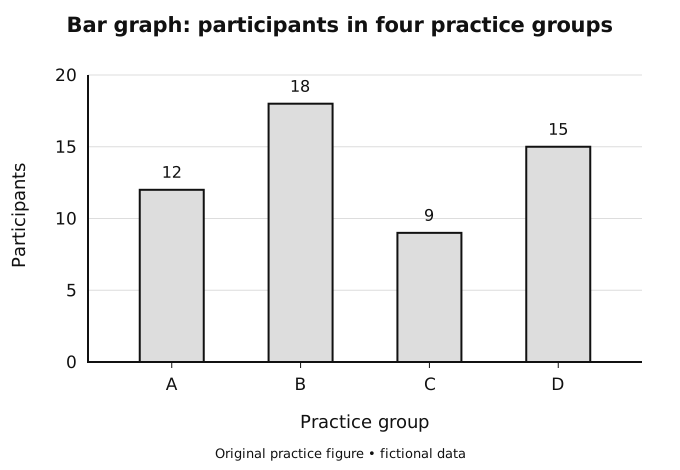
Figure: Bar graph: participants in four practice groups (use for Question 59)
Bar graph: group A has 12 participants, B 18, C 9, and D 15.
Participants in four practice groups (fictional data)
Group
Participants
A
12
B
18
C
9
D
15
Question 59
Math · Measurement and Data · M.2.1 · Hot spot (lettered-region practice)
Select the bar for the group that had exactly 3 fewer participants than Group D.
A. Bar A
B. Bar B
C. Bar C
D. Bar D
Show answer and explanation
Answer: A. Group D has 15 participants. 15 − 3 = 12, which is Group A.
Why the other choices are wrong
B. Group B has 18, which is 3 more than Group D.
C. Group C has 9, which is 6 fewer.
D. This is Group D itself.
Remember: Read the reference value first (here, Group D), then do the arithmetic, then find the matching bar.
Where to look: Graph values: D = 15, A = 12.
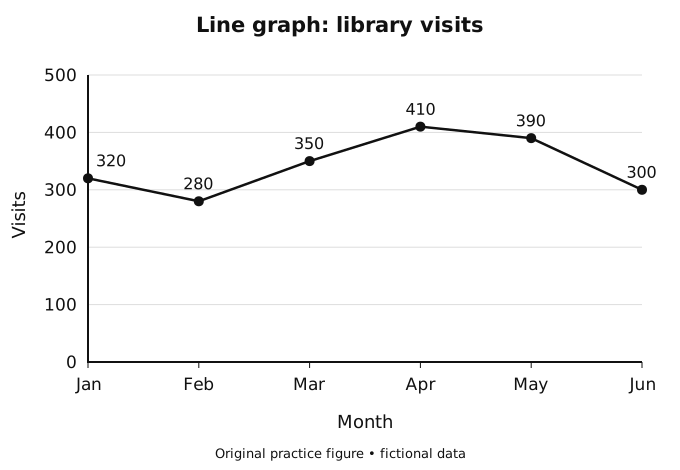
Data: Line graph: library visits (use for Question 60)
Line graph: Jan 320 visits, Feb 280, Mar 350, Apr 410, May 390, Jun 300.
Monthly library visits (fictional data)
Month
Jan
Feb
Mar
Apr
May
Jun
Visits
320
280
350
410
390
300
Question 60
Math · Measurement and Data · M.2.1 · Multiple choice
Between which two consecutive months did library visits increase the most?
A. January to February
B. February to March
C. March to April
D. April to May
Show answer and explanation
Answer: B. Changes: Jan→Feb −40, Feb→Mar +70, Mar→Apr +60, Apr→May −20. The largest increase is +70, February to March.
Why the other choices are wrong
A. Visits fell by 40.
C. April is the highest month, but the rise into it (+60) is smaller than February to March.
D. Visits fell by 20.
Remember: "Increased the most" asks about the steepest upward step, not the highest point.
Check: month-to-month changes are −40, +70, +60, −20, −90.
Question 61
Math · Measurement and Data · M.2.2 · Multiple choice
A student's five quiz scores are 78, 85, 92, 70, and 85. What is the mean score?
A. 85
B. 82
C. 22
D. 102.5
Show answer and explanation
Answer: B. Mean = sum ÷ count = (78 + 85 + 92 + 70 + 85) ÷ 5 = 410 ÷ 5 = 82.
Why the other choices are wrong
A. 85 is both the median and the mode, not the mean.
C. 22 is the range (92 − 70).
D. This divides by 4 instead of 5.
Remember: Mean, median, mode, and range are all different. Know which one the question asks for.
Math · Measurement and Data · M.2.2 · Supply answer
A clinic recorded these wait times, in minutes, for six patients: 19, 11, 24, 15, 12, 17. What is the median wait time in minutes? Type the number only.
Your answer: ________
Show answer and explanation
Answer: 16 Put the values in order: 11, 12, 15, 17, 19, 24. With six values there are two middle numbers, 15 and 17. The median is their average: (15 + 17) ÷ 2 = 16.
Common mistakes: Common slips: taking the middle of the unsorted list (24 and 15), or choosing just one of the two middle values.
Remember: Sort first, always. With an even number of values, average the middle two.
Math · Measurement and Data · M.2.2 · Multiple select
The numbers of books read last month by seven book-club members are 2, 3, 3, 5, 6, 8, and 15. Which statements are true? Select all that apply.
A. The mode is 3.
B. The median is 5.
C. The mean is 5.
D. The range is 13.
E. The mean is less than the median.
F. Removing the 15 would raise the mean.
Show answer and explanation
Answers: A, B, D. Mode: 3 appears twice (A true). Median: the middle of seven sorted values is the 4th, which is 5 (B true). Range: 15 − 2 = 13 (D true).
Why the other choices are wrong
C. The mean is 42 ÷ 7 = 6, not 5.
E. The mean (6) is greater than the median (5), because the 15 pulls the mean up.
F. Removing the largest value would lower the mean, to 27 ÷ 6 = 4.5.
Remember: An unusually large value pulls the mean toward it but barely moves the median.
Math · Measurement and Data · M.2.2 · Multiple choice
A small office has six salaries: $41,000, $43,000, $44,000, $46,000, $47,000, and the owner's $210,000. Which statement is true?
A. The median, $45,000, better describes a typical salary, because the $210,000 value pulls the mean up.
B. The mean, about $71,800, best describes a typical salary.
C. The owner's salary affects the median more than the mean.
D. The mean and median are equal.
Show answer and explanation
Answer: A. Mean: $431,000 ÷ 6 ≈ $71,833. Median: the average of the 3rd and 4th values, ($44,000 + $46,000) ÷ 2 = $45,000. Five of six salaries sit near $45,000, so the median describes a typical salary better.
Why the other choices are wrong
B. The mean is higher than five of the six salaries, so it isn't typical.
C. It's the reverse. An outlier moves the mean much more than the median.
D. They differ by almost $27,000.
Remember: When one value is far from the rest, the median usually describes the typical case better than the mean.
Math · Measurement and Data · M.2.3 · Multiple choice
A student uses the number of hours she studies each week to predict her weekly quiz score. Which is the independent (explanatory) variable?
A. The number of hours studied each week
B. The weekly quiz score
C. The number of quizzes taken
D. The student
Show answer and explanation
Answer: A. Hours studied is the input, or explanatory variable; the quiz score is the response being predicted. Calling hours the independent variable in this model does not establish that study time alone causes the score.
Why the other choices are wrong
B. The score is the response being predicted, so it is the dependent variable in this model.
C. The number of quizzes isn't one of the two variables being compared.
D. The student is the person studied, not a variable.
Remember: In a prediction model, identify the input and the response being predicted. Do not confuse prediction with proof of cause and effect.
Math · Measurement and Data · M.2.4 · Multiple choice
A garden bed is shaped like a 12 ft by 5 ft rectangle with a right triangle attached along one 5 ft side. The triangle's two legs are 5 ft and 4 ft. What is the total area of the bed?
A. 60 square feet
B. 80 square feet
C. 34 feet
D. 70 square feet
Show answer and explanation
Answer: D. Rectangle: 12 × 5 = 60 sq ft. Right triangle: ½ × 5 × 4 = 10 sq ft. Total: 60 + 10 = 70 sq ft.
Why the other choices are wrong
A. This counts only the rectangle.
B. This forgets the ½ in the triangle formula (5 × 4 = 20).
C. This is the rectangle's perimeter, and area uses square units.
Remember: Split a composite shape into simple pieces, find each area, then add. Area is always in square units.
Math · Measurement and Data · M.2.5 · Supply answer
A patient's weight is recorded as 154 pounds. Using 1 kilogram ≈ 2.2 pounds, what is the patient's weight in kilograms? Type a whole number.
Your answer: ________ kg
Show answer and explanation
Answer: 70 (kg) A kilogram is heavier than a pound, so the number of kilograms must be smaller than the number of pounds. Divide: 154 ÷ 2.2 = 70.
Common mistakes: Common wrong paths: 338.8 (multiplying instead of dividing; the number can't grow when the unit gets bigger), and 60.6 (dividing by 2.54, the inch-to-centimeter factor). Check: using the exact definition, 1 lb = 0.453 592 37 kg, 154 lb ≈ 69.85 kg, which still rounds to 70.
Remember: Before calculating, predict whether the answer should get bigger or smaller.
Science · Questions 74–117 · Optional average-pace target for these 44 questions: 52:48. On test day, an optional 10-minute break comes right before this section.
Question 74
Science · Human Anatomy and Physiology · S.1.1 · Multiple choice
Using standard anatomical terms, which word correctly describes the location of the wrist compared with the elbow?
A. Proximal
B. Superior
C. Distal
D. Deep
Show answer and explanation
Answer: C.Distal means farther from the point where a limb attaches to the trunk. The wrist is farther from the shoulder than the elbow is, so the wrist is distal to the elbow.
Why the other choices are wrong
A.Proximal means closer to the trunk. The elbow is proximal to the wrist, not the other way around.
B.Superior means above. With the arms at the sides, the wrist is below the elbow.
D.Deep describes distance from the body surface, not position along a limb.
Remember: For limbs, think "proximal = close to the attachment, distal = distant from it."
Science · Human Anatomy and Physiology · S.1.2 · Multiple choice
During a normal breath in (inspiration), what does the diaphragm do?
A. It relaxes and moves upward, making the chest cavity larger.
B. It contracts and moves upward, making the chest cavity smaller.
C. It contracts and moves downward, making the chest cavity larger.
D. It relaxes, which pushes air into the lungs.
Show answer and explanation
Answer: C. When the diaphragm contracts, it moves down toward the abdomen and enlarges the chest cavity. The larger space lowers pressure in the lungs, so air flows in.
Why the other choices are wrong
A. Relaxing moves the diaphragm up and shrinks the chest cavity. That's breathing out.
B. Contraction moves the diaphragm down, not up.
D. Air isn't pushed in. It flows in because pressure in the lungs drops.
Remember: Breathing in: muscles contract, space gets bigger, pressure drops, air flows in.
Science · Human Anatomy and Physiology · S.1.3 · Ordered response
Put these structures in the order blood passes through them, starting with blood that has just returned from the body.
Items to order:
A. Pulmonary trunk
B. Right atrium
C. Right ventricle
D. Tricuspid valve
E. Pulmonary valve
Show answer and explanation
Correct order: B → D → C → E → A. Blood from the body enters the right atrium. It crosses the tricuspid valve into the right ventricle. The right ventricle pumps it through the pulmonary valve into the pulmonary trunk, which carries it toward the lungs.
Common mistakes: Common errors: putting the pulmonary valve before the right ventricle (a valve sits between the structures it separates), or confusing the tricuspid valve (right side) with the mitral valve (left side).
Remember: Each side of the heart runs atrium → atrioventricular valve → ventricle → semilunar valve → artery.
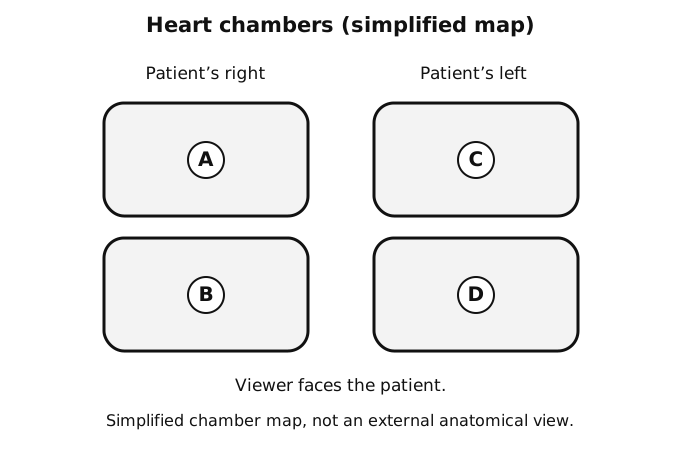
Figure: Heart chambers (simplified map) (use for Question 79)
Simplified two-by-two chamber map, not an external anatomical view. Patient's right is on the viewer's left: A upper left, B lower left, C upper right, D lower right.
Figure: a simplified chamber map, not a literal external view of the heart. The patient's right side is on the viewer's left. Four chambers are lettered:
Region A: upper chamber on the viewer's left
Region B: lower chamber on the viewer's left
Region C: upper chamber on the viewer's right
Region D: lower chamber on the viewer's right
Question 79
Science · Human Anatomy and Physiology · S.1.3 · Hot spot (lettered-region practice)
Select the chamber that pumps oxygen-rich blood into the aorta.
A. Region A
B. Region B
C. Region C
D. Region D
Show answer and explanation
Answer: D. Oxygen-rich blood returns from the lungs to the left atrium, passes to the left ventricle, and the left ventricle pumps it into the aorta. In this simplified chamber map, the patient's left side is on your right, so the left ventricle is the lower chamber on the viewer's right (Region D).
Why the other choices are wrong
A. This is the right atrium, which receives oxygen-poor blood from the body.
B. This is the right ventricle, which pumps blood to the lungs.
C. This is the left atrium. It receives oxygen-rich blood but sends it to the ventricle, not the aorta.
Remember: On any anatomy diagram, find the "patient's left/right" orientation before you choose.
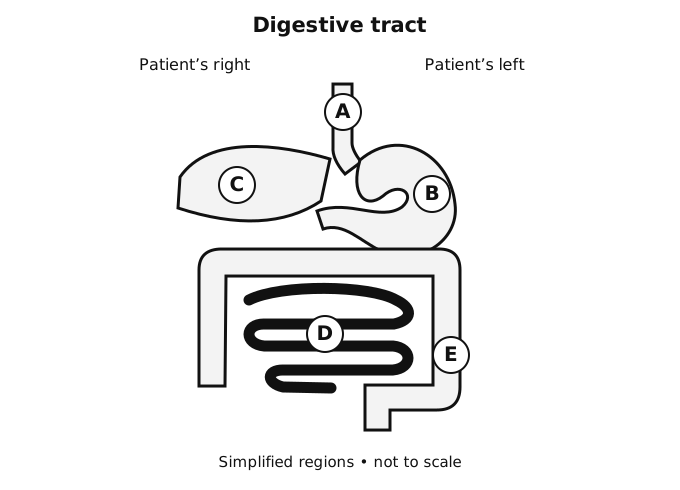
Simplified digestive-region diagram. A is a tube through the chest; B a J-shaped pouch below the diaphragm on the patient's left; C a large upper-right abdominal organ; D central coils; E a wider tube framing the coils.
Figure: a simple outline of the digestive tract with five lettered regions:
Region A: tube running down from the throat through the chest
Region B: J-shaped pouch just below the diaphragm, on the patient's left
Region C: large organ in the upper right of the abdomen
Region D: long, coiled tube filling the center of the abdomen
Region E: wider tube that frames the coils on three sides
Question 80
Science · Human Anatomy and Physiology · S.1.4 · Hot spot (lettered-region practice)
Select the organ where almost all absorption of nutrients from digested food takes place.
A. Region A
B. Region B
C. Region C
D. Region D
E. Region E
Show answer and explanation
Answer: D. The small intestine (the long, coiled tube, Region D) is the site of most chemical digestion and almost all absorption.
Why the other choices are wrong
A. The esophagus carries food to the stomach. It doesn't absorb nutrients.
B. The stomach mixes and partly digests food, but it isn't the main absorption site.
C. The liver is an accessory organ. Food doesn't pass through it.
E. The large intestine finishes absorbing water and forms feces. Most nutrients are already absorbed by then.
Remember: "Small" refers to the small intestine's diameter. It's the longest part of the digestive tract, and that's where absorption happens.
Science · Human Anatomy and Physiology · S.1.5 · Multiple select
Which responses are typical when the sympathetic ("fight-or-flight") division of the nervous system is activated? Select all that apply.
A. Heart rate increases.
B. Pupils dilate.
C. The airways (bronchi) dilate.
D. Digestive activity increases.
E. Heart rate slows.
Show answer and explanation
Answers: A, B, C. Fight-or-flight readies the body for action: the heart speeds up, the pupils widen to take in more light, and the airways open for more air.
Why the other choices are wrong
D. Digestion slows during sympathetic activity. "Rest and digest" is the parasympathetic division.
E. Slowing the heart is a parasympathetic effect.
Remember: Sort each effect by asking whether it would help you run or fight right now.
Science · Human Anatomy and Physiology · S.1.7 · Multiple choice
Where does fertilization of an egg by a sperm usually take place?
A. In the uterus
B. In the uterine (fallopian) tube
C. In the ovary
D. In the cervix
Show answer and explanation
Answer: B. Fertilization usually happens in the uterine tube, most often in its wide middle section (the ampulla), while the egg is moving toward the uterus.
Why the other choices are wrong
A. The uterus is where an embryo implants after fertilization.
C. The ovary releases the egg; fertilization happens after the egg leaves it.
Science · Human Anatomy and Physiology · S.1.9 · Multiple choice
After a meal raises blood glucose, which hormone does the pancreas release to help lower it?
A. Glucagon
B. Epinephrine
C. Insulin
D. Calcitonin
Show answer and explanation
Answer: C. Beta cells in the pancreas release insulin as blood glucose rises. Insulin helps cells take up and use glucose, which lowers the blood level.
Why the other choices are wrong
A. Glucagon (from alpha cells) raises blood glucose.
B. Epinephrine is an adrenal hormone involved in fight-or-flight.
D. Calcitonin comes from the thyroid and lowers blood calcium.
Remember: Insulin lets glucose in to cells; glucagon helps raise blood glucose when it is low.
Science · Human Anatomy and Physiology · S.1.9 · Multiple choice
When blood levels of thyroid hormones rise above normal, what typically happens to the release of thyroid-stimulating hormone (TSH)?
A. It stops permanently.
B. It stays the same.
C. It decreases.
D. It increases.
Show answer and explanation
Answer: C. Thyroid hormone levels are controlled by negative feedback. Rising T3 and T4 reduce TSH production, which brings thyroid hormone levels back down.
Why the other choices are wrong
A. Feedback adjusts TSH; it doesn't shut it off permanently.
B. The whole point of feedback is that TSH responds.
D. More TSH would push thyroid hormones even higher. That's the opposite of negative feedback.
Remember: Negative feedback means the output turns down its own signal.
Science · Human Anatomy and Physiology · S.1.10 · Multiple choice
Which pairing correctly matches a urinary structure with its main job?
A. Glomerulus: filters blood to form filtrate
B. Renal tubule: stores urine until urination
C. Urinary bladder: filters wastes out of the blood
D. Ureter: returns water to the blood
Show answer and explanation
Answer: A. The glomerulus is a capillary bed that filters blood. The filtrate then moves through the nephron's tubules, where most of it is reabsorbed.
Why the other choices are wrong
B. The bladder stores urine. Tubules reabsorb and adjust the filtrate.
C. The bladder stores urine; it doesn't filter blood.
D. Ureters carry urine to the bladder; they don't return water to the blood.
Science · Human Anatomy and Physiology · S.1.10 · Ordered response
Put these structures in the order urine passes through them.
Items to order:
A. Urinary bladder
B. Urethra
C. Kidney
D. Ureter
Show answer and explanation
Correct order: C → D → A → B. Urine forms in the kidney, travels down the ureter to the urinary bladder for storage, and leaves the body through the urethra.
Common mistakes: The most common mix-up is ureter vs. urethra. The ureter comes first (kidney to bladder); the urethra comes last (bladder to outside).
Remember: Ureter has two e's and there are two ureters, one from each kidney. The urethra is the single exit.
Science · Human Anatomy and Physiology · S.1.11 · Multiple select
Which statements describe the adaptive (specific) immune response? Select all that apply.
A. Activated B cells can become plasma cells that secrete antibodies.
B. It targets specific antigens.
C. It can produce memory cells that respond faster to a later exposure.
D. Intact skin is one of its main defenses.
E. It responds the same way to every pathogen.
Show answer and explanation
Answers: A, B, C. Adaptive immunity is specific (B), uses B cells that become antibody-secreting plasma cells (A), and forms memory cells that give a stronger, faster secondary response (C).
Why the other choices are wrong
D. Skin is a barrier defense, part of innate immunity.
E. An identical response to every pathogen is not antigen specificity. Adaptive cells recognize particular antigens; innate responses are not literally identical to every pathogen either.
Remember: Adaptive immunity is specific and has memory. Innate immunity is general and immediate.
A red blood cell is placed in a solution with a much higher concentration of solutes that cannot cross its membrane than in its own cytoplasm (a hypertonic solution). What will most likely happen?
A. Water will enter the cell, and the cell may burst.
B. Water will leave the cell, and the cell will shrink.
C. There will be no net movement of water.
D. Solutes will leave the cell by osmosis.
Show answer and explanation
Answer: B. In a hypertonic solution, water moves out of the cell toward the higher concentration of nonpenetrating solutes, so the cell shrinks.
Why the other choices are wrong
A. This happens in a hypotonic solution.
C. This happens in an isotonic solution.
D. Osmosis is the movement of water, not solutes.
Remember: For this cell, net water movement is toward the side with more solute that cannot cross the membrane.
A section of a DNA template strand is written 3′-TACGGA-5′. Which mRNA sequence is made from it, written 5′ to 3′?
A. AUGCCU
B. ATGCCT
C. UACGGA
D. TUCGGA
Show answer and explanation
Answer: A. mRNA pairs with the template: T→A, A→U, C→G, G→C. The template is read 3′ to 5′ as RNA is made 5′ to 3′, so 3′-TACGGA-5′ produces 5′-AUGCCU-3′. RNA uses uracil (U) where DNA would have thymine (T).
Why the other choices are wrong
B. This is the DNA complement. mRNA uses U instead of T.
C. This copies the template instead of pairing with it.
D. This mixes copying and pairing, and RNA contains no T.
In a fictional plant, allele P (purple flowers) is dominant over allele p (white flowers). A heterozygous purple plant (Pp) is crossed with a white plant (pp). What is the probability that an offspring has white flowers?
A. 0
B. 1/4
C. 1/2
D. 3/4
Show answer and explanation
Answer: C. Punnett square: the Pp parent gives P or p; the pp parent gives only p. The four equally likely combinations are Pp, Pp, pp, pp. Two of four are pp (white): 2/4 = 1/2.
Why the other choices are wrong
A. The white parent always passes p, so white offspring are possible.
B. 1/4 is the white fraction for a Pp × Pp cross, not Pp × pp.
D. 3/4 is the purple fraction for a Pp × Pp cross.
Remember: Draw the 2 × 2 square every time. It makes the possible allele combinations visible.
Using the same fictional plant (P = purple, dominant; p = white), which pair of plants has the same phenotype but different genotypes?
A. PP and pp
B. Pp and pp
C. pp and pp
D. PP and Pp
Show answer and explanation
Answer: D. PP and Pp both have at least one dominant P, so both look purple (same phenotype), but their allele combinations differ (different genotypes).
Why the other choices are wrong
A. Different genotypes and different phenotypes (purple vs white).
B. Different genotypes and different phenotypes.
C. Same genotype and same phenotype.
Remember: Genotype = the letters. Phenotype = what you see.
A neutral atom has an atomic number of 13 and a mass number of 27. How many protons, neutrons, and electrons does it have?
A. 13 protons, 27 neutrons, 13 electrons
B. 14 protons, 13 neutrons, 14 electrons
C. 13 protons, 14 neutrons, 14 electrons
D. 13 protons, 14 neutrons, 13 electrons
Show answer and explanation
Answer: D. The atomic number gives the protons: 13. Neutrons = mass number − atomic number = 27 − 13 = 14. A neutral atom has as many electrons as protons: 13.
Why the other choices are wrong
A. The mass number counts protons plus neutrons, so neutrons can't be 27.
B. This swaps protons and neutrons.
C. A neutral atom's electrons equal its protons.
Remember: Z = protons. A − Z = neutrons. Neutral means electrons = protons.
Data: Paper-towel absorbency test (use for Questions 111–112)
Classroom investigation (fictional data)
A student compared two brands of paper towel. She cut sheets of equal area, dipped each sheet in water for 30 seconds, let it drip for 30 seconds, and calculated the water absorbed as wet mass minus dry mass. She tested five new sheets of each brand.
In one town, weeks with more umbrella sales also have more minor traffic accidents. Which interpretation is best supported by this association?
A. Buying umbrellas causes people to drive carelessly.
B. Car accidents make people want umbrellas.
C. The two can't be related, because umbrellas and cars have nothing in common.
D. A third factor, such as rainy weather, could affect both; the association does not establish that either one causes the other.
Show answer and explanation
Answer: D. Rain is one possible common factor, but these data do not establish the cause of either increase. Two things rising together doesn't show that one causes the other.
Why the other choices are wrong
A. This assumes causation from a correlation alone.
B. This reverses the causation with no support.
C. They clearly are related in the data; the question is why.
Remember: When two things move together, look for a hidden third factor before assuming cause and effect.
If the trend shown continues, what is the most reasonable prediction for this enzyme's activity at 50 °C?
A. About 36, because enzymes always work best when heated
B. Higher than 36
C. Lower than 15
D. Exactly the same as at 20 °C
Show answer and explanation
Answer: C. Activity peaks at 35 °C and then falls: 30 at 40 °C, 15 at 45 °C. Continuing that downward trend puts 50 °C below 15. High temperatures can change a protein's shape (denaturation) and reduce its function.
Why the other choices are wrong
A. The data show activity falling above 35 °C.
B. Nothing in the trend points upward past 35 °C.
D. No data support an exact match to the 20 °C value.
Remember: Extend the most recent part of a trend, not the part you like best.
In a pond, algae are eaten by snails, snails are eaten by sunfish, and sunfish are eaten by herons. Using only these feeding relationships and assuming other conditions stay the same, if a disease sharply reduces the snail population, what is the most likely short-term result?
A. Algae decrease and sunfish increase.
B. Algae increase and sunfish decrease.
C. Herons increase.
D. No other populations change.
Show answer and explanation
Answer: B. With fewer snails eating them, algae can grow. With fewer snails to eat, the sunfish lose food and are likely to decline.
Why the other choices are wrong
A. This reverses both effects.
C. If sunfish decline, herons have less food, not more.
D. Organisms in a food chain depend on each other, so a big drop in one affects its neighbors.
Remember: Trace one link at a time: what did the lost population eat, and what ate it?
Where to look: the food chain given in the question.
A student tests whether a fertilizer increases bean-plant height. Group 1 gets fertilizer. Group 2 gets none but has the same soil, water, and light. What is the purpose of Group 2?
A. It doubles the amount of data.
B. It gives a baseline for comparing plants with and without the fertilizer.
C. It tests a second fertilizer.
D. It makes sure every plant grows.
Show answer and explanation
Answer: B. A control group provides the comparison without the factor being tested. Here, the unfertilized group helps the student assess whether fertilizer is associated with a difference in height under otherwise matched conditions.
Why the other choices are wrong
A. Its job is comparison, not just more data.
C. Group 2 gets no fertilizer at all.
D. A control can't guarantee growth; it gives a comparison.
Remember: For this experiment, compare plants with and without fertilizer while keeping the other relevant conditions matched.
A student wants to know whether water temperature affects how fast sugar dissolves. In her first trial, the warm-water cup had more water and was stirred more than the cold-water cup. What is the best way to fix the design?
A. Stir the warm cup even more, so the difference is easier to see.
B. Test only warm water, since it will obviously be faster.
C. Use more sugar in the cold cup to make the test fair.
D. Keep the water volume, amount of sugar, and stirring the same, and change only the temperature.
Show answer and explanation
Answer: D. Water volume and stirring were also different, so any difference in dissolving time could come from them, not from temperature. Holding everything constant except temperature makes it a fair test.
Why the other choices are wrong
A. Adding more stirring adds another difference instead of removing one.
B. With only one temperature, there's nothing to compare.
C. Changing sugar amount adds a new variable.
Remember: For this single-variable experiment, change temperature while keeping the other relevant conditions the same.
English and Language Usage · Conventions of Standard English · E.1.1 · Multiple choice
Choose the word that correctly completes the sentence: The students left ________ coats in the hallway.
A. there
B. their
C. they're
D. thier
Show answer and explanation
Answer: B.Their shows possession: the coats belong to the students.
Why the other choices are wrong
A.There refers to a place.
C.They're means "they are."
D.Thier is a misspelling.
Remember: Homophones sound the same but have different jobs: their (owning), there (place), they're (they are). A correctly spelled word can still be the wrong word here.
English and Language Usage · Conventions of Standard English · E.1.1 · Multiple select
Which words are spelled correctly in standard American English? Select all that apply.
A. preferred
B. regretted
C. stopping
D. targetted
E. commited
F. occured
Show answer and explanation
Answers: A, B, C. For the words here, double the final consonant before a suffix that starts with a vowel when the word ends in one vowel plus one consonant and is either one syllable (stop → stopping) or stressed on the last syllable (pre-FER → preferred, re-GRET → regretted). Final w, x, and y are not doubled under this rule.
Why the other choices are wrong
D.Target is stressed on the first syllable (TAR-get), so no doubling: targeted.
E.Commit is stressed on the last syllable (com-MIT), so the t doubles: committed.
F.Occur is stressed on the last syllable (oc-CUR), so the r doubles: occurred.
Remember: Check the spelling and stress: stopping, preferred, and regretted double the final consonant; targeted does not. Final w, x, and y do not double before -ed or -ing.
English and Language Usage · Conventions of Standard English · E.1.2 · Multiple choice
Which sentence uses a semicolon correctly?
A. Because the clinic opens at seven; the pharmacy opens later.
B. The clinic; opens at seven every morning.
C. Bring three items; gauze, tape, and gloves.
D. The clinic opens at seven; the pharmacy opens at nine.
Show answer and explanation
Answer: D. A semicolon joins two closely related independent clauses. "The clinic opens at seven" and "the pharmacy opens at nine" could each stand alone.
Why the other choices are wrong
A. "Because the clinic opens at seven" is a dependent clause, which needs a comma, not a semicolon.
B. The semicolon splits a subject from its verb.
C. A list introduced by a complete sentence takes a colon.
Remember: Semicolon test: can the words on both sides stand alone as sentences?
English and Language Usage · Conventions of Standard English · E.1.3 · Multiple choice
Which sentence is a complex sentence (one independent clause plus at least one dependent clause)?
A. The bus was late, and Rosa ran to class.
B. Although the bus was late, Rosa reached class on time.
C. Rosa ran to class.
D. The bus was late; Rosa ran to class.
Show answer and explanation
Answer: B. "Although the bus was late" is a dependent clause; it can't stand alone. "Rosa reached class on time" is independent. One of each makes a complex sentence.
Why the other choices are wrong
A. Two independent clauses joined by and: a compound sentence.
C. One independent clause: a simple sentence.
D. Two independent clauses joined by a semicolon: a compound sentence.
Remember: Complex sentences usually contain a subordinating word such as although, because, when, or if.
English and Language Usage · Conventions of Standard English · E.1.3 · Multiple select
Which of the following are complete sentences? Select all that apply.
A. The results arrived this morning.
B. Because the results arrived late.
C. After the meeting ended, everyone left quickly.
D. Running down the hallway to catch the elevator.
E. The nurse who trained the new volunteers.
Show answer and explanation
Answers: A, C. A and C each have a subject and a complete verb and express a complete thought. C begins with a dependent clause, but the main clause "everyone left quickly" completes it.
Why the other choices are wrong
B. A dependent clause standing alone is a fragment.
D. A phrase with no subject and no complete verb is a fragment.
E. "Who trained the new volunteers" describes the nurse, but the noun phrase still lacks the main-clause verb needed for a complete sentence.
Remember: Read each option alone, out loud. If it leaves you waiting for more, it's a fragment.
English and Language Usage · Conventions of Standard English · E.1.3 · Multiple choice
Which revision combines these sentences into one correct complex sentence that keeps the cause and effect? Kim missed the bus. She was late for her exam.
A. Kim missed the bus, she was late for her exam.
B. Because Kim missed the bus. She was late for her exam.
C. Kim missed the bus because she was late for her exam.
D. Because Kim missed the bus, she was late for her exam.
Show answer and explanation
Answer: D.Because turns the first sentence into a dependent clause that states the cause, and a comma links it to the main clause.
Why the other choices are wrong
A. This is a comma splice.
B. "Because Kim missed the bus." is now a fragment.
C. This reverses the cause: it says being late made her miss the bus.
Remember: When combining, make sure the logic survives, not just the grammar.
English and Language Usage · Knowledge of Language · E.2.2 · Multiple choice
A library flyer for the public reads: Patrons are advised to refrain from the consumption of food or beverages within the confines of the reading room. Which revision best suits a general audience?
A. Please don't eat or drink in the reading room.
B. Patrons shall refrain from ingesting comestibles in the reading room.
C. NO FOOD!!!
D. It is recommended that consumption be avoided in the reading-room area.
Show answer and explanation
Answer: A. The correct revision keeps the full message (no food or drink, in the reading room) in short, everyday words.
Why the other choices are wrong
B. Still stiff and full of uncommon words.
C. Too abrupt, and it leaves out drinks.
D. Wordy, passive, and vague about what shouldn't be consumed.
Remember: Plain language means short, familiar words that keep the whole meaning.
English and Language Usage · Knowledge of Language · E.2.3 · Multiple choice
Which sentence would make the best topic sentence for this paragraph? ________. First, walking to work saves money on gas and parking. It also builds exercise into a busy day. Finally, many walkers say the quiet time helps them plan their work.
A. Walking to work has several practical benefits.
B. Gas prices have risen in recent years.
C. Some people prefer to drive to work.
D. Exercise is important for heart health.
Show answer and explanation
Answer: A. Every supporting sentence names a benefit of walking to work. A states that main idea.
Why the other choices are wrong
B. Too narrow: it covers only the money point.
C. Off topic: the paragraph is about walking.
D. Too narrow and too general at once: it covers one point and isn't about walking to work.
Remember: A topic sentence should cover every detail in the paragraph, not just one of them.
English and Language Usage · Knowledge of Language · E.2.3 · Multiple choice
Choose the transition that best connects the sentences: The morning session filled within an hour. ________, the evening session still had open seats a week later.
A. As a result
B. For example
C. Therefore
D. In contrast
Show answer and explanation
Answer: D. The sentences contrast two sessions: one filled fast, and the other didn't. In contrast signals that difference.
Why the other choices are wrong
A. The sentences show a contrast, not an established cause-and-effect relationship.
B. The second sentence isn't an example of the first.
C.Therefore signals a conclusion, not a contrast.
Remember: Name the relationship first (contrast, cause, example, addition), then pick the transition that signals it.
English and Language Usage · Knowledge of Language · E.2.3 · Ordered response
Put these sentences in the order that makes the most logical paragraph.
Items to order:
A. During that trial, evening visits averaged 140 per night.
B. Based on those numbers, the board made the later hours permanent.
C. Last fall, students at Ridgeview College complained that the library closed at 6 p.m.
D. In response, the library board extended weekday hours to 10 p.m. as a one-semester trial.
Show answer and explanation
Correct order: C → D → A → B. C states the problem. D responds to it ("In response"). A refers back to the trial ("During that trial"). B refers back to the numbers ("those numbers") and concludes.
Common mistakes: Each sentence after the first begins with a phrase that points back to something earlier: In response, that trial, those numbers. Any other order leaves one of those phrases pointing at nothing.
Remember: In this paragraph, place each backward reference (that trial, those numbers, in response) after the event or detail it refers to.
English and Language Usage · Using Language and Vocabulary to Express Ideas in Writing · E.3.1 · Multiple choice
A writer has finished organizing her essay and is happy with its ideas and evidence. She now reads it line by line to catch typos, misspellings, and missing punctuation. Which stage of the writing process is she in?
A. Prewriting
B. Drafting
C. Revising
D. Proofreading
Show answer and explanation
Answer: D. Proofreading is the final search for surface errors (spelling, punctuation, typos) after the content and organization are settled.
Why the other choices are wrong
A. Prewriting is generating and planning ideas.
B. Drafting is getting the ideas down in sentences and paragraphs.
C. Revising reworks content and organization, which she has already finished.
Remember: Revise the ideas first; proofread the surface last.
English and Language Usage · Using Language and Vocabulary to Express Ideas in Writing · E.3.1 · Multiple select
A writer is revising a draft for content and organization before proofreading it for surface errors. Which tasks belong to this revision stage? Select all that apply.
A. Moving paragraphs so the ideas build logically
B. Adding evidence to support a weak claim
C. Correcting the spelling of recieve
D. Deleting a paragraph that doesn't support the main point
E. Adding a missing comma after an introductory clause
Show answer and explanation
Answers: A, B, D. Reorganizing (A), adding needed evidence (B), and cutting ideas that don't fit the main point (D) all change content or organization.
Why the other choices are wrong
C. Fixing a misspelling is proofreading.
E. Adding a comma is proofreading.
Remember: If the change would matter even with perfect spelling and punctuation, it's revision.
English and Language Usage · Using Language and Vocabulary to Express Ideas in Writing · E.3.1 · Multiple choice
Which is the strongest thesis statement for an essay about hospital volunteer programs?
A. This essay is about hospital volunteers.
B. Hospital volunteer programs help patients by easing loneliness, help volunteers by building job skills, and help staff by freeing time for clinical work.
C. Many hospitals have volunteers.
D. Are hospital volunteer programs a good idea?
Show answer and explanation
Answer: B. The strongest thesis makes a clear, specific claim and previews the three points the essay will develop.
Why the other choices are wrong
A. Announces the topic but makes no claim.
C. Too general: it does not state what the essay will explain about hospital volunteer programs.
D. A question, not a position.
Remember: A strong thesis gives the essay a clear, specific main point and indicates how the essay will develop it.
English and Language Usage · Using Language and Vocabulary to Express Ideas in Writing · E.3.1 · Multiple choice
A student argues that her campus should add a late-night shuttle. Which sentence gives the most relevant support?
A. Many students enjoy riding the bus.
B. Campus security logged 62 requests for late-night escorts last semester, most from students leaving the library after 10 p.m.
C. The campus was founded in 1968.
D. The shuttles are painted in school colors.
Show answer and explanation
Answer: B. The correct sentence is specific evidence that students need safe late-night transportation, which is exactly what the shuttle would provide.
Why the other choices are wrong
A. Vague, and not about late-night need.
C. Irrelevant history.
D. Irrelevant detail.
Remember: Relevant evidence speaks directly to the claim. Interesting-but-unrelated facts weaken an argument.
English and Language Usage · Using Language and Vocabulary to Express Ideas in Writing · E.3.1 · Ordered response
Put these steps for writing a short report in a logical order.
Items to order:
A. Revise the draft's organization and evidence
B. Brainstorm ideas
C. Proofread for spelling and punctuation
D. Write a first draft
Show answer and explanation
Correct order: B → D → A → C. Generate ideas first, then draft. Revise the big-picture content next, and proofread last so you aren't polishing sentences you might cut.
Common mistakes: Writers often go back and forth between stages, but you can't revise a draft that doesn't exist, and proofreading before revising wastes effort on text that may change.
Remember: Big to small: ideas, draft, content and organization, surface errors.
English and Language Usage · Using Language and Vocabulary to Express Ideas in Writing · E.3.2 · Multiple select
Which words contain a word part meaning "slow"? Select all that apply.
A. bradycardia
B. tachycardia
C. bradypnea
D. hypoglycemia
E. bradykinesia
F. hyperthermia
Show answer and explanation
Answers: A, C, E.Brady- means slow. Bradycardia is a slow heart rate (cardi- = heart), bradypnea is slow breathing (-pnea = breathing), and bradykinesia is slow movement (kinesi- = movement).
Why the other choices are wrong
B.Tachy- means fast.
D.Hypo- means under or deficient: a level, not a speed.
Count one point for each question you answered correctly on your first try. A multiple-select question counts only if you chose every correct answer and nothing else, and an ordered-response question counts only if the whole order is right. That's how ATI scores these formats too: there is no partial credit. If you opened an explanation before answering, don't count that question as correct.
Your percentage is your number correct ÷ 150 × 100. For each subject, divide by that subject's count (39, 34, 44, or 33).
Score by sub-area
Subject
Sub-area
Questions
Count
Your correct
Reading
Key Ideas and Details
1–3, 6, 8–13, 24, 30–32, 35
15
___
Reading
Craft and Structure
4–5, 14–16, 19, 23, 33–34
9
___
Reading
Integration of Knowledge and Ideas
7, 17–18, 20–22, 25–29, 36–39
15
___
Math
Number and Algebra
40–57
18
___
Math
Measurement and Data
58–73
16
___
Science
Human Anatomy and Physiology
74–91
18
___
Science
Biology
92–100
9
___
Science
Chemistry
101–108
8
___
Science
Scientific Reasoning
109–117
9
___
English and Language Usage
Conventions of Standard English
118–129
12
___
English and Language Usage
Knowledge of Language
130–140
11
___
English and Language Usage
Using Language and Vocabulary to Express Ideas in Writing
141–150
10
___
Show the full answer key
Question
Answer
Objective
Question
Answer
Objective
1
B
R.1.3
76
D
S.1.2
2
B
R.1.4
77
C
S.1.2
3
C
R.1.1
78
B→D→C→E→A
S.1.3
4
C
R.2.2
79
D
S.1.3
5
B
R.2.3
80
D
S.1.4
6
D
R.1.2
81
A
S.1.5
7
C
R.3.1
82
A, B, C
S.1.5
8
B
R.1.5
83
D
S.1.6
9
D
R.1.5
84
B
S.1.7
10
A, B, D
R.1.5
85
D
S.1.8
11
B→A→D→C→E
R.1.6
86
C
S.1.9
12
A
R.1.6
87
C
S.1.9
13
D
R.1.3
88
A
S.1.10
14
A, B, E
R.2.1
89
C→D→A→B
S.1.10
15
A
R.2.1
90
A, B, C
S.1.11
16
A
R.2.4
91
B
S.1.12
17
D
R.3.3
92
A
S.2.1
18
A
R.3.3
93
B
S.2.1
19
B
R.2.2
94
B
S.2.2
20
B
R.3.2
95
A
S.2.2
21
D
R.3.2
96
C
S.2.3
22
A, B
R.3.2
97
D
S.2.3
23
A
R.2.4
98
A, B, C
S.2.4
24
D
R.1.2
99
C
S.2.4
25
C
R.3.4
100
A
S.2.5
26
A
R.3.4
101
D
S.3.1
27
C
R.3.4
102
C
S.3.1
28
D
R.3.4
103
A, B
S.3.2
29
C
R.3.1
104
B
S.3.3
30
D
R.1.1
105
A
S.3.3
31
C
R.1.4
106
D
S.3.4
32
B
R.1.4
107
B
S.3.5
33
B
R.2.3
108
D
S.3.6
34
B
R.2.2
109
B
S.4.1
35
C
R.1.2
110
A
S.4.1
36
A
R.3.3
111
C
S.4.4
37
C
R.3.3
112
C
S.4.2
38
A
R.3.1
113
D
S.4.2
39
D
R.3.1
114
C
S.4.3
40
A
M.1.1
115
B
S.4.3
41
87.5
M.1.1
116
B
S.4.4
42
B
M.1.2
117
D
S.4.4
43
D
M.1.2
118
A
E.1.1
44
B→E→D→A→C
M.1.3
119
A
E.1.1
45
B
M.1.3
120
B
E.1.1
46
A
M.1.4
121
A, B, C
E.1.1
47
11
M.1.4
122
B
E.1.2
48
C
M.1.5
123
D
E.1.2
49
A
M.1.5
124
D
E.1.2
50
C
M.1.6
125
A
E.1.2
51
400
M.1.6
126
B
E.1.3
52
C
M.1.7
127
C
E.1.3
53
D
M.1.8
128
A, C
E.1.3
54
B
M.1.8
129
D
E.1.3
55
D
M.1.9
130
C
E.2.1
56
D
M.1.9
131
B
E.2.1
57
A
M.1.10
132
A
E.2.1
58
C
M.2.1
133
A
E.2.1
59
A
M.2.1
134
C
E.2.2
60
B
M.2.1
135
A
E.2.2
61
B
M.2.2
136
C
E.2.2
62
16
M.2.2
137
D
E.2.2
63
A, B, D
M.2.2
138
A
E.2.3
64
A
M.2.2
139
D
E.2.3
65
A
M.2.3
140
C→D→A→B
E.2.3
66
B
M.2.3
141
D
E.3.1
67
A
M.2.3
142
A, B, D
E.3.1
68
D
M.2.4
143
B
E.3.1
69
18.84
M.2.4
144
B
E.3.1
70
D
M.2.4
145
B→D→A→C
E.3.1
71
D
M.2.5
146
A
E.3.2
72
70
M.2.5
147
C
E.3.2
73
C
M.2.5
148
C
E.3.2
74
C
S.1.1
149
B
E.3.2
75
C
S.1.1
150
A, C, E
E.3.2
What your score means (and doesn't)
Your result is a raw percentage on Castleport's original questions. The real TEAS reports total and section scores that are equated — adjusted for differences between test forms — so no outside practice test can produce your official score, and we don't estimate one. Each sub-area result here rests on 8 to 18 questions. Treat it as a pointer to what to review, not a verdict.
There's also no single passing score to aim for. ATI says each nursing or allied health program sets its own requirement, so check the admissions page of every program you're applying to. If you need to retest, ATI itself has no waiting period between attempts, but your program may limit attempts or require a wait, and every TEAS at ATI attempt is recorded on your ATI transcript.
How this practice test compares with the real TEAS 7
This test matches the real exam's scored question counts by section and sub-area. It is not a full administration of the 170-question exam, and matching counts does not establish matching difficulty.
Real ATI TEAS 7
This practice test
Total questions
170: 150 scored plus 20 unscored pretest questions you can't identify
150, all scored
Reading
45 questions (39 scored), 55 minutes
39 questions
Math
38 questions (34 scored), 57 minutes
34 questions
Science
50 questions (44 scored), 60 minutes
44 questions
English and Language Usage
37 questions (33 scored), 37 minutes
33 questions
Testing time
209 minutes, each section timed separately, plus an optional 10-minute break after Math
3 hr 4 min 28 s as an optional average-pace target, if you time yourself
Question formats
Mostly four-option multiple choice; about 20% multiple select, supply answer, ordered response, or hot spot
30 of 150 (20%) in those four formats
Partial credit
None
None: score it the same way
Guessing
No penalty; unanswered questions count as wrong
Same advice: answer everything
Calculator
On computer exams, an on-screen basic calculator in every section; for paper testing, a calculator is provided. Personal calculators are not allowed
Use any basic calculator
Going back
Only within the section that's open
Anywhere on this page
Scores
Equated total and section scores; sub-area scores are raw percentages
Using Language and Vocabulary to Express Ideas in Writing
10
10
Every one of ATI's 64 published TEAS 7 objectives is represented in the item mapping. This does not mean every skill within a broad objective is tested exhaustively; the code under each question (such as R.1.3) matches the objective list in ATI's content outline. ATI's summary table calls the third English sub-area "Vocabulary Acquisition," while its detailed objective list and help pages use "Using Language and Vocabulary to Express Ideas in Writing." They're the same content.
How we set the exam pace
We divided each real section's time limit by its total question count, then multiplied by the number of questions in that section here. Reading, for example: (55 × 60 seconds ÷ 45 questions) × 39 = 2,860 seconds, or 47 minutes 40 seconds. Math works out to 90 seconds per question, Science to 72, and English to 60. These are average-rate practice targets, not a claim that our questions take the same time or have the same difficulty as ATI's. The 10-minute optional break is outside the testing-time calculation.
The five question formats
Multiple choice: four options, one correct answer. Most questions on the test.
Multiple select: five or six options with at least two correct. You need every correct option and no wrong ones. Try Questions 10, 14, and 22.
Supply answer: ATI may ask for text or a number; this set uses numeric answers. Follow any rounding or format instruction exactly. Try Questions 41, 47, and 51.
Ordered response: arrange four to six items in order. Try Questions 11, 44, and 78.
Hot spot: ATI asks you to select a region of an image. This set uses lettered regions in figures and a table as a static adaptation. Try Questions 9, 59, and 79.
Format descriptions come from ATI's question types page. On this page, hot-spot practice uses lettered choices with figures, tables, and written descriptions. It does not reproduce ATI's testing interface.
Other free TEAS 7 practice worth your time
Once you've worked through these 150 questions, fresh questions you haven't seen are the best check on what stuck.
ATI's free practice test. Sixty questions (15 per subject) from the company that writes the TEAS, with rationales. You can retake it, but it's the same 60 questions every time, so your first attempt is the one that tells you the most. It requires an ATI account and a $0.00 checkout. ATI's free practice test · ATI's access steps
ATI's content outline. The full list of 64 objectives this test is built on, plus a few sample questions. Free, no account needed. ATI TEAS 7 content outline (PDF)
After the test: turn your misses into a plan
A raw score tells you less than your list of misses does. Here's a way to use it.
Sort each miss into one of four piles:didn't know it, misread the question, ran out of time, or tripped on the format (for example, missed one option on a select-all). Each pile needs a different fix: content review, slower reading of the stem, pacing practice, or format practice.
Use the objective codes. Every question lists an ATI objective code. Write down the codes you missed and look them up in ATI's content outline to see the full skill behind each one. The source link under each explanation is a good place to start reviewing.
Retry later, not right away. Come back to your missed questions after a few days. Getting a question right five minutes after reading its explanation mostly measures memory of that explanation.
Check yourself on new questions. Retaking the same set inflates your score because you remember the answers. For a fresh check, use questions you haven't seen, such as ATI's free practice test.
Sources and about this test
By Castleport Test Prep Editorial Team. Exam facts on this page last verified September 21, 2026, against ATI's content outline and help pages.
We wrote all 150 questions, passages, and data sets for this page and mapped each one to an objective in ATI's TEAS 7 content outline. The exam-format and scoring information was checked against ATI's own publications. Explanations cite the relevant teaching source or show the passage evidence or calculation. The readings, labels, surveys, and experiments are fictional, written for practice.
Castleport Test Prep is an independent publisher. We are not affiliated with, endorsed by, or approved by Assessment Technologies Institute, L.L.C. (ATI). ATI TEAS and TEAS are used only to identify the exam; all trademarks belong to their respective owners. These practice questions are original and unofficial. They are not real or recalled exam questions, and using them does not guarantee any score or admission.