Free NLN NEX Practice Test
This free NLN NEX practice test contains 145 original questions with explanations: 50 Verbal, 40 Math, and 55 Science. It is unofficial and requires no signup.
Question 1 · Word Knowledge · Word Analysis
The patient's dizziness was transient; it faded within a minute after she sat down.
As used in the sentence, transient most nearly means
Show answer and explanation
Answer: D. brief
The clue is “faded within a minute,” so the dizziness didn't last. Brief matches, and it matches the dictionary sense of transient: passing in and out of existence in a short time. Mild is about how strong something is, and the sentence never says. Recurring means happening again; nothing says the dizziness came back. Alarming describes a reaction the sentence doesn't give. On context-clue questions, find the phrase that explains the word, then pick the option that matches that phrase.
Optional local answer checker
Check answers while you practice
The complete 145-question test, five passages, options, explanations, sources, and answer key remain available in server-rendered HTML. This checker reports raw practice feedback only; it does not calculate an NLN percentile or composite, set a pass line, or predict admission.
The patient's dizziness was transient; it faded within a minute after she sat down. As used in the sentence, transient most nearly means
Review results when you are ready. Finish practice before viewing a percentage.
Percentages use presented-item denominators: 145 overall, 50 Verbal, 40 Math, and 55 Science. This is not an NLN percentile, composite, pass prediction, or admissions verdict.
Verbal practice questions
Word Knowledge (Questions 1–25)
In Questions 1–15, work out each word from context clues or word parts. Questions 16–25 test vocabulary directly.
Questions 1–50 cover 25 Word Knowledge and 25 Reading Comprehension items. Choose an answer before opening its explanation. For a scored attempt, record your first answer; an answer viewed before you respond counts as unanswered. Optional subject pacing and its limits appear below the practice questions.
Verbal · Math · Science · Score your practice test
Question 2 · Word Knowledge · Word Analysis
The lab assistant was meticulous, recording every measurement to a tenth of a gram and dating each page of her notebook.
As used in the sentence, meticulous most nearly means
Show answer and explanation
Answer: D. extremely careful
The details (every measurement to a tenth of a gram, every page dated) describe someone who pays close attention to small things. That is extremely careful, the core meaning of meticulous. Hurried and sloppy work skips details instead of adding them. Easily distracted is the opposite of what the sentence shows. Private and secretive is about hiding information, and nothing suggests she hid her notes.
Source: Merriam-Webster, “meticulous”.
Question 3 · Word Knowledge · Word Analysis
Unlike the crowded forest along the river, the hillside had only sparse vegetation: a few shrubs scattered among the rocks.
As used in the sentence, sparse most nearly means
Show answer and explanation
Answer: B. thinly scattered
Two clues point the same way. “Unlike the crowded forest” sets up a contrast, and “a few shrubs scattered among the rocks” describes the hillside directly. So sparse means thinly scattered. Thick and tangled describes the crowded forest, the thing being contrasted. Brightly colored and recently planted add ideas (color, timing) the sentence never mentions.
Source: Merriam-Webster, “sparse”.
Question 4 · Word Knowledge · Word Analysis
Maria was candid with her advisor, openly admitting that she had skipped several chemistry lectures.
As used in the sentence, candid most nearly means
Show answer and explanation
Answer: B. frank and honest
“Openly admitting” is an example clue: Maria told the truth plainly. That is frank and honest. Vague and unclear is the opposite of open. Angry and upset isn't suggested anywhere. Sorry and apologetic is the tempting trap. Admitting something is not the same as apologizing for it, and the sentence doesn't say she said sorry. Candid is about honesty, not regret.
Source: Merriam-Webster, “candid”.
Question 5 · Word Knowledge · Word Analysis
Because the roof was never repaired, the old barn continued to deteriorate; each winter, more boards rotted and fell away.
As used in the sentence, deteriorate most nearly means
Show answer and explanation
Answer: C. grow worse
Cause and effect gives it away: no repairs, and every winter more boards rot and fall. The barn's condition was getting worse, so deteriorate means grow worse. Stay the same contradicts “more boards rotted.” Be rebuilt is the opposite of what happened. Attract visitors has nothing to do with the clues.
Source: Merriam-Webster, “deteriorate”.
Question 6 · Word Knowledge · Word Analysis
Adding a second cashier helped alleviate the long lines, and customers were soon checking out quickly.
As used in the sentence, alleviate most nearly means
Show answer and explanation
Answer: B. ease
The result, “customers were soon checking out quickly,” shows the lines got shorter. So alleviate means ease or lessen a problem. Lengthen and create would make the lines worse, which contradicts the outcome. Count doesn't change the lines at all.
Source: Merriam-Webster, “alleviate”.
Question 7 · Word Knowledge · Word Analysis
With a storm in the forecast, it seemed prudent to bring the lawn chairs inside before leaving for the weekend.
As used in the sentence, prudent most nearly means
Show answer and explanation
Answer: A. sensible
The sentence gives a reason (a storm is coming) and a careful action taken ahead of time. Planning to avoid damage is sensible, which is what prudent means. Unnecessary contradicts the reason given. Expensive and exciting don't fit a quick chore done to protect the chairs.
Source: Merriam-Webster, “prudent”.
Question 8 · Word Knowledge · Word Analysis
The sign's directions were ambiguous: half the visitors turned left at the fountain, and the other half turned right.
As used in the sentence, ambiguous most nearly means
Show answer and explanation
Answer: C. open to more than one meaning
The colon introduces the evidence: readers of the same sign went in opposite directions. The directions could be understood two ways, so ambiguous means open to more than one meaning. Printed in small letters might make a sign hard to read, but it wouldn't explain two different readings. Recently updated and strictly enforced aren't supported by anything in the sentence.
Source: Merriam-Webster, “ambiguous”.
Question 9 · Word Knowledge · Word Analysis
The word part bene- in beneficial means
Show answer and explanation
Answer: D. good or well
Bene- comes from the Latin bene, “well,” which is why beneficial describes something that produces good results. Against is the meaning of anti- or contra-. Before is pre-. Many is multi- or poly-.
Source: Merriam-Webster, “benefit” (etymology: Latin bene, “well”).
Question 10 · Word Knowledge · Word Analysis
Based on its word parts, dehydrate most likely means
Show answer and explanation
Answer: D. to remove water from
Break the word apart. De- can mean “remove” or “take away,” and hydr means “water,” as in hydrant and hydrate. Together they give to remove water from. None of the other choices uses the water root, and none of them removes anything.
Source: Merriam-Webster, “dehydrate”.
Question 11 · Word Knowledge · Word Analysis
A bactericide is a substance that
Show answer and explanation
Answer: B. kills bacteria
The ending -cide means “killer,” as in insecticide or pesticide. So a bactericide kills bacteria. The other choices keep the bacteri- part but ignore what -cide adds.
Question 12 · Word Knowledge · Word Analysis
The prefix circum- in circumference means
Show answer and explanation
Answer: D. around
Circum- means “around,” and the circumference is the distance around a circle. Across describes a diameter, half is semi- or hemi-, and inside is intra-.
Source: Merriam-Webster, “circum-”.
Question 13 · Word Knowledge · Word Analysis
In the word atypical, the prefix a- means
Show answer and explanation
Answer: C. not or without
Here a- means “not” or “without,” so atypical means not typical. Again is re-, above is super- or hyper-, and between is inter-.
Question 14 · Word Knowledge · Word Analysis
Based on its prefix, intercellular fluid is found
Show answer and explanation
Answer: D. between cells
Inter- means “between” or “among,” as in interstate (between states). Intercellular fluid is fluid between cells. The trap is inside a single cell, which would be intracellular: intra- means “within.” The nucleus and skin surface aren't signaled by any part of the word.
Source: Merriam-Webster, “intercellular”.
Question 15 · Word Knowledge · Word Analysis
Using its word parts (in- + aud + -ible), inaudible means
Show answer and explanation
Answer: B. not able to be heard
In- means “not,” aud means “hear” (as in audio and audience), and -ible means “able to be.” Put together: not able to be heard. Easy to hear drops the in-. Not able to be seen swaps in a different sense; that would be invisible. Able to be spoken doesn't use the hearing root at all.
Source: Merriam-Webster, “inaudible”.
Question 16 · Word Knowledge · Vocabulary Development
The clinic had an adequate supply of gloves for the week.
Which word is closest in meaning to adequate?
Show answer and explanation
Answer: C. sufficient
Adequate means enough for the need, which is sufficient. Excessive means more than enough, a common mix-up. Expensive is about cost and damaged is about condition; neither describes quantity.
Source: Merriam-Webster, “adequate”.
Question 17 · Word Knowledge · Vocabulary Development
The instructor asked each student to give a concise answer.
Which word is closest in meaning to concise?
Show answer and explanation
Answer: A. brief
Concise means short and to the point, free of extra detail, so brief is the synonym. Detailed means including many particulars; it does not necessarily mean brief and to the point. Creative and polite describe other qualities an answer might have, not its length.
Source: Merriam-Webster, “concise”.
Question 18 · Word Knowledge · Vocabulary Development
He was reluctant to change his work schedule.
Which word is closest in meaning to reluctant?
Show answer and explanation
Answer: A. hesitant
Reluctant means unwilling or hesitating, so hesitant fits. Enthusiastic is the opposite. Qualified is about ability, not willingness: you can be qualified to do something and still be reluctant. Careless describes how something is done, not whether you want to do it.
Source: Merriam-Webster, “reluctant”.
Question 19 · Word Knowledge · Vocabulary Development
The crew wore protective suits to remove the hazardous waste.
Which word is closest in meaning to hazardous?
Show answer and explanation
Answer: D. dangerous
Hazardous means involving risk of harm, which is dangerous. The protective suits support that reading. Heavy, valuable, and unusual could describe waste, but none of them means risky.
Source: Merriam-Webster, “hazardous”.
Question 20 · Word Knowledge · Vocabulary Development
Which word is most nearly the OPPOSITE of scarce?
Show answer and explanation
Answer: D. abundant
Scarce means not plentiful, so its opposite is abundant, meaning plentiful. Rare is a synonym, the classic trap on antonym questions. Expensive may go along with scarcity, but it describes price, not amount. Hidden is about visibility.
Source: Merriam-Webster, “scarce”.
Question 21 · Word Knowledge · Vocabulary Development
Which word is most nearly the OPPOSITE of conceal?
Show answer and explanation
Answer: B. reveal
Conceal means to hide or keep out of sight, so the opposite is reveal. Hide is a synonym. Protect and repair are unrelated actions.
Source: Merriam-Webster, “conceal”.
Question 22 · Word Knowledge · Vocabulary Development
Which word is most nearly the OPPOSITE of expand?
Show answer and explanation
Answer: A. contract
Expand means to increase in size. Its opposite is contract, to draw together and become smaller. Enlarge is a synonym. Release and repeat don't describe a change in size.
Source: Merriam-Webster, “contract” (verb).
Question 23 · Word Knowledge · Vocabulary Development
Choose the word that correctly completes the sentence.
Skipping breakfast did not seem to ___ her quiz score, which matched her usual result.
Show answer and explanation
Answer: A. affect
The sentence needs a verb meaning “influence,” in its base form after “did not seem to.” That is affect. Effect is most often a noun; as a verb it means “to bring about,” which makes no sense here. Affects and effects are the wrong form after “to.”
Source: Merriam-Webster, “affect” (verb; affect vs. effect usage note).
Question 24 · Word Knowledge · Vocabulary Development
Choose the word that correctly completes the sentence.
The red scarf was a perfect ___ to her gray coat.
Show answer and explanation
Answer: D. complement
A complement is something that completes or goes well with something else, which fits a scarf that suits a coat. A compliment is praise; the scarf isn't praising the coat. Complacent is an adjective meaning self-satisfied. An implement is a tool.
Source: Merriam-Webster, “complement”.
Question 25 · Word Knowledge · Vocabulary Development
Choose the word that correctly completes the sentence.
Honesty is a guiding ___ for the research team.
Show answer and explanation
Answer: A. principle
The sentence needs a noun meaning a basic rule or belief: principle. Principal means “main” or refers to a head of a school; one memory trick is “the princiPAL is your pal.” Principally is an adverb and principled is an adjective, so neither fits after “a guiding.”
Source: Merriam-Webster, “principle”.
Reading Comprehension (Questions 26–50)
Five original passages, five questions each. Answer from what the passage says, not from what you already know about the topic.
Passage 1: Why Leaves Change Color
Original passage based on the sources linked below.
[1] In spring and summer, most tree leaves look green because of chlorophyll, the pigment that captures light energy for photosynthesis. During the growing season, the large amount of chlorophyll makes the green color dominate.
[2] Leaves also hold yellow and orange pigments called carotenoids. They are present all summer long, but the heavy green color masks them. They are there; you just can't see them yet.
[3] A signal for change comes with the season. As autumn nights grow longer, chlorophyll production slows and then stops, and the green fades. With the green gone, the carotenoids finally show. Because they were present the whole time, yellows and golds tend to appear fairly reliably from one year to the next.
[4] Reds and purples come from a different group of pigments, anthocyanins. Unlike carotenoids, most anthocyanins are made in the fall rather than stored from summer. Bright sunlight lets a leaf keep producing sugars during the day. Some of those sugars remain trapped in the leaves. Plenty of sugar plus plenty of light spurs anthocyanin production.
[5] That is why weather matters so much. According to the U.S. Forest Service, a run of warm, sunny days followed by cool but not freezing nights tends to produce the most brilliant displays. Temperature and moisture vary from year to year, so no two autumns look exactly alike.
Sources: USDA Forest Service, Why Leaves Change Color, pp. 1–2 (archived fact sheet SP-01-01).
Question 26 · Reading Comprehension · Reading for Information
According to the passage, which pigment makes leaves look green during the growing season?
Show answer and explanation
Answer: B. chlorophyll
Paragraph 1 says leaves look green “because of chlorophyll.” Carotenoids are yellow and orange (paragraph 2), and anthocyanins are red and purple (paragraph 4). The mix option combines two pigments that are not green.
Source: USDA Forest Service, Why Leaves Change Color, pp. 1–2 (archived fact sheet SP-01-01).
Question 27 · Reading Comprehension · Reading for Information
Which seasonal change does paragraph 3 connect with slowing chlorophyll production?
Show answer and explanation
Answer: B. nights growing longer in autumn
Paragraph 3 connects longer autumn nights with chlorophyll production slowing and stopping. Frost and rainfall aren't named there as the signal. Carotenoids don't run out; they become visible because they were present all along.
Source: USDA Forest Service, Why Leaves Change Color, pp. 1–2 (archived fact sheet SP-01-01).
Question 28 · Reading Comprehension · Application
Which statement best expresses the main idea of the passage?
Show answer and explanation
Answer: C. Green chlorophyll fades in fall, other pigments show or form, and weather affects how bright they get.
The passage walks through chlorophyll fading (paragraph 3), carotenoids showing (paragraphs 2–3), anthocyanins forming (paragraph 4), and weather's role (paragraph 5). Only the correct choice covers all of that. The carotenoid choice contradicts paragraph 2, which says carotenoids are present all summer. Seed-spreading animals never appear in the passage. The chlorophyll-only choice contradicts the whole passage, which names three kinds of pigment.
Source: USDA Forest Service, Why Leaves Change Color, pp. 1–2 (archived fact sheet SP-01-01).
Question 29 · Reading Comprehension · Application
In paragraph 2, the word masks most nearly means
Show answer and explanation
Answer: C. hides
The next sentence explains it: the carotenoids are there, “you just can't see them yet.” The green covers them up, so masks means hides. Creates is wrong because the pigments already exist. Protects and brightens aren't supported by the context.
Source: USDA Forest Service, Why Leaves Change Color, pp. 1–2 (archived fact sheet SP-01-01).
Question 30 · Reading Comprehension · Inference
Based on the passage, an autumn with mostly cloudy days would most likely produce
Show answer and explanation
Answer: D. less vivid reds, because less sunlight means fewer sugars for anthocyanins
Paragraph 4 says bright sunlight lets leaves keep producing sugars and that “plenty of sugar plus plenty of light” spurs anthocyanin production. Fewer sunny days means less of both, so reds should be less vivid. Carotenoids aren't formed by clouds; they were present all summer. Cloudy days do not rule out color change; paragraph 3 connects it with the seasonal change in night length. The “more vivid reds” choice ignores the missing sunlight.
Source: USDA Forest Service, Why Leaves Change Color, pp. 1–2 (archived fact sheet SP-01-01).
Passage 2: Noise and the Inner Ear
Original passage based on the sources linked below.
[1] Everyday sounds, from traffic to a humming refrigerator, are usually harmless. The trouble starts when a sound is too loud, even for a short time, or when it is both loud and long-lasting. Either situation can damage delicate structures deep inside the ear and cause noise-induced hearing loss.
[2] Hearing depends on a chain of events. Sound waves travel down the ear canal and make the eardrum vibrate. Three tiny bones in the middle ear pass those vibrations to the cochlea, a snail-shaped, fluid-filled part of the inner ear. There, sensory cells called hair cells ride a wave in the fluid and turn that motion into electrical signals, which the auditory nerve carries to the brain.
[3] Sound is measured in A-weighted decibels (dBA). The National Institute on Deafness and Other Communication Disorders (NIDCD) says sounds at or below 70 dBA are unlikely to cause hearing loss, even after long exposure. Long or repeated exposure to sounds at or above 85 dBA can cause hearing loss, and the louder the sound, the less time it takes. NIDCD lists normal conversation at about 60 to 70 dBA, motorcycles and dirt bikes at 80 to 110 dBA, and a fireworks show at 140 to 160 dBA.
[4] Most noise-induced hearing loss comes from damage to hair cells. Birds and amphibians can regrow these cells, but humans cannot. Once human hair cells die, they are gone for good.
[5] Because the damage usually builds up gradually, many people do not notice it at first. Over time, sounds may start to seem muffled, and conversations may become harder to follow. The good news is that this kind of hearing loss can be prevented: reducing the noise, wearing earplugs or earmuffs during loud activities, or simply moving away from the source all cut down on exposure.
Sources: NIDCD, Noise-Induced Hearing Loss (last updated April 16, 2025).
Question 31 · Reading Comprehension · Reading for Information
According to the passage, long or repeated exposure to sounds at what level can cause hearing loss?
Show answer and explanation
Answer: A. 85 dBA or higher
Paragraph 3 states that long or repeated exposure to sounds at or above 85 dBA can cause hearing loss. 60 dBA is the low end of normal conversation. 70 dBA or lower is the range the passage calls unlikely to cause loss. 140 dBA is a fireworks show, and the passage never says only that level is harmful.
Source: NIDCD, Noise-Induced Hearing Loss (last updated April 16, 2025).
Question 32 · Reading Comprehension · Reading for Information
Which cells does the passage say turn sound vibrations into electrical signals?
Show answer and explanation
Answer: C. hair cells in the cochlea
Paragraph 2 says hair cells in the cochlea turn the motion into electrical signals. The eardrum vibrates and the middle-ear bones pass the vibrations along, but neither makes electrical signals. The auditory nerve carries the signals to the brain after the hair cells create them.
Source: NIDCD, Noise-Induced Hearing Loss (last updated April 16, 2025).
Question 33 · Reading Comprehension · Application
Using the passage's information, which situation poses the greatest risk to hearing?
Show answer and explanation
Answer: A. attending a fireworks show
Paragraph 3 lists a fireworks show at 140 to 160 dBA, far above the 85 dBA level linked to hearing loss. Normal conversation is 60 to 70 dBA, which the passage calls unlikely to cause loss. A library and a refrigerator are the kinds of everyday sounds paragraph 1 calls usually harmless.
Source: NIDCD, Noise-Induced Hearing Loss (last updated April 16, 2025).
Question 34 · Reading Comprehension · Application
The author's main purpose in the passage is to
Show answer and explanation
Answer: B. explain how loud sound damages hearing and how the damage can be prevented
The passage explains how hearing works, what sound levels are risky, why the damage lasts, and how to prevent it. The banning choice overstates the tone; the passage recommends protection, not bans. Birds come up in one sentence only, so a comparison isn't the purpose. The treatment choice contradicts paragraph 4, which says human hair cells don't grow back.
Source: NIDCD, Noise-Induced Hearing Loss (last updated April 16, 2025).
Question 35 · Reading Comprehension · Inference
Based on paragraphs 4 and 5, which conclusion is best supported?
Show answer and explanation
Answer: B. Protecting hearing ahead of time matters because noise damage to hair cells cannot be undone.
Paragraph 4 says human hair cells that die are “gone for good,” and paragraph 5 says the damage can be prevented. Put together, prevention matters because repair isn't possible. Paragraph 5 says many people don't notice the damage at first. Paragraph 4 says human hair cells don't regrow. Paragraph 3 says sounds at or below 70 dBA are unlikely to cause loss, so the claim about any sound below 85 dBA is wrong.
Source: NIDCD, Noise-Induced Hearing Loss (last updated April 16, 2025).
Passage 3: How a Phone Knows Where It Is
Original passage based on the sources linked below.
[1] The Global Positioning System (GPS) is owned by the U.S. government and has three parts: satellites in space, stations on the ground that monitor and control them, and receivers, like the one in a phone, that use the satellites' signals.
[2] GPS satellites travel in medium Earth orbit, about 20,200 kilometers (12,550 miles) above the surface, and each one circles the planet twice a day. The United States commits to keeping at least 24 working GPS satellites available 95 percent of the time. The satellites are arranged in six orbital planes, a constellation designed so that a receiver can see at least four satellites from almost anywhere on Earth.
[3] Each satellite constantly broadcasts radio signals that include its location, its status, and a precise time from atomic clocks on board. The signals travel at the speed of light. A receiver notes exactly when each signal arrives. The difference between the time a signal was sent and the time it was received is its travel time, and distance equals speed multiplied by time. By working out its distance from several satellites whose positions are known, the receiver can calculate where it is.
[4] Accuracy depends on more than the satellites. According to GPS.gov, a GPS-enabled smartphone is typically accurate to within about 4.9 meters (16 feet) under open sky, but accuracy gets worse near buildings, bridges, and trees. Common causes of error include signals being blocked, using a device indoors or underground, and signals bouncing off buildings or walls before they reach the receiver.
Sources: GPS.gov, Space Segment; GPS.gov, GPS Accuracy: smartphone accuracy and common causes of error; GPS.gov, How GPS Works (archived poster: signal timing and distance calculation); NOAA, What is GPS?.
Question 36 · Reading Comprehension · Reading for Information
According to the passage, what information do GPS satellite signals include?
Show answer and explanation
Answer: A. the satellite's location, status, and a precise time
Paragraph 3 says each satellite broadcasts its location, its status, and a precise time from onboard atomic clocks. The receiver works out its own position; the satellites don't send addresses, maps, or weather.
Source: GPS.gov, How GPS Works (archived poster: signal timing and distance calculation).
Question 37 · Reading Comprehension · Reading for Information
How often does each GPS satellite circle Earth?
Show answer and explanation
Answer: B. twice a day
Paragraph 2 says each satellite circles the planet twice a day. The other choices borrow numbers from the same paragraph: 24 is the minimum number of working satellites, and 95 is the percent of time that commitment covers.
Source: GPS.gov, Space Segment.
Question 38 · Reading Comprehension · Application
In paragraph 2, the word constellation most nearly means
Show answer and explanation
Answer: D. an arranged group of satellites
In everyday speech a constellation is a pattern of stars, and that's the trap. In this paragraph, the word refers to the satellites “arranged in six orbital planes,” so it means an arranged group of satellites. A ground station is a different part of the system (paragraph 1), and six planes is more than a single orbit.
Source: GPS.gov, Space Segment.
Question 39 · Reading Comprehension · Application
A hiker's phone shows her location jumping around while she walks through thick forest at the bottom of a narrow canyon. Based on the passage, what is the most likely reason?
Show answer and explanation
Answer: C. Trees and canyon walls are blocking or reflecting the satellite signals.
Paragraph 4 says accuracy worsens near trees and that blocked signals and signals bouncing off walls cause errors. A canyon under thick forest has both problems. Nothing in the passage says satellites stop broadcasting, and seeing more satellites is the design goal, not a problem. Clock failure in cold weather is never mentioned.
Source: GPS.gov, GPS Accuracy: smartphone accuracy and common causes of error.
Question 40 · Reading Comprehension · Inference
Based on paragraph 3, why do the satellites' clocks need to be so precise?
Show answer and explanation
Answer: A. The receiver turns signal travel time into distance, so a small timing error would throw off the calculated position.
Paragraph 3 explains that distance equals speed multiplied by travel time, and that the receiver finds its position from those distances. If the time is off, the distance and position are off too. The passage never links the clocks to the satellites' orbits. It says the signals travel at the speed of light, not slower. Time zones aren't mentioned.
Source: GPS.gov, How GPS Works (archived poster: signal timing and distance calculation).
Passage 4: The Nurse Who Drew the Numbers
Original passage based on the sources linked below.
[1] Florence Nightingale is often remembered as a nurse carrying a lamp through hospital wards at night. During the Crimean War (1853–1856), she and a team of nurses ran hospitals for wounded British soldiers evacuated from the fighting. What she found there went far beyond bandages and bedside care.
[2] The hospitals were crowded and unsanitary. Careful records of how soldiers died told a shocking story: more soldiers were killed by preventable diseases, spread by unsanitary conditions, than by battlefield wounds.
[3] Numbers alone rarely change minds, so Nightingale worked to make these impossible to ignore. Working with the statistician William Farr, she presented the data in striking diagrams. In her best-known chart, each wedge stood for one month, and its colored areas compared mortality from different causes. Blue areas represented deaths from preventable disease, red areas deaths from wounds, and black areas deaths from other causes. One glance showed how large the blue areas were.
[4] Nightingale did not invent this type of chart, but she used it with unusual force. Her aim was to convince the British army and government that military hospitals needed sweeping sanitary reform. Her charts also showed that death rates fell after sanitary improvements were made.
[5] Her statistical work earned recognition in her own time. In 1858 she became the first woman elected a fellow of the Statistical Society of London, now the Royal Statistical Society. Her diagrams are still discussed as an early example of using pictures of data to argue for change.
Sources: Science Museum, Florence Nightingale: The pioneer statistician; The Nightingale Society, The real goods and the oversell; Science Museum collection, Nightingale mortality diagram (original graphic, month/cause legend).

Question 41 · Reading Comprehension · Reading for Information
According to the passage, what did the records show about how soldiers died?
Show answer and explanation
Answer: B. More soldiers died from preventable diseases than from battlefield wounds.
Paragraph 2 says more soldiers were killed by preventable diseases than by battlefield wounds. The wounds choice reverses that finding. The charts' large blue areas (paragraph 3) show the causes were not even. The passage reports a fall in death rates after improvements, not that most deaths came afterward.
Source: Science Museum, Florence Nightingale: The pioneer statistician.
Question 42 · Reading Comprehension · Reading for Information
In Nightingale's best-known chart, what did the colored areas within each month's wedge represent?
Show answer and explanation
Answer: C. mortality from different causes during that month
Paragraph 3 explains that each wedge stood for one month and its colored areas compared causes of mortality: preventable disease, wounds, and other causes. Nurses, hospital counts, and the length of the war aren't what those colored areas represented.
Source: Science Museum, Florence Nightingale: The pioneer statistician.
Question 43 · Reading Comprehension · Application
The author's main purpose in the passage is to
Show answer and explanation
Answer: A. show how Nightingale used data and diagrams to push for hospital reform
Most of the passage is about her records, her diagrams, and her goal of reform. The invention choice contradicts paragraph 4, which says she did not invent this type of chart. Daily nursing tasks are only brushed aside in paragraph 1, and French hospitals never appear.
Source: Science Museum, Florence Nightingale: The pioneer statistician; The Nightingale Society, The real goods and the oversell.
Question 44 · Reading Comprehension · Application
In paragraph 4, the word sweeping most nearly means
Show answer and explanation
Answer: D. wide-ranging
“Sweeping sanitary reform” means reform that reaches across the whole system, so wide-ranging fits. Cleaning is the literal meaning of sweep, and it's a tempting trap in a sentence about sanitation. But the word describes the size of the reform, not a broom. Quick and careless and temporary don't match Nightingale's goal of lasting change.
Source: Science Museum, Florence Nightingale: The pioneer statistician.
Question 45 · Reading Comprehension · Inference
Based on the passage, why were the diagrams likely more persuasive than a table of numbers?
Show answer and explanation
Answer: C. They let readers see the size of the preventable-disease problem at a glance.
Paragraph 3 says numbers alone rarely change minds and that “one glance” at the chart showed how large the blue areas were. That supports the at-a-glance answer. The passage never says the diagrams held more data or used official colors. The chart did include deaths from wounds, shown in red.
Source: Science Museum, Florence Nightingale: The pioneer statistician.
Passage 5: A Library Tries a New Room Policy
Original fictional passage for this practice set.
[1] At a college library, students kept complaining that the online system showed every group study room as booked, even when several rooms sat empty. Staff suspected that some groups reserved rooms and never showed up, while others stayed far longer than they needed. Before changing anything, staff spent two weeks recording how the rooms were actually used.
[2] The library then began a four-week trial with two new rules. First, a group could reserve a room for no more than two hours at a time, so that one group could not hold a room for an excessive period. Second, a group had to check in at the front desk within 10 minutes of its reservation's start time. If no one checked in by then, staff could release the room to another group.
[3] During the trial, the share of available room-hours that were actually used rose compared with the two-week baseline. Staff were careful not to overstate that result. The trial happened to overlap with the college's exam period, when students tend to study more, so some of the increase might have happened with or without the new rules.
[4] In their report, staff called the results promising but not conclusive. They also noted that room-hours measure how much the rooms were used, not how many different students got a turn. They recommended repeating the comparison during a similar part of a later semester before making the policy permanent.
Question 46 · Reading Comprehension · Reading for Information
Under the trial rules, when could staff release a reserved room to another group?
Show answer and explanation
Answer: C. when no one had checked in within 10 minutes of the reservation's start time
Paragraph 2 says that if no one checked in within 10 minutes of the start time, staff could release the room. One hour of use isn't a release condition. The online system showing “booked” was the original problem, not a rule. And under the trial a group couldn't reserve more than two hours in the first place.
Source: Passage 5 above (original fictional passage).
Question 47 · Reading Comprehension · Reading for Information
What reason does the passage give for the two-hour limit?
Show answer and explanation
Answer: B. to keep one group from holding a room for an excessive period
Paragraph 2 states the reason directly: so that one group could not hold a room for an excessive period. Cleaning, cost, and system speed are never mentioned.
Source: Passage 5 above (original fictional passage).
Question 48 · Reading Comprehension · Application
A group reserved a room for 3:00 p.m. It is now 3:12 p.m., and no one from the group has checked in. Under the trial rules, what may staff do?
Show answer and explanation
Answer: C. release the room to another group
The 10-minute check-in window ended at 3:10 p.m., and no one checked in, so staff may release the room. Holding it until 5:00 ignores the rule. A three-hour reservation breaks the two-hour limit. The passage describes no penalty for future reservations.
Source: Passage 5 above (original fictional passage).
Question 49 · Reading Comprehension · Application
Which statement best summarizes the passage?
Show answer and explanation
Answer: D. A library tested new room rules and found encouraging but not yet conclusive results.
The passage describes a trial, a rise in room use, and staff calling the results “promising but not conclusive.” The “proved … always” choice overstates what staff concluded. Room use rose during the trial, which overlapped the exam period, so the second choice contradicts the passage. No paper sign-up sheet is mentioned.
Source: Passage 5 above (original fictional passage).
Question 50 · Reading Comprehension · Inference
Why did staff most likely recommend repeating the comparison during a similar part of a later semester?
Show answer and explanation
Answer: A. so that heavy studying during exams would not be mistaken for an effect of the new rules
Paragraph 3 says the trial overlapped the exam period, when students study more, so part of the increase might have happened anyway. Comparing similar periods helps reduce exam-season demand as an alternative explanation. Nothing says the rules were too popular, and room-hours clearly were measured during exams. More check-ins isn't the purpose of a comparison.
Source: Passage 5 above (original fictional passage).
Math practice questions
Questions 51–90. The NEX testing platform has a built-in calculator (NLN Technical Manual, §4.2), so practice with a basic four-function calculator, and check your setup as well as your arithmetic. Optional count-based pacing estimate: about 53 minutes (method and limits). Numbers that appear in health settings are for arithmetic practice only; they are not dosing or care instructions.
Numbers and Operations (Questions 51–62)
Question 51 · Numbers and Operations · Computation
What is 2/3 + 3/4?
Show answer and explanation
Answer: B. 1 5/12
Rewrite both fractions with the common denominator 12: 2/3 = 8/12 and 3/4 = 9/12. Then 8/12 + 9/12 = 17/12 = 1 5/12. The answer 5/7 comes from adding the tops and the bottoms separately, which is not the rule for adding fractions. 5/12 uses the common denominator but forgets to change the numerators. 1/2 is what you get by multiplying (2/3 × 3/4 = 6/12) instead of adding.
Source: OpenStax, Prealgebra 2e, §4.5 Add and Subtract Fractions with Different Denominators.
Question 52 · Numbers and Operations · Computation
What is 7.2 ÷ 0.06?
Show answer and explanation
Answer: C. 120
Multiply both numbers by 100 so the divisor becomes a whole number: 7.2 ÷ 0.06 = 720 ÷ 6 = 120. Check: 0.06 × 120 = 7.2. The answers 1.2, 12, and 1,200 all use the right digits but move the decimal point the wrong number of places. A quick size check helps: dividing by a number much smaller than 1 makes the result bigger than 7.2.
Question 53 · Numbers and Operations · Computation
Which percent is equal to 7/8?
Show answer and explanation
Answer: B. 87.5%
Divide: 7 ÷ 8 = 0.875. To change a decimal to a percent, multiply by 100: 87.5%. The answer 78% just reuses the digits 7 and 8. 8.75% and 0.875% put the decimal point in the wrong place; 0.875% forgets to multiply by 100 at all.
Question 54 · Numbers and Operations · Computation
What is the value of −3 + 4 × (6 − 8)² ÷ 2?
Show answer and explanation
Answer: C. 5
Work in order: parentheses, then exponents, then multiplication and division from left to right, then addition. (6 − 8) = −2. Next, (−2)² = 4. Then 4 × 4 = 16, and 16 ÷ 2 = 8. Finally, −3 + 8 = 5. The answer −11 treats (−2)² as −4, but a negative number squared is positive. The answer 2 adds −3 + 4 before multiplying. The answer 29 multiplies 4 × (−2) before squaring.
Source: OpenStax, Prealgebra 2e, §2.1 Use the Language of Algebra (order of operations).
Question 55 · Numbers and Operations · Problem Solving
A jacket costs $80. It is marked 25% off, and then a 5% sales tax is added to the sale price. What is the total cost?
Show answer and explanation
Answer: C. $63.00
Take the discount first: 25% of $80 is $20, so the sale price is $60. Then add tax on the sale price: 5% of $60 is $3, for a total of $63.00. $60.00 forgets the tax. $64.00 subtracts 25% − 5% = 20% in one step, but tax is added to the discounted price, not netted against the discount. $84.00 adds the tax and skips the discount.
Source: OpenStax, Prealgebra 2e, §6.3 Solve Sales Tax, Commission, and Discount Applications.
Question 56 · Numbers and Operations · Problem Solving
Weekly attendance at a study group rose from 240 people to 300 people. What was the percent increase?
Show answer and explanation
Answer: D. 25%
Percent increase = amount of change ÷ original amount. The change is 300 − 240 = 60, and 60 ÷ 240 = 0.25, or 25%. 20% divides by the new amount (60 ÷ 300) instead of the original. 60% treats the raw change as a percent. 125% is the new amount as a percent of the old (300 ÷ 240), not the increase.
Source: OpenStax, Prealgebra 2e, §6.2 Solve General Applications of Percent.
Question 57 · Numbers and Operations · Problem Solving
A club splits 64 donated books between two schools in a 3 : 5 ratio. How many books does the school with the smaller share receive?
Show answer and explanation
Answer: A. 24
A 3 : 5 ratio has 3 + 5 = 8 equal parts. Each part is 64 ÷ 8 = 8 books, so the smaller share is 3 × 8 = 24. 40 is the larger share (5 × 8). 32 splits the books evenly and ignores the ratio. 38.4 treats 3 : 5 as the fraction 3/5 of the total, which isn't what a ratio means, and a fraction of a book is a warning sign.
Question 58 · Numbers and Operations · Problem Solving
After a 20% discount, a textbook costs $36. What was the original price?
Show answer and explanation
Answer: C. $45.00
After a 20% discount you pay 80% of the original, so 0.80 × original = $36. Divide: $36 ÷ 0.80 = $45.00. Check: 20% of $45 is $9, and $45 − $9 = $36. $43.20 adds 20% of the sale price, but the discount was 20% of the original, a larger number. $28.80 takes another 20% off. $56.00 adds $20 as if the discount were a dollar amount.
Source: OpenStax, Prealgebra 2e, §6.3 Solve Sales Tax, Commission, and Discount Applications.
Question 59 · Numbers and Operations · Problem Solving
A case holds 48 bottles of water. On Monday, 3/4 of the bottles were used. On Tuesday, 1/3 of the remaining bottles were used. How many bottles are left?
Show answer and explanation
Answer: D. 8
Monday: 3/4 of 48 is 36 bottles used, leaving 12. Tuesday: 1/3 of those 12 is 4 bottles used, leaving 8. The answer 4 is how many were used on Tuesday, not how many are left. 12 stops after Monday. 32 takes 1/3 of the full case (16) and skips Monday entirely.
Source: OpenStax, Prealgebra 2e, §4.5 Add and Subtract Fractions with Different Denominators.
Question 60 · Numbers and Operations · Problem Solving
Which number is largest?
Show answer and explanation
Answer: A. 5/8
Convert everything to decimals: 5/8 = 0.625, 0.605 stays 0.605, 61% = 0.61, and 3/5 = 0.6. The largest is 0.625, which is 5/8. It's easy to be pulled toward 0.605 because it has the most digits, or toward 61% because 61 looks big. Compare place value, not the length of the number.
Question 61 · Numbers and Operations · Problem Solving
Which size of the same brand of oatmeal costs the least per ounce?
Show answer and explanation
Answer: D. 20-ounce box for $5.40
Divide price by ounces for each box: $3.60 ÷ 12 = $0.30, $4.64 ÷ 16 = $0.29, $5.40 ÷ 20 = $0.27, and $8.96 ÷ 32 = $0.28. The 20-ounce box has the lowest cost per ounce. The 32-ounce box is the tempting guess, since bigger packages are often cheaper per unit, but here it costs a cent more per ounce.
Question 62 · Numbers and Operations · Problem Solving
At 6 a.m. the temperature was −4°C. By noon it was 9°C. By how many degrees did the temperature rise?
Show answer and explanation
Answer: C. 13 degrees
The rise is the final temperature minus the starting temperature: 9 − (−4) = 9 + 4 = 13 degrees. You can also count on a number line: 4 degrees up to 0, then 9 more. 5 degrees ignores the negative sign (9 − 4). 9 degrees is the final temperature, not the change. −13 subtracts in the wrong order; a rise is positive.
Measurement (Questions 63–76)
Question 63 · Measurement · Computation
How many grams are in 2,500 milligrams?
Show answer and explanation
Answer: B. 2.5 g
Milli- means one-thousandth, so 1 gram = 1,000 milligrams. To go from milligrams to grams, divide by 1,000: 2,500 ÷ 1,000 = 2.5 g. 0.25 g and 25 g move the decimal the wrong number of places. 2,500,000 g multiplies instead of dividing, but grams are the larger unit, so the number must get smaller.
Source: NIST, Metric (SI) Prefixes: kilo, centi, and milli; OpenStax, Prealgebra 2e, §7.5 Systems of Measurement.
Question 64 · Measurement · Computation
How many milliliters are in 0.75 liter?
Show answer and explanation
Answer: B. 750 mL
1 liter = 1,000 milliliters, so multiply: 0.75 × 1,000 = 750 mL. The other choices shift the decimal point too few or too many places. A sense check: 0.75 liter is three-quarters of a liter, and three-quarters of 1,000 is 750.
Source: NIST, Metric (SI) Prefixes: kilo, centi, and milli; OpenStax, Prealgebra 2e, §7.5 Systems of Measurement.
Question 65 · Measurement · Computation
A person is 1.82 meters tall. What is this height in centimeters?
Show answer and explanation
Answer: D. 182 cm
1 meter = 100 centimeters, so 1.82 × 100 = 182 cm. 1,820 cm multiplies by 1,000 (the meter-to-millimeter factor). 18.2 cm multiplies by 10. 0.0182 cm divides instead of multiplying; centimeters are smaller units, so the number should get bigger.
Source: NIST, Metric (SI) Prefixes: kilo, centi, and milli; OpenStax, Prealgebra 2e, §7.5 Systems of Measurement.
Question 66 · Measurement · Computation
How many inches are in 5 feet 4 inches? (1 foot = 12 inches)
Show answer and explanation
Answer: D. 64 inches
Convert the feet, then add the extra inches: 5 × 12 = 60, and 60 + 4 = 64 inches. 54 inches treats a foot as 10 inches. 60 inches forgets the extra 4. 9 inches just adds 5 + 4 without converting.
Source: OpenStax, Prealgebra 2e, §7.5 Systems of Measurement.
Question 67 · Measurement · Computation
What is 3:45 p.m. in 24-hour time?
Show answer and explanation
Answer: B. 1545
For p.m. times from 1:00 to 11:59, add 12 to the hour: 3 + 12 = 15, so 3:45 p.m. is 1545. 0345 is 3:45 a.m. 1345 adds 10 instead of 12, and 1645 adds 13.
Source: OpenStax, Prealgebra 2e, §7.5 Systems of Measurement.
Question 68 · Measurement · Problem Solving
A bookshelf is 64 inches tall. Using 1 inch = 2.54 centimeters, how tall is it in centimeters?
Show answer and explanation
Answer: D. 162.56 cm
Each inch is 2.54 cm, so multiply: 64 × 2.54 = 162.56 cm. Centimeters are smaller than inches, so the number must get bigger. 25.2 cm divides instead (64 ÷ 2.54 is about 25.2). 66.54 cm adds the conversion factor. 16.256 cm has the right digits with the decimal point in the wrong place.
Source: OpenStax, Prealgebra 2e, §7.5 Systems of Measurement: conversion factors.
Question 69 · Measurement · Problem Solving
A patient's weight is recorded as 154 pounds. Using 1 kilogram = 2.2 pounds, what is the weight in kilograms?
Show answer and explanation
Answer: B. 70 kg
A kilogram is heavier than a pound, so the number of kilograms must be smaller: 154 ÷ 2.2 = 70. Check: 70 × 2.2 = 154. 338.8 kg multiplies by 2.2 instead of dividing. 151.8 kg subtracts 2.2 as if it were an amount. 77 kg halves the weight, a shortcut that isn't the conversion given. The factor 2.2 is a rounded value, which is why the question states it.
Source: OpenStax, Prealgebra 2e, §7.5 Systems of Measurement: conversion factors.
Question 70 · Measurement · Problem Solving
A stock salt solution contains 250 milligrams of salt in every 5 milliliters. How many milliliters of the solution contain 150 milligrams of salt?
Show answer and explanation
Answer: B. 3 mL
Set up a proportion: 250 mg / 5 mL = 150 mg / x mL. The solution holds 50 mg per mL (250 ÷ 5), so 150 ÷ 50 = 3 mL. 0.6 mL is 150 ÷ 250, which is only part of the setup. 8.3 mL flips the ratio (250 ÷ 150 × 5). 30 mL divides 150 by 5 as if each milliliter held 5 mg.
Source: OpenStax, Prealgebra 2e, §6.5 Solve Proportions and their Applications.
Question 71 · Measurement · Problem Solving
A lab pump moves liquid at 125 milliliters per hour. How long will it take to move 1 liter?
Show answer and explanation
Answer: A. 8 hours
Convert first: 1 liter = 1,000 mL. Then time = amount ÷ rate = 1,000 ÷ 125 = 8 hours. 0.125 hours divides the rate by the amount, which is backward. 0.8 hours uses 100 mL in a liter, and 80 hours uses 10,000 mL. Both are conversion errors.
Source: OpenStax, Prealgebra 2e, §7.5 Systems of Measurement; OpenStax, Prealgebra 2e, §5.6 Ratios and Rate.
Question 72 · Measurement · Problem Solving
A night shift starts at 2230 and ends at 0615 the next morning. Assume there is no clock change overnight. How long is the shift?
Show answer and explanation
Answer: A. 7 hours 45 minutes
Split the shift at midnight. From 2230 to 2400 is 1 hour 30 minutes. From 0000 to 0615 is 6 hours 15 minutes. Together: 7 hours 45 minutes. 16 hours 15 minutes comes from subtracting 0615 from 2230, which measures the wrong stretch of time. 6 hours 15 minutes counts only the hours after midnight. 8 hours 15 minutes miscounts the time before midnight.
Source: OpenStax, Prealgebra 2e, §7.5 Systems of Measurement.
Question 73 · Measurement · Problem Solving
Use °C = (°F − 32) × 5/9. What is 98.6°F in degrees Celsius?
Show answer and explanation
Answer: C. 37.0°C
Subtract first, because of the parentheses: 98.6 − 32 = 66.6. Then multiply by 5/9: 66.6 × 5 ÷ 9 = 37.0°C. 22.8°C multiplies 98.6 by 5/9 before subtracting 32. 66.6°C stops after the first step. 119.9°C multiplies by 9/5, the factor for going from Celsius to Fahrenheit.
Source: OpenStax, Prealgebra 2e, §7.5 Systems of Measurement.
Question 74 · Measurement · Problem Solving
On a map, 1 centimeter represents 25 kilometers. Two towns are 3.4 centimeters apart on the map. What is the actual distance between them?
Show answer and explanation
Answer: D. 85 km
Each map centimeter stands for 25 km, so multiply: 3.4 × 25 = 85 km. 7.4 km divides 25 by 3.4. 28.4 km adds the two numbers. 850 km puts the decimal point in the wrong place; 3 cm alone would be 75 km, so the answer must be close to that.
Source: OpenStax, Prealgebra 2e, §6.5 Solve Proportions and their Applications.
Question 75 · Measurement · Problem Solving
A rectangular floor is 12 feet long and 9.5 feet wide. Flooring costs $3 per square foot. Using area = length × width, how much will flooring cost for the whole floor?
Show answer and explanation
Answer: D. $342
Area = 12 × 9.5 = 114 square feet. Cost = 114 × $3 = $342. $114 finds the area but forgets the price. $129 uses the perimeter (2 × 12 + 2 × 9.5 = 43 feet) instead of the area; perimeter measures the edge, not the surface you cover. $64.50 adds the two sides and multiplies by 3.
Source: OpenStax, Prealgebra 2e, §7.5 Systems of Measurement.
Question 76 · Measurement · Problem Solving
A pitcher holds 1.8 liters. Using 1 fluid ounce ≈ 30 milliliters, what volume is this in 8-fluid-ounce cups, including a partial cup?
Show answer and explanation
Answer: A. 7.5 cups
Chain the conversions: 1.8 L = 1,800 mL. Then 1,800 ÷ 30 = 60 fluid ounces, and 60 ÷ 8 = 7.5 cups. 60 cups stops at fluid ounces. 225 cups divides 1,800 mL by 8 without converting to ounces. 6 cups would require treating each cup as 300 mL rather than 8 × 30 = 240 mL. The factor 30 mL is an approximation, which is why the question gives it.
Source: OpenStax, Prealgebra 2e, §7.5 Systems of Measurement: conversion factors.
Algebra (Questions 77–83)
Question 77 · Algebra · Computation
Solve for x: 5x − 7 = 18
Show answer and explanation
Answer: A. x = 5
Undo the subtraction first by adding 7 to both sides: 5x = 25. Then divide both sides by 5: x = 5. Check: 5(5) − 7 = 18. x = 2.2 subtracts 7 instead of adding it (11 ÷ 5). x = 3.6 ignores the −7 (18 ÷ 5). x = 25 forgets the last step of dividing by 5.
Source: OpenStax, Prealgebra 2e, §8.3 Solve Equations with Variables and Constants on Both Sides.
Question 78 · Algebra · Computation
What is the value of 3a² − 2b when a = 4 and b = 5?
Show answer and explanation
Answer: B. 38
Square first: a² = 16. Then 3 × 16 = 48 and 2 × 5 = 10, so 48 − 10 = 38. 14 treats a² as 2a (3 × 8 − 10). 58 adds 2b instead of subtracting. 134 squares 3a instead of just a: (3 × 4)² − 10 = 144 − 10.
Source: OpenStax, Prealgebra 2e, §2.1 Use the Language of Algebra (order of operations).
Question 79 · Algebra · Computation
Solve: −2x + 3 > 11
Show answer and explanation
Answer: D. x < −4
Subtract 3 from both sides: −2x > 8. Divide both sides by −2, and flip the inequality sign because you divided by a negative number: x < −4. Check with x = −5: −2(−5) + 3 = 13, which is greater than 11. x > −4 forgets to flip the sign. x > 4 loses the negative. x < −7 adds 3 instead of subtracting it.
Source: OpenStax, Elementary Algebra 2e, §2.7 Solve Linear Inequalities.
Question 80 · Algebra · Problem Solving
A gym charges a one-time $25 joining fee plus $12 per month. Dana has paid $121 in total. For how many months has she been a member?
Show answer and explanation
Answer: A. 8 months
Write the equation 25 + 12m = 121. Subtract the fee: 12m = 96. Divide: m = 8. Check: 25 + 12 × 8 = 121. The other choices come from setups that don't give whole numbers: 121 ÷ 12 is about 10 (ignores the fee), 146 ÷ 12 is about 12 (adds the fee), and 121 ÷ 37 is about 3 (adds the fee to the monthly price).
Source: OpenStax, Prealgebra 2e, §8.3 Solve Equations with Variables and Constants on Both Sides.
Question 81 · Algebra · Problem Solving
A paint mix uses 15 mL of blue paint for every 20 mL of white paint. How many milliliters of blue paint go with 12 mL of white paint?
Show answer and explanation
Answer: C. 9 mL
Set up blue/white = 15/20 = x/12. Simplify 15/20 to 3/4, then x = 12 × 3/4 = 9 mL. 16 mL flips the ratio (12 × 20 ÷ 15). 7 mL subtracts the 5 mL difference from 12, but ratios work by multiplying, not by keeping a fixed difference. 180 mL multiplies 12 × 15 and never divides by 20.
Source: OpenStax, Prealgebra 2e, §6.5 Solve Proportions and their Applications.
Question 82 · Algebra · Problem Solving
A rectangle is (3x + 4) centimeters long and x centimeters wide. Its perimeter is 40 centimeters. Use P = 2L + 2W, where L is length and W is width. What is x?
Show answer and explanation
Answer: A. 4
Perimeter = 2 × length + 2 × width = 2(3x + 4) + 2x = 6x + 8 + 2x = 8x + 8. Set 8x + 8 = 40, so 8x = 32 and x = 4. Check: the length is 16 and the width is 4, and 2(16 + 4) = 40. 4.5 forgets to multiply the 4 by 2 (8x + 4 = 40). 5 drops the constant (8x = 40). 9 uses length + width = 40, which is only half the perimeter.
Source: OpenStax, Prealgebra 2e, §7.3 Distributive Property.
Question 83 · Algebra · Problem Solving
A club has $220. It spends $40 on a banner and wants to buy T-shirts that cost $18 each. What is the greatest number of T-shirts the club can buy without spending more than $220?
Show answer and explanation
Answer: C. 10
Write 40 + 18n ≤ 220. Subtract 40: 18n ≤ 180. Divide: n ≤ 10, so the club can buy 10 shirts and spend exactly $220. 9 treats “not more than” as “less than,” which wrongly rules out spending exactly $220. 12 ignores the banner (220 ÷ 18 is about 12.2). 14 adds the banner cost instead of subtracting it.
Source: OpenStax, Elementary Algebra 2e, §2.7 Solve Linear Inequalities.
Data and Information (Questions 84–90)
Question 84 · Data and Information · Computation
What is the mean of 8, 10, 13, 17, and 27?
Show answer and explanation
Answer: D. 15
The mean is the sum divided by the count: 8 + 10 + 13 + 17 + 27 = 75, and 75 ÷ 5 = 15. 13 is the median (the middle value). 19 is the range (27 − 8). 75 is the sum before dividing.
Source: OpenStax, Prealgebra 2e, §5.5 Averages and Probability.
Question 85 · Data and Information · Computation
What is the median of 4, 9, 2, 7, 12, and 6?
Show answer and explanation
Answer: C. 6.5
Put the values in order first: 2, 4, 6, 7, 9, 12. With six values, the median is the mean of the two middle ones: (6 + 7) ÷ 2 = 6.5. 4.5 averages the two middle values of the unsorted list (2 and 7). About 6.7 is the mean (40 ÷ 6). 10 is the range (12 − 2).
Source: OpenStax, Prealgebra 2e, §5.5 Averages and Probability.
Question 86 · Data and Information · Computation
What is the mode of this data set? 3, 5, 5, 6, 8, 8, 9
Show answer and explanation
Answer: C. 5 and 8
The mode is the value that appears most often. Here 5 and 8 each appear twice, and every other value appears once, so the set has two modes: 5 and 8. 6 is the median. “8 only” misses the tie with 5. Both 5 and 8 tie for the greatest frequency, so “no mode” does not describe this set.
Source: OpenStax, Prealgebra 2e, §5.5 Averages and Probability.
Question 87 · Data and Information · Problem Solving
Class A's quiz scores were 70, 75, 80, 85, and 90. Class B's scores were 60, 78, 82, 84, and 96. Which statement is true?
Show answer and explanation
Answer: B. Class B's median is 2 points higher than Class A's.
Both lists are already in order. Class A's median is 80 and Class B's is 82, so B's is 2 points higher. The “same median” trap comes from the means: both classes average exactly 80, but the question is about medians. 16 points is the difference between the ranges (36 − 20), not the medians.
Source: OpenStax, Prealgebra 2e, §5.5 Averages and Probability.
Question 88 · Data and Information · Problem Solving
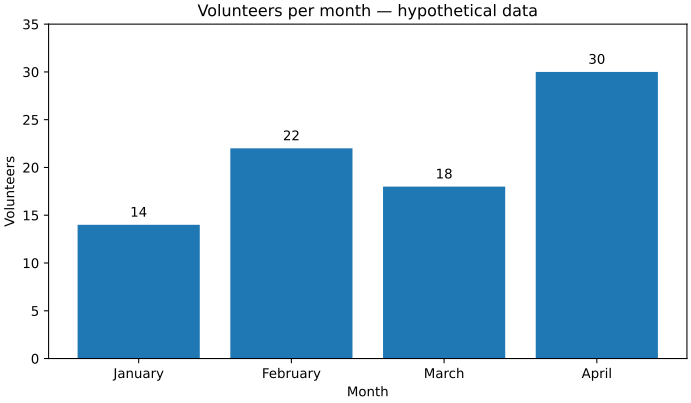
Volunteers per month (hypothetical bar graph values)
| Month | January | February | March | April |
|---|---|---|---|---|
| Volunteers | 14 | 22 | 18 | 30 |
A bar graph shows how many volunteers helped at a food bank each month; its values are shown in the table. How many more volunteers were there in the month with the most volunteers than in the month with the fewest?
Show answer and explanation
Answer: A. 16
The most volunteers came in April (30) and the fewest in January (14): 30 − 14 = 16. 8 compares January with February. 12 compares April with March. 44 adds the most and the fewest instead of subtracting.
Source: OpenStax, Prealgebra 2e, §5.5 Averages and Probability.
Question 89 · Data and Information · Problem Solving
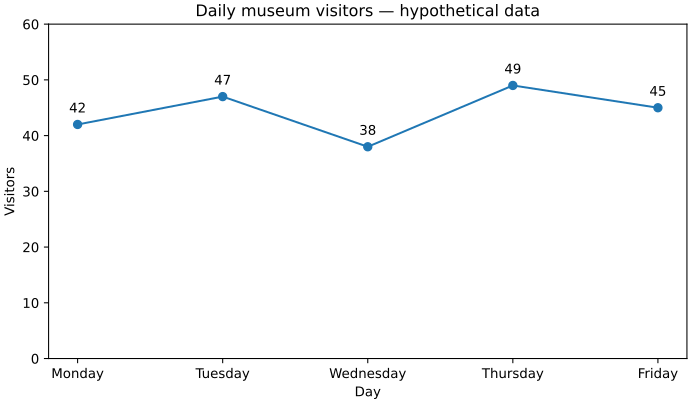
Daily museum visitors (hypothetical line graph values)
| Day | Monday | Tuesday | Wednesday | Thursday | Friday |
|---|---|---|---|---|---|
| Visitors | 42 | 47 | 38 | 49 | 45 |
A line graph shows daily visitors to a small museum; its values are shown in the table. Between which two days did the number of visitors increase the most?
Show answer and explanation
Answer: A. Wednesday to Thursday
Find each day-to-day change: Monday to Tuesday +5, Tuesday to Wednesday −9, Wednesday to Thursday +11, Thursday to Friday −4. The largest increase is +11, Wednesday to Thursday. Tuesday to Wednesday is a decrease, not an increase. Thursday has the highest count, but the question asks about the increase, not the highest day.
Source: OpenStax, Prealgebra 2e, §5.5 Averages and Probability.
Question 90 · Data and Information · Problem Solving
A clinic recorded these wait times, in minutes: 31, 33, 34, 35, 36, 38, 95. Which value best describes a typical wait?
Show answer and explanation
Answer: B. The median, 35 minutes, because the one 95-minute wait pulls the mean upward.
Six of the seven waits fall between 31 and 38 minutes. The single 95-minute wait is an outlier that raises the mean to about 43 (302 ÷ 7), higher than every wait but one. The median, 35, sits right in the typical group. The range (95 − 31 = 64) describes spread, not a typical value. No wait time repeats, so there is no mode.
Source: OpenStax, Prealgebra 2e, §5.5 Averages and Probability.
Science practice questions
Questions 91–145. Tables marked hypothetical contain made-up data for interpretation practice; the science behind every answer is sourced in its explanation. Optional count-based pacing estimate: about 55 minutes (method and limits).
Biology (Questions 91–110)
Question 91 · Biology · Knowledge
Which cell structure assembles proteins?
Show answer and explanation
Answer: C. ribosome
Ribosomes are the cell's protein builders; they read messenger RNA and link amino acids into proteins. The mitochondrion makes most of the cell's ATP (usable energy). The nucleus stores DNA and directs the cell, but it isn't where proteins are assembled. Lysosomes break down worn-out parts and wastes.
Question 92 · Biology · Knowledge
Which pair of structures is found in photosynthetic plant cells but not in animal cells?
Show answer and explanation
Answer: C. cell wall and chloroplasts
Photosynthetic plant cells have a rigid cell wall outside the membrane and chloroplasts for photosynthesis; animal cells have neither. Every other pair lists structures that plant and animal cells share, including mitochondria. Plants need mitochondria too, to release energy from the sugar they make.
Question 93 · Biology · Application
A student places red blood cells in a salt solution whose solute concentration is higher than that of the cells' cytoplasm. Assume water can cross the cell membrane but the dissolved solute cannot during the observation. What will most likely happen to the cells?
Show answer and explanation
Answer: D. Water will move out of the cells, and they will shrink.
With the solute unable to cross the membrane, the solution is hypertonic to the cells, so water leaves by osmosis and they shrink. Water moving in until cells burst describes a hypotonic solution, where the outside has less solute. The salt choice mixes up solute movement with osmosis; this question is about water. No net movement describes an isotonic solution, where concentrations match.
Source: OpenStax, Biology for AP Courses, §5.2 Passive Transport (tonicity).
Question 94 · Biology · Knowledge
Which statement best describes simple diffusion?
Show answer and explanation
Answer: C. Particles move from an area of higher concentration to an area of lower concentration without the cell using energy.
Diffusion is passive: particles spread from where they are crowded to where they are less crowded, and the cell spends no energy. Moving against the gradient with ATP is active transport. The water-only choice gets osmosis backward; water moves toward the side with more solute. Wrapping around a particle to take it in is endocytosis.
Source: OpenStax, Biology for AP Courses, §5.2 Passive Transport (tonicity).
Question 95 · Biology · Knowledge
In animals, which process produces haploid gametes (egg and sperm cells) from a diploid cell?
Show answer and explanation
Answer: B. meiosis
In animal gamete formation, meiosis halves the chromosome number from diploid (two sets) to haploid (one set). Mitosis makes genetically identical cells with the same chromosome number. Binary fission is how bacteria divide. Fertilization does the reverse of meiosis, joining two haploid gametes into a diploid zygote.
Question 96 · Biology · Application
The body cells of a certain species contain 24 chromosomes (2n = 24). How many chromosomes are in each of its gametes?
Show answer and explanation
Answer: D. 12
Gametes are made by meiosis, which halves the chromosome number: 24 ÷ 2 = 12 (n = 12). 24 is the body-cell number, which mitosis would keep. 48 doubles it, and 6 halves it twice. When two gametes of 12 join at fertilization, the offspring is back to 24.
Question 97 · Biology · Knowledge
In double-stranded DNA, which sequence pairs base by base with ATGCCA?
Show answer and explanation
Answer: D. TACGGT
In DNA, adenine (A) pairs with thymine (T), and guanine (G) pairs with cytosine (C). Going letter by letter, ATGCCA pairs with TACGGT. UACGGU uses uracil (U), which is found in RNA, not DNA. ATGCCA just repeats the original strand. GCATTG pairs A with G and T with C, which breaks the base-pairing rules.
Source: OpenStax, Biology 2e, §14.2 DNA Structure and Sequencing.
Question 98 · Biology · Application
In pea plants, violet flowers (A) are dominant over white flowers (a). A plant with genotype Aa is crossed with a plant with genotype aa. What percentage of the offspring are expected to have white flowers?
Show answer and explanation
Answer: C. 50%
A Punnett square for Aa × aa gives Aa, Aa, aa, aa. Only aa plants show the recessive white color, so 2 of 4, or 50%, are expected to be white. 25% is the answer for an Aa × Aa cross. 0% would require one parent to be AA. 75% is the share of dominant-looking offspring from Aa × Aa.
Source: OpenStax, Biology 2e, §12.2 Characteristics and Traits (Punnett squares).
Question 99 · Biology · Knowledge
What is the process in which the information in a gene's DNA is copied into messenger RNA (mRNA)?
Show answer and explanation
Answer: A. transcription
Transcription copies a gene's DNA sequence into mRNA. Translation is the next step, when ribosomes read the mRNA to build a protein. Replication copies the entire DNA molecule before a cell divides. A mutation is a change in the DNA sequence, not a copying process.
Question 100 · Biology · Knowledge
What are the main products of photosynthesis?
Show answer and explanation
Answer: D. glucose and oxygen
Photosynthesis uses light energy to turn carbon dioxide and water into glucose (a sugar) and oxygen. Carbon dioxide and water are the starting materials, not the products. Carbon dioxide is taken in, not released, by photosynthesis. Nitrogen isn't part of the reaction.
Source: OpenStax, Biology 2e, §8.1 Overview of Photosynthesis.
Question 101 · Biology · Application
Which change would most likely lower the rate of photosynthesis in a healthy green plant?
Show answer and explanation
Answer: B. moving the plant from a sunny spot into a dark closet
Photosynthesis runs on light energy, so taking away light lowers the rate. Extra carbon dioxide supplies a raw material and can increase the rate when carbon dioxide is limiting. Watering dry soil provides the other raw material, water. A sunnier window adds light.
Source: OpenStax, Biology 2e, §8.1 Overview of Photosynthesis.
Question 102 · Biology · Interpretation
Identification key
| Step | If the animal… | Then… |
|---|---|---|
| 1a | has feathers | Bird |
| 1b | has no feathers | Go to step 2 |
| 2a | has hair or fur | Mammal |
| 2b | has no hair or fur | Go to step 3 |
| 3a | has moist skin without scales | Amphibian |
| 3b | has dry skin covered with scales | Reptile |
Use the key to identify an animal that has no feathers, no hair or fur, and dry skin covered with scales.
Show answer and explanation
Answer: B. reptile
Follow the key step by step. Step 1: no feathers, so go to 2. Step 2: no hair or fur, so go to 3. Step 3: dry, scaly skin leads to reptile. Bird requires feathers, mammal requires hair or fur, and amphibian requires moist skin without scales. The key does the sorting; the traits match how biologists describe these groups.
Source: OpenStax, Biology 2e, §29.4 Reptiles.
Question 103 · Biology · Application
Green beetles and brown beetles live on brown tree bark. Birds spot and eat green beetles more often than brown ones. Beetle color is inherited. After many generations, what is the most likely result?
Show answer and explanation
Answer: A. Brown beetles make up a larger share of the population.
This is natural selection. Brown beetles survive and reproduce more often, and they pass the brown trait on, so brown becomes more common over generations. Individual beetles don't change color because they need to; populations change because survival differs. With other influences unchanged, this survival advantage favors a larger brown share over generations; it does not guarantee a particular proportion. Nothing suggests the beetles stop reproducing.
Source: OpenStax, Biology 2e, §18.1 Understanding Evolution.
Question 104 · Biology · Knowledge
Organisms that make their own food using energy from sunlight, such as plants, are called
Show answer and explanation
Answer: D. producers
Photosynthetic producers (autotrophs) capture energy from sunlight and store it in food they make themselves, forming the base of food chains. Consumers get energy by eating other organisms. Decomposers break down dead material. Parasites feed on a living host.
Source: OpenStax, Biology 2e, §46.2 Energy Flow through Ecosystems.
Question 105 · Biology · Interpretation
Hypothetical population counts
| Year | 1 | 2 | 3 | 4 | 5 |
|---|---|---|---|---|---|
| Rabbits | 400 | 600 | 900 | 500 | 300 |
| Foxes | 20 | 25 | 40 | 55 | 30 |
The table shows hypothetical population counts for rabbits and the foxes that prey on them. Which statement is best supported by the data?
Show answer and explanation
Answer: A. Fox numbers peaked the year after rabbit numbers peaked.
Rabbits peak in Year 3 (900) and foxes peak in Year 4 (55), one year later. A lag like this is common in predator–prey data: more prey supports more predators, and more predators then cut the prey population. The same-year choice misreads the table. Rabbit numbers fall in Years 4 and 5. Foxes are fewer than rabbits in every year in this table.
Question 106 · Biology · Knowledge
Which feature describes bacterial cells?
Show answer and explanation
Answer: A. They have no nucleus.
Bacteria are prokaryotes: their DNA sits in the cytoplasm instead of inside a membrane-bound nucleus. They still have DNA, a cell membrane, and ribosomes.
Question 107 · Biology · Application
Why don't antibiotics cure illnesses caused by viruses, such as the common cold?
Show answer and explanation
Answer: B. Antibiotics act against bacteria, and viruses are not bacteria.
The CDC's guidance is that antibiotics do not work on infections caused by viruses, such as colds and flu. Antibiotics target bacteria; viruses are a different kind of germ. There's no 10-day rule. Viruses are much smaller than bacteria, not larger. Antibiotics are not designed to destroy white blood cells.
Question 108 · Biology · Knowledge
In an experiment comparing a new treatment with no treatment, what is the purpose of the untreated control group?
Show answer and explanation
Answer: C. It does not receive the treatment being tested, so the results can be compared with the group that does.
A control group is the comparison point. It's handled the same way as the experimental group except for the factor being tested, helping researchers assess that factor while reducing alternative explanations. Giving it the largest dose makes it an experimental group. Choosing groups to get a predicted result is bias. Both groups are measured; that's the point of comparing them.
Question 109 · Biology · Application
A student wants to test whether a fertilizer affects how tall bean plants grow. Which design is the fairest test?
Show answer and explanation
Answer: A. Two groups of bean plants get the same light, water, soil, and pot size, and only one group gets the fertilizer.
A fair test changes one variable, the fertilizer, and keeps everything else the same, to reduce alternative explanations for a difference in height. The window-and-closet design also changes light. Giving both groups fertilizer means nothing tests fertilizer. Changing fertilizer and water together makes it impossible to tell which one mattered.
Question 110 · Biology · Interpretation
Hypothetical enzyme activity
| Temperature (°C) | 10 | 20 | 30 | 40 | 50 | 60 |
|---|---|---|---|---|---|---|
| Activity (units) | 12 | 25 | 41 | 55 | 18 | 2 |
The table shows hypothetical results from an experiment measuring an enzyme's activity at different temperatures. Which conclusion is best supported?
Show answer and explanation
Answer: D. Of the temperatures tested, activity was highest at 40°C and dropped sharply above it.
Activity climbs from 12 to 55 units up to 40°C, then falls to 18 and 2. That fits how enzymes behave: warmth speeds reactions up to a point, but too much heat changes the enzyme's shape and it stops working well. Activity doesn't rise steadily; it drops after 40°C. At 60°C activity is lowest, not highest. The values change a lot, so temperature clearly matters. Note the careful wording: “of the temperatures tested.”
Source: OpenStax, Biology 2e, §6.5 Enzymes.
Human Anatomy (Questions 111–121)
Question 111 · Human Anatomy · Interpretation
Blood-flow diagram
Right ventricle → pulmonary arteries → lungs → pulmonary veins → [ ? ] → left ventricle → aorta
The diagram shows part of the path blood takes through the heart and lungs. Which structure belongs in the blank?
Show answer and explanation
Answer: A. left atrium
Pulmonary veins carry oxygen-rich blood from the lungs back to the heart, and they empty into the left atrium. From there, blood passes into the left ventricle, which pumps it out through the aorta. The right atrium receives oxygen-poor blood from the body. The superior vena cava is one of the veins that delivers that blood. The pulmonary trunk carries blood away from the right ventricle toward the lungs.
Source: OpenStax, Anatomy and Physiology 2e, §19.1 Heart Anatomy.
Question 112 · Human Anatomy · Knowledge
Where are the adrenal glands located?
Show answer and explanation
Answer: B. on top of the kidneys
The adrenal glands sit atop the kidneys, attached by a fibrous capsule. The gland at the base of the brain is the pituitary. The gland in the neck below the larynx is the thyroid. The pancreas lies behind the stomach.
Source: OpenStax, Anatomy and Physiology 2e, §17.6 The Adrenal Glands.
Question 113 · Human Anatomy · Knowledge
What are the tiny, finger-like projections that line the small intestine called?
Show answer and explanation
Answer: B. villi
Villi line the small intestine and greatly increase its surface area for absorbing nutrients. Alveoli are air sacs in the lungs. Nephrons are the filtering units of the kidneys. Rugae are folds in the stomach lining.
Source: OpenStax, Anatomy and Physiology 2e, §23.5 The Small and Large Intestines.
Question 114 · Human Anatomy · Knowledge
Which layer of the skin is the outermost?
Show answer and explanation
Answer: D. epidermis
The epidermis is the outer layer of the skin. The dermis lies beneath it and holds blood vessels, nerves, and glands. The hypodermis (subcutaneous layer) is deeper still. The periosteum isn't part of the skin; it covers bones.
Source: OpenStax, Anatomy and Physiology 2e, §5.1 Layers of the Skin.
Question 115 · Human Anatomy · Application
During a sore throat, a person notices small, tender swellings along the side of the neck. Which lymph-filtering structures are these most likely to be?
Show answer and explanation
Answer: A. lymph nodes
Lymph nodes sit along lymphatic vessels, including many in the neck, and filter lymph as immune cells respond to infection. The question's clue, structures that filter lymph, points directly to them. The thyroid is a single gland at the front of the neck. The vocal cords are inside the larynx. Salivary glands make saliva; they don't filter lymph.
Source: OpenStax, Anatomy and Physiology 2e, §21.1 Anatomy of the Lymphatic and Immune Systems.
Question 116 · Human Anatomy · Interpretation
Arm diagram (from the trunk outward)
Trunk → shoulder → upper arm → elbow → forearm → wrist → fingertips
The diagram lists points along the arm, starting from where the arm attaches to the trunk. Which point is distal to the elbow?
Show answer and explanation
Answer: B. wrist
Distal means farther from where a limb attaches to the trunk. On the diagram, the wrist lies beyond the elbow, so it is distal to it. The shoulder and upper arm lie closer to the trunk, so they are proximal to the elbow. The collarbone is part of the shoulder girdle, closer to the trunk still.
Source: OpenStax, Anatomy and Physiology 2e, §1.6 Anatomical Terminology.
Question 117 · Human Anatomy · Knowledge
The central nervous system consists of the
Show answer and explanation
Answer: B. brain and spinal cord
The central nervous system (CNS) is the brain and spinal cord. Nerves that branch out from them, including cranial and spinal nerves, make up the peripheral nervous system. Each wrong choice mixes in peripheral nerves or leaves out part of the CNS.
Source: OpenStax, Anatomy and Physiology 2e, §12.1 Basic Structure and Function of the Nervous System.
Question 118 · Human Anatomy · Knowledge
Where does fertilization of an egg usually take place?
Show answer and explanation
Answer: C. in the uterine (fallopian) tube
Fertilization usually happens in the outer part of the uterine tube, after an oocyte (egg) is released from the ovary and enters the tube. The fertilized egg then travels to the uterus and implants in its lining, which is why the uterus is a tempting trap. The ovary releases the egg but isn't where it's usually fertilized. The cervix is the narrow lower part of the uterus.
Source: OpenStax, Anatomy and Physiology 2e, §27.2 Anatomy and Physiology of the Ovarian Reproductive System.
Question 119 · Human Anatomy · Application
Gas exchange works best across structures with very thin walls, a huge total surface area, and a dense network of capillaries. Which respiratory structures best fit this description?
Show answer and explanation
Answer: A. alveoli
Alveoli are tiny air sacs with walls only a cell or so thick, wrapped in capillaries. Together they create an enormous surface for oxygen and carbon dioxide to cross. The trachea and bronchi are airways reinforced with cartilage, built to conduct air rather than exchange gases. The larynx houses the vocal cords.
Source: OpenStax, Anatomy and Physiology 2e, §22.1 Organs and Structures of the Respiratory System.
Question 120 · Human Anatomy · Interpretation
Urine-flow diagram
Kidney → X → urinary bladder → Y → outside the body
The diagram shows the path urine takes out of the body. Which structure is labeled X?
Show answer and explanation
Answer: C. ureter
Urine made in the kidney travels down a ureter to the urinary bladder, so X is the ureter. The urethra (Y) carries urine from the bladder out of the body; the two names are easy to mix up. The renal vein carries blood, not urine. Nephrons are the tiny filtering units inside the kidney.
Source: OpenStax, Anatomy and Physiology 2e, §25.2 Gross Anatomy of Urine Transport.
Question 121 · Human Anatomy · Application
After an inner-ear problem, a person feels dizzy and has trouble keeping balance, but their hearing is unchanged. Which part of the inner ear is most involved in the balance problem?
Show answer and explanation
Answer: D. the semicircular canals and vestibule
The semicircular canals and vestibule detect head movement and position, so they handle balance. The cochlea handles hearing, and hearing is unchanged. The eardrum and middle-ear bones pass sound vibrations along; they aren't part of the inner ear's balance system.
Source: OpenStax, Anatomy and Physiology 2e, §14.1 Sensory Perception.
Human Physiology (Questions 122–132)
Question 122 · Human Physiology · Application
Cardiac output = heart rate × stroke volume. A person's heart rate rises from 70 to 100 beats per minute while stroke volume stays at 70 milliliters per beat. What happens to cardiac output?
Show answer and explanation
Answer: B. It rises from 4.9 to 7.0 liters per minute.
Use the formula: 70 × 70 = 4,900 mL per minute (4.9 L), and 100 × 70 = 7,000 mL per minute (7.0 L). A higher heart rate with the same stroke volume means more blood pumped each minute. It can't stay the same when one factor rises and the other holds steady. The milliliters choice confuses heart rate with output. The “less time to fill” choice contradicts the question, which says stroke volume stays at 70 mL.
Source: OpenStax, Anatomy and Physiology 2e, §19.4 Cardiac Physiology.
Question 123 · Human Physiology · Application
After a meal, blood glucose rises. The pancreas releases insulin, which helps cells take up glucose, and blood glucose falls back toward its normal level. This is an example of
Show answer and explanation
Answer: D. negative feedback
In negative feedback, a change triggers a response that pushes the value back toward normal. Rising glucose leads to insulin, which lowers glucose. Positive feedback would push the change even further in the same direction. A reflex arc is a nerve pathway, and an allergic response is an immune reaction; neither describes this hormone loop.
Source: OpenStax, Anatomy and Physiology 2e, §1.5 Homeostasis; OpenStax, Anatomy and Physiology 2e, §17.9 The Endocrine Pancreas.
Question 124 · Human Physiology · Knowledge
Bile is made by the liver and stored in the gallbladder. How does bile mainly help digestion?
Show answer and explanation
Answer: B. It breaks large fat globules into smaller droplets.
Bile emulsifies fats, breaking big fat globules into tiny droplets that digestive enzymes can work on more easily. Enzymes, not bile, break proteins into amino acids. Most water from undigested food is absorbed in the intestines. Insulin comes from the pancreas.
Question 125 · Human Physiology · Application
On a hot day, which response helps the skin release excess body heat?
Show answer and explanation
Answer: D. Sweat glands release sweat, and blood vessels in the dermis widen.
Sweat cools the skin as it evaporates, and wider dermal blood vessels bring more warm blood near the surface, where heat can escape. Narrowing those vessels conserves heat, which is the cold-weather response. Goose bumps and shivering are also responses to cold; shivering actually makes heat.
Source: OpenStax, Anatomy and Physiology 2e, §5.3 Functions of the Integumentary System.
Question 126 · Human Physiology · Knowledge
Which cells produce antibodies?
Show answer and explanation
Answer: B. B cells
Antibodies are proteins made by B cells (B lymphocytes); activated B cells develop into plasma cells that release large amounts of antibody. Helper T cells coordinate the immune response but don't make antibodies. Red blood cells carry oxygen, and platelets help blood clot.
Question 127 · Human Physiology · Knowledge
In adults, most blood cells are produced in the
Show answer and explanation
Answer: C. red bone marrow
Red bone marrow is where blood cells are made. Yellow bone marrow mainly stores fat. Cartilage is flexible connective tissue at joints and in other places. The periosteum is the membrane covering the outside of bones.
Source: OpenStax, Anatomy and Physiology 2e, §6.1 The Functions of the Skeletal System.
Question 128 · Human Physiology · Interpretation
Reflex diagram
Pain receptor (nociceptor) in skin → Label 1 → spinal cord → Label 2 → arm muscle contracts
The diagram shows a simple reflex that pulls a hand away from a hot surface. Which label marks the motor neuron?
Show answer and explanation
Answer: A. Label 2
Follow the signal. The receptor in the skin detects painful heat, and Label 1 is the sensory neuron that carries the message to the spinal cord. The spinal cord relays it, and Label 2 is the motor neuron that carries the command out to the muscle. The receptor and spinal cord are real parts of the reflex, but neither is the motor neuron.
Source: OpenStax, Anatomy and Physiology 2e, §14.3 Motor Responses: withdrawal reflex.
Question 129 · Human Physiology · Knowledge
During a typical menstrual cycle, which organs are the main source of estrogen and progesterone?
Show answer and explanation
Answer: D. ovaries
The ovaries produce estrogen and progesterone. The testes primarily produce testosterone, not the main supply of these ovarian-cycle hormones. The thyroid gland makes hormones that regulate metabolism. The pituitary releases hormones (such as FSH and LH) that signal the ovaries, but it doesn't make estrogen and progesterone itself.
Source: OpenStax, Anatomy and Physiology 2e, §27.2 Anatomy and Physiology of the Ovarian Reproductive System.
Question 130 · Human Physiology · Interpretation
Hypothetical breathing data
| Blood CO₂ level | Normal | Slightly raised | Raised | High |
|---|---|---|---|---|
| Breaths per minute | 12 | 16 | 22 | 28 |
The table shows hypothetical measurements of breathing rate at different blood carbon dioxide (CO₂) levels. Which statement is best supported?
Show answer and explanation
Answer: C. Breathing rate increased as blood CO₂ increased.
Reading left to right, CO₂ goes up and breathing rate climbs from 12 to 28 breaths per minute. That matches physiology: rising CO₂ stimulates chemoreceptors, which increase breathing rate and depth to help remove the extra CO₂. The first two wrong choices misread the table. The last choice makes a causal claim that the table cannot establish. A higher breathing rate alone does not tell you how much fresh air reaches the alveoli; breathing depth matters too.
Source: OpenStax, Anatomy and Physiology 2e, §22.3 The Process of Breathing.
Question 131 · Human Physiology · Application
When a person is dehydrated, the body releases more antidiuretic hormone (ADH). What is the most likely effect?
Show answer and explanation
Answer: C. The kidneys reabsorb more water, so urine becomes more concentrated.
ADH increases how much water the kidneys reabsorb from their collecting tubules back into the blood. Less water leaves in urine, so urine is more concentrated. That helps conserve water during dehydration. Less water reabsorbed is the effect of low ADH. Urine production slows but doesn't stop, and filtering continues.
Source: OpenStax, Anatomy and Physiology 2e, §26.2 Water Balance: ADH.
Question 132 · Human Physiology · Interpretation
Hypothetical pupil measurements
| Lighting | Dim room | Normal room | Bright sunlight |
|---|---|---|---|
| Pupil diameter (mm) | 7 | 4 | 2 |
The table shows hypothetical pupil diameters measured in different lighting. Which statement is best supported?
Show answer and explanation
Answer: B. Pupil diameter decreased as the light became brighter.
The pupil shrinks from 7 mm in a dim room to 2 mm in bright sunlight. That's the pupillary light reflex: in bright light the pupil constricts to limit the light reaching the retina, and in dim light it dilates. The other choices contradict the table.
Source: OpenStax, Anatomy and Physiology 2e, §15.2 Autonomic Reflexes and Homeostasis.
Chemistry (Questions 133–137)
Question 133 · Chemistry · Knowledge
Carbon-12 and carbon-14 are isotopes of carbon. How do their atoms differ?
Show answer and explanation
Answer: B. They have different numbers of neutrons.
Isotopes of an element have the same number of protons, which is what makes both atoms carbon, but different numbers of neutrons. That's why their mass numbers (12 and 14) differ. A different number of protons would make them different elements. Neutral atoms of the same element have the same number of electrons, because electrons match protons. The atomic number is the proton count, so it's the same for both.
Source: OpenStax, Chemistry 2e, §2.3 Atomic Structure and Symbolism.
Question 134 · Chemistry · Knowledge
How does the bond form when sodium and chlorine combine to make sodium chloride?
Show answer and explanation
Answer: A. Sodium transfers an electron to chlorine, forming oppositely charged ions that attract each other.
Sodium chloride has an ionic bond. The sodium atom gives up an electron to become Na⁺, chlorine gains it to become Cl⁻, and the opposite charges attract. Sharing electrons, whether equally or unequally, describes covalent bonds, not table salt. Protons stay in the nucleus; bonding involves electrons.
Question 135 · Chemistry · Application
A sealed, rigid container of gas is heated. What happens to the pressure inside, and why?
Show answer and explanation
Answer: A. It increases, because the gas particles move faster and hit the walls more often and with more force.
Heat raises the particles' average kinetic energy, so they move faster. In a rigid container the volume can't change, so faster particles collide with the walls more often and harder, and pressure rises. The particles can't spread farther apart in a rigid container. The same number of particles still pushes harder when they move faster. The particles themselves don't grow.
Source: OpenStax, Chemistry 2e, §9.5 The Kinetic-Molecular Theory.
Question 136 · Chemistry · Knowledge
Mayonnaise contains tiny droplets of oil spread throughout a water-based liquid, with egg yolk keeping the droplets from separating. This mixture is best classified as
Show answer and explanation
Answer: C. an emulsion
An emulsion is a mixture of two liquids that normally don't mix, with one spread through the other as tiny droplets, often held in place by an emulsifier such as egg yolk. In a solution the dissolved substance mixes evenly at the level of molecules or ions, which oil in water doesn't do. A pure compound isn't a mixture at all. A tincture is a solution made with alcohol as the solvent.
Source: OpenStax, Chemistry 2e, §11.5 Colloids; Merriam-Webster, “tincture”.
Question 137 · Chemistry · Interpretation
Four solutions
| Solution | W | X | Y | Z |
|---|---|---|---|---|
| pH | 2 | 5 | 7 | 11 |
Note: Assume dilute aqueous solutions at 25°C. Each decrease of 1 pH unit means the hydronium-ion (H₃O⁺) concentration is 10 times greater.
Use the table and its note. Which solution is the most acidic, and how does its hydronium-ion concentration compare with solution X's?
Show answer and explanation
Answer: D. W; about 1,000 times greater
Lower pH means more acidic, so W (pH 2) is the most acidic. It is 3 pH units below X (pH 5), and each unit is a factor of 10, so 10 × 10 × 10 = 1,000. “3 times” treats the pH scale as if it were linear. Z has the highest pH, so it's basic, not acidic. Y (pH 7) is neutral and sits 2 units above X, so its hydronium-ion concentration is 100 times lower than X's, not higher.
Health (Questions 138–145)
Question 138 · Health · Knowledge
How does the World Health Organization's constitution define health?
Show answer and explanation
Answer: C. complete physical, mental, and social well-being, not just the absence of disease
The WHO constitution describes health as complete physical, mental, and social well-being and not merely the absence of disease or infirmity. “The absence of disease” is exactly what the definition says health is more than. Body weight, blood pressure, and missed workdays are narrow measures, not a definition of health.
Question 139 · Health · Application
Before eating, Jordan wets his hands, adds soap, rubs them together for about 5 seconds, rinses, and dries them with a clean towel. Which change would best match CDC's handwashing steps?
Show answer and explanation
Answer: C. Scrub with soap for at least 20 seconds before rinsing.
CDC's steps are wet, lather, scrub for at least 20 seconds, rinse, and dry. Jordan's only gap is the scrubbing time. CDC says warm or cold water both work, and it never says soap can be skipped. Drying with a clean towel or air-drying are both fine. The 20 seconds apply to scrubbing with soap, not rinsing.
Source: CDC, About Handwashing: five steps.
Question 140 · Health · Knowledge
According to the CDC, how much sleep do adults ages 18 to 60 need each night?
Show answer and explanation
Answer: A. 7 or more hours
CDC lists 7 or more hours per night for adults ages 18 to 60. Four to six hours falls short of that. Twelve or more hours is in the range listed for young children, including naps.
Source: CDC, About Sleep: hours by age.
Question 141 · Health · Application
A parent who smokes wants to protect a young child from secondhand smoke at home. Based on CDC guidance, which step is most effective?
Show answer and explanation
Answer: A. Keep the home and car completely smoke-free.
CDC says there is no safe level of secondhand smoke exposure and that only 100% smoke-free indoor air fully protects people. Smoke from another room still spreads through the home. CDC materials say opening windows, using fans, and running air purifiers don't remove secondhand smoke's harmful chemicals.
Source: CDC, Preventing Exposure to Secondhand Smoke in the Home.
Question 142 · Health · Application
After a stroke, a person receives rehabilitation to improve walking and reduce lasting disability. In the primary, secondary, and tertiary prevention framework, this is an example of
Show answer and explanation
Answer: C. tertiary prevention
Tertiary prevention limits disability and other consequences after disease is established, such as rehabilitation to improve walking after a stroke. Primary prevention reduces risk before disease starts. Secondary prevention detects and treats disease early; screening is one of its tools. This example is about reducing established disability, not screening for an undetected disease.
Source: CDC MMWR, A Framework for Assessing the Effectiveness of Disease and Injury Prevention (1992): tertiary prevention; WHO, Rehabilitation: stroke examples and reducing disability (April 22, 2024).
Question 143 · Health · Knowledge
What is the main purpose of a health screening test?
Show answer and explanation
Answer: B. to find a disease or risk early in people who do not yet have symptoms
Screening looks for disease in people without symptoms, when treatment can work better. That's secondary prevention. Treating a diagnosed disease isn't screening. Vaccination is primary prevention. Rehabilitation aimed at reducing established disability is tertiary prevention.
Question 144 · Health · Interpretation
Hypothetical data
| Town | A | B | C | D |
|---|---|---|---|---|
| Vaccination coverage | 95% | 85% | 70% | 60% |
| Cases per 10,000 residents | 2 | 9 | 31 | 58 |
The table shows hypothetical vaccination coverage and disease case rates in four towns. Which statement is best supported by the data?
Show answer and explanation
Answer: D. In these data, towns with higher vaccination coverage reported lower case rates.
As coverage drops from 95% to 60%, the reported case rate rises from 2 to 58 per 10,000 residents. That is an association in these hypothetical data, not proof of causation. Town A has coverage above 60% (95%) and still reports 2 cases per 10,000 residents, so the “prevents every case” choice is false. Town D has the highest case rate, not the lowest. The “causes higher case rates” choice both reverses the observed direction and makes an unsupported causal claim. The table does not give the towns’ population sizes, so it cannot establish their total numbers of cases.
Source: OpenStax, Biology 2e, §1.1 The Science of Biology: evidence and testing hypotheses.
Question 145 · Health · Interpretation
Food thermometer readings
| Dish | Thermometer reading | Safe minimum (FoodSafety.gov) |
|---|---|---|
| Roast chicken | 158°F | 165°F |
| Hamburger (ground beef) | 162°F | 160°F |
| Baked salmon | 146°F | 145°F |
| Pork chop (rested 3 minutes) | 147°F | 145°F, plus a 3-minute rest |
Use the safe minimum internal temperatures in the table. Which dish needs more cooking?
Show answer and explanation
Answer: A. roast chicken
Compare each reading with its minimum. Roast chicken reads 158°F, but poultry needs 165°F, so it needs more cooking. The hamburger (162°F) is above its 160°F minimum. The salmon (146°F) is above its 145°F minimum. The pork chop (147°F) is above 145°F, and it has rested the required 3 minutes.
Source: FoodSafety.gov, Safe Minimum Internal Temperature Chart.
Score your practice test
Give yourself one point for each correct answer and count blanks as wrong. That mirrors the real NEX, where unanswered questions count as incorrect and there's no penalty for guessing (NLN NEX Technical Brief, p. 2). So on test day, never leave a question blank.
Record your first answer before opening its explanation. Count a question as unanswered if you viewed the answer first. For the full set, percent correct = 100 × correct ÷ 145; for a subject, divide by 50 (Verbal), 40 (Math), or 55 (Science). Round percentages to one decimal place. Do not average the three subject percentages: their denominators differ.
| Result | Your count |
|---|---|
| Correct | ___ |
| Incorrect attempts | ___ |
| Unanswered or answer viewed first | ___ |
| Total | 145 |
Answer key
Verbal (Questions 1–50)
| Q | Answer | Q | Answer | Q | Answer | Q | Answer | Q | Answer |
|---|---|---|---|---|---|---|---|---|---|
| 1 | D | 2 | D | 3 | B | 4 | B | 5 | C |
| 6 | B | 7 | A | 8 | C | 9 | D | 10 | D |
| 11 | B | 12 | D | 13 | C | 14 | D | 15 | B |
| 16 | C | 17 | A | 18 | A | 19 | D | 20 | D |
| 21 | B | 22 | A | 23 | A | 24 | D | 25 | A |
| 26 | B | 27 | B | 28 | C | 29 | C | 30 | D |
| 31 | A | 32 | C | 33 | A | 34 | B | 35 | B |
| 36 | A | 37 | B | 38 | D | 39 | C | 40 | A |
| 41 | B | 42 | C | 43 | A | 44 | D | 45 | C |
| 46 | C | 47 | B | 48 | C | 49 | D | 50 | A |
Math (Questions 51–90)
| Q | Answer | Q | Answer | Q | Answer | Q | Answer | Q | Answer |
|---|---|---|---|---|---|---|---|---|---|
| 51 | B | 52 | C | 53 | B | 54 | C | 55 | C |
| 56 | D | 57 | A | 58 | C | 59 | D | 60 | A |
| 61 | D | 62 | C | 63 | B | 64 | B | 65 | D |
| 66 | D | 67 | B | 68 | D | 69 | B | 70 | B |
| 71 | A | 72 | A | 73 | C | 74 | D | 75 | D |
| 76 | A | 77 | A | 78 | B | 79 | D | 80 | A |
| 81 | C | 82 | A | 83 | C | 84 | D | 85 | C |
| 86 | C | 87 | B | 88 | A | 89 | A | 90 | B |
Science (Questions 91–145)
| Q | Answer | Q | Answer | Q | Answer | Q | Answer | Q | Answer |
|---|---|---|---|---|---|---|---|---|---|
| 91 | C | 92 | C | 93 | D | 94 | C | 95 | B |
| 96 | D | 97 | D | 98 | C | 99 | A | 100 | D |
| 101 | B | 102 | B | 103 | A | 104 | D | 105 | A |
| 106 | A | 107 | B | 108 | C | 109 | A | 110 | D |
| 111 | A | 112 | B | 113 | B | 114 | D | 115 | A |
| 116 | B | 117 | B | 118 | C | 119 | A | 120 | C |
| 121 | D | 122 | B | 123 | D | 124 | B | 125 | D |
| 126 | B | 127 | C | 128 | A | 129 | D | 130 | C |
| 131 | C | 132 | B | 133 | B | 134 | A | 135 | A |
| 136 | C | 137 | D | 138 | C | 139 | C | 140 | A |
| 141 | A | 142 | C | 143 | B | 144 | D | 145 | A |
Your results by content area
These are the content areas NLN uses for each test, with the same number of questions per area as the scored NEX (NLN Technical Brief, pp. 3–6).
| Test | Content area | Questions | Number of questions | Your number correct |
|---|---|---|---|---|
| Verbal | Word Knowledge | 1–25 | 25 | ___ of 25 |
| Verbal | Reading Comprehension | 26–50 | 25 | ___ of 25 |
| Math | Numbers and Operations | 51–62 | 12 | ___ of 12 |
| Math | Measurement | 63–76 | 14 | ___ of 14 |
| Math | Algebra | 77–83 | 7 | ___ of 7 |
| Math | Data and Information | 84–90 | 7 | ___ of 7 |
| Science | Biology | 91–110 | 20 | ___ of 20 |
| Science | Human Anatomy | 111–121 | 11 | ___ of 11 |
| Science | Human Physiology | 122–132 | 11 | ___ of 11 |
| Science | Chemistry | 133–137 | 5 | ___ of 5 |
| Science | Health | 138–145 | 8 | ___ of 8 |
| All | Total | 1–145 | 145 | ___ of 145 |
A few areas are small: Chemistry has 5 questions, Algebra and Data and Information have 7 each, and Health has 8. One or two answers can swing those results a lot, so read them as signals, not measurements.
Your results by skill
NLN's score report also sorts results by skill, which NLN calls dimensions. We labeled every question with the same dimension names; these are our editorial classifications, not NLN-validated ratings of the items. If most of your misses are Knowledge questions, start with more content review. If they cluster in Application, Interpretation, or Problem Solving, practice using what you know on new situations and data.
| Test | Skill (NLN dimension) | Questions | Number of questions |
|---|---|---|---|
| Verbal | Word Analysis | 1–15 | 15 |
| Verbal | Vocabulary Development | 16–25 | 10 |
| Verbal | Reading for Information | 26–27, 31–32, 36–37, 41–42, 46–47 | 10 |
| Verbal | Application | 28–29, 33–34, 38–39, 43–44, 48–49 | 10 |
| Verbal | Inference | 30, 35, 40, 45, 50 | 5 |
| Math | Computation | 51–54, 63–67, 77–79, 84–86 | 15 |
| Math | Problem Solving | 55–62, 68–76, 80–83, 87–90 | 25 |
| Science | Knowledge | 91–92, 94–95, 97, 99–100, 104, 106, 108, 112–114, 117–118, 124, 126–127, 129, 133–134, 136, 138, 140, 143 | 25 |
| Science | Application | 93, 96, 98, 101, 103, 107, 109, 115, 119, 121–123, 125, 131, 135, 139, 141–142 | 18 |
| Science | Interpretation | 102, 105, 110–111, 116, 120, 128, 130, 132, 137, 144–145 | 12 |
NLN's report also shows a Logic and Reasoning category that combines certain skills: Word Analysis and Inference in Verbal, Problem Solving in Math, and Application and Interpretation in Science (NLN NEX Technical Brief, pp. 3–6 and 13). In this set, that's 20 Verbal, 25 Math, and 30 Science questions, the same counts as the scored NEX.
What your score means, and what it doesn't
Your percent correct describes how you did on these 145 questions. It isn't an NLN percentile, a composite score, or a prediction of your NEX result. NLN tries out its questions on real applicants and compares scores against large groups of RN and LPN/VN applicants; our questions haven't been through that process, so there's no fair way to convert this score into a NEX score.
NLN also doesn't set a passing score. Each nursing program decides what it requires (NLN Student Resources FAQ).
How to review what you missed
- Use the two tables above to sort your misses by content area and skill. Start with the area where you missed the largest share.
- Read the full explanation for each miss, including why your choice was wrong. Many misses come from a specific slip: a flipped ratio, a skipped step, a synonym trap. Naming the slip helps you catch it next time.
- Cover the explanation and solve the question again on paper. You want your reasoning to match the explanation, not just your letter.
- For any area where you missed several, work through the free review sources below, then retry those questions.
How this practice test compares with the real NEX
The National League for Nursing’s Nursing Entrance Exam (NEX) is an admissions assessment for applicants to prelicensure RN and LPN/VN programs, not a nursing license (NLN Technical Brief, p. 2). This page is for that nursing-admissions task.
| Real NEX | This practice test | |
|---|---|---|
| Questions | 163 shown: 145 scored plus 18 unscored tryout questions | 145, all counted |
| Verbal | 58 shown, 50 scored: Word Knowledge 25, Reading Comprehension 25 | 50, same split |
| Math | 45 shown, 40 scored: Numbers and Operations 12, Measurement 14, Algebra 7, Data and Information 7 | 40, same split |
| Science | 60 shown, 55 scored: Biology 20, Human Anatomy 11, Human Physiology 11, Chemistry 5, Health 8 | 55, same split |
| Reading passages | 5 scored passages plus 1 tryout passage, written at a ninth-grade level or higher | 5 original passages |
| Format | Four-option multiple choice; no guessing penalty; unanswered questions count as incorrect | Same format |
| Time | 60 minutes for each subject, all in one sitting | Untimed, or optional arithmetic pacing estimates of 52, 53, and 55 minutes |
| Calculator | Built into the testing platform | Use a basic four-function calculator |
| Scores | Percentile ranks and a composite score, compared with RN and LPN/VN applicants | Your raw count and percent correct on these practice items |
Sources: NLN NEX Technical Brief, pp. 2–6, 11, and 13–15; NLN NEX Technical Manual, §2.3 and §4.2.
Where the pacing numbers come from
On the real test, each 60-minute clock also covers that subject's unscored tryout questions. We scaled the clock to our shorter sections: 60 minutes × 50/58 ≈ 52 minutes for Verbal, 60 × 40/45 ≈ 53 minutes for Math, and 60 × 55/60 = 55 minutes for Science. These are arithmetic pacing estimates, not NLN timings or evidence that our items take the same amount of time as official items. If you'd rather rehearse the full clock, give yourself 60 minutes per section; you'll have more time per presented question than the official count-based average, though actual item difficulty and reading time vary.
What we matched, and what we couldn't
We matched the question counts for every scored content area and used NLN's dimension labels and published allocations to organize the set. Biology, for example, has 10 Knowledge, 7 Application, and 3 Interpretation questions here, the same as NLN's scored blueprint. Topics come from NLN's published content outlines. We left out what the NEX dropped from the older PAX, physics and extended geometry, but kept measurement, scale, and supplied-formula problems, because NLN kept those (Technical Manual, §4.2).
Matching counts does not establish equivalent difficulty or validated skill classification. NLN field-tests its questions on applicants before they count; ours haven't been field-tested. Use this set to find what to study, not to predict your score.
Free sources for reviewing each content area
| Content area | Free source | Where to start |
|---|---|---|
| Word Knowledge | Merriam-Webster (use the entry linked with each question) | Look up each word you missed. Entries show word origins and usage notes, which help you build word-part skills. |
| Numbers and Operations | OpenStax Prealgebra 2e | §4.5 Fractions, §5.2 Decimals, §6.2 Percent applications |
| Measurement | OpenStax Prealgebra 2e; NIST | §7.5 Systems of Measurement; NIST SI prefix table |
| Algebra | OpenStax Prealgebra 2e | §2.1 Language of algebra, §8.3 Solving equations, Linear inequalities |
| Data and Information | OpenStax Prealgebra 2e | §5.5 Averages (mean, median, mode) |
| Biology | OpenStax Biology 2e | Start with §4.3 Eukaryotic Cells and §12.2 Punnett squares |
| Human Anatomy and Human Physiology | OpenStax Anatomy and Physiology 2e | Start with §1.6 Anatomical terminology and §1.5 Homeostasis |
| Chemistry | OpenStax Chemistry 2e | §2.3 Atomic structure, §7.1 Ionic bonding, §14.2 pH |
| Health | CDC and WHO | CDC handwashing, CDC sleep, WHO definition of health |
All of these are free to read online without an account.
NLN NEX practice test FAQ
Are these real NEX questions?
No. We wrote every question and passage from NLN's published content outlines. These are original practice items, not official, leaked, or recalled exam questions; no NLN review is claimed.
Can I use a calculator on the NEX?
Yes. NLN's technical manual says the testing platform has a built-in calculator (Technical Manual, §4.2). If you test online through Proctor360, NLN's March 2026 candidate guide lists only four allowed items: a basic four-function calculator, a dry-erase board no larger than 8.5 × 11 inches, a dry-erase marker, and an eraser (NLN Proctor360 guide). If you test in person, ask your school or testing site what it provides.
What NEX score do I need?
NLN doesn't set a passing score; your nursing program does (NLN Student Resources FAQ).
Is the NEX the same as the PAX?
No. NLN released the NEX on February 11, 2024, as the update to the PAX (Technical Brief, p. 2). NLN removed physics and extended geometry, added more unit conversions, and added a Data and Information area to Math (Technical Manual, §4.2). Old PAX materials still overlap, but they won't match the current topic mix.
Sources and how we built this test
By the Castleport Test Prep Editorial Team.
Official NLN sources
- Nursing Entrance Exam: NEX Technical Brief, footer dated January 26, 2026: test structure, content areas, dimensions, and score reporting (pp. 2–6, 13–15).
- NEX Technical Manual, March 2024: purpose, built-in calculator, and changes from the PAX (§4.2). The newer brief governs current counts and reporting where the documents differ.
- NLN Student Resources: institutional cut-score responsibility and candidate instructions.
- Test Candidate’s Guide: Taking NLN Exams Online with Proctor360, March 2026, p. 22: allowed materials for that online testing route.
How we built and checked this set
We wrote every question and passage ourselves, using NLN's published content outlines for topics and NLN's scored counts for the number of questions in each content area and skill. Each explanation links a source for the fact or rule behind its answer, or points to its original fictional reading passage. The sources include OpenStax textbooks; U.S. government agencies such as the CDC, NIH, NIST, NOAA, the USDA Forest Service, and GPS.gov; the World Health Organization; Merriam-Webster; and historical collection sources. Tables labeled hypothetical, and the library in Passage 5, are made up for practice.
This resource was developed and source-checked with AI assistance. The questions, answer choices, and explanations were checked together, and the numerical answers were recalculated. That is not a documented nurse-educator, clinician, or NLN review, and it does not establish calibrated difficulty or predict an admissions result. Our editorial standards explain that distinction.
Found an error? Report a correction and include this page's URL and the question number. Do not send real or recalled exam questions.
Last verified: September 22, 2026. This date covers the cited exam structure, content allocations, score-report context, institution-set cut scores, calculator and route-specific material rules, and the teaching sources used for this version. It does not represent a test of your testing site's arrangements or a professional review.
Castleport Test Prep is an independent exam prep publisher and is not affiliated with, endorsed by, or approved by the National League for Nursing (NLN). These practice questions are original and unofficial; they are not real or recalled NEX questions. Exam names such as NLN NEX and PAX are used only to identify the exams, and trademarks belong to their respective owners. No practice resource can guarantee a score or admission.