Free NREMT Paramedic Practice Test
These 50 original, unofficial practice questions cover every domain and item format on the National Registry Paramedic exam, including three unfolding clinical judgment cases. Answer each one before you read its explanation, then score yourself with the key at the end; this is a fixed practice set, not a full-length adaptive exam.
Practice questions
Question 1
You are working a witnessed adult cardiac arrest. The monitor shows ventricular fibrillation, and you deliver one shock. What should happen immediately after the shock?
Choose one.
Show answer
Answer and explanation
Answer: D. Resume chest compressions immediately
Current AHA guidance uses a single-shock strategy with CPR resumed right after the shock, because every pause in compressions costs perfusion. Rhythm and pulse checks wait for the end of the 2-minute cycle. A: a pulse check now only lengthens the pause. B: stacked shocks are what the single-shock approach replaced. C: in shockable rhythms, epinephrine comes after initial defibrillation attempts have failed, and never in place of compressions.
Source: AHA 2025 Guidelines, Part 9: Adult Advanced Life Support, §5 Defibrillation, recommendation 3 and supportive text 3; §10 Vasopressors, recommendations 2–4.
Question 2
A 71-year-old has sudden right-sided weakness and trouble speaking. Glucose is 140 mg/dL, BP 196/104, and she was last known well 9 hours ago. Mark each action Indicated or Not indicated.
Choose one answer in each row.
Show answer
Answer and explanation
Answer:
- Notify the receiving hospital early, including any findings concerning for a large-vessel occlusion → Indicated
- Give dextrose because stroke patients need extra glucose → Not indicated
- Determine and document the last-known-well time and who reported it → Indicated
- Consider a thrombectomy-capable destination per your local stroke plan → Indicated
- Give an antihypertensive to bring the systolic BP below 160 → Not indicated
For this suspected-stroke presentation, routine field treatment to reduce systolic BP below 160 is not indicated. Document a specific last-known-well time and its source. Her glucose of 140 mg/dL does not warrant dextrose. Early notification should include any findings concerning for a large-vessel occlusion. A last-known-well under 24 hours may still make her a thrombectomy candidate, so the 9-hour mark doesn't end the stroke pathway.
Source: NASEMSO National Model EMS Clinical Guidelines, Version 3.0 (March 2022), pp. 48–50, Suspected Stroke/TIA: Assessment 1–3; Treatment 1, 4, and 6; Key Considerations 1–3 (p. 49); AHA/ASA 2026 Acute Ischemic Stroke Guideline: Top Things to Know (January 26, 2026), Top Things to Know, item 2: destination decisions within the local stroke system.
Question 3
Your stable patient has a possible wrist fracture, normal vital signs, and a 15-minute transport. Your partner wants to run lights and siren "because that's what we always do." Which response best reflects national guidance?
Choose one.
Show answer
Answer and explanation
Answer: C. Use them only when the time saved is expected to be clinically important for this patient
A 2022 joint statement from NAEMSP, ACEP, NASEMSO, NAEMT and other national groups says lights and siren should be used only when the time saved is anticipated to be clinically important; only a small share of medical emergencies have better outcomes with them. The national model guideline adds that routine use isn't warranted and that speed must stay safe for the vehicle and road. B: routine use adds crash risk without patient benefit. A: no speed margin makes an unneeded emergency transport safe. D: a patient's wish isn't a clinical indication.
Source: Joint Statement on Lights & Siren Vehicle Operations on EMS Responses (2022), pp. 1–2, rationale and statement principles on clinically important time savings and crash risk; NASEMSO National Model EMS Clinical Guidelines, Version 3.0 (March 2022), p. 13, Patient Safety Considerations 1–2.
Question 4
You deliver a term baby who is limp and not crying. Put these newborn resuscitation steps in order, first to last.
Put in order.
Show answer
Answer and explanation
Answer: C → E → A → B → D.
- Warm, dry, and stimulate; position and clear the airway as needed
- Check for apnea or gasping, or a heart rate below 100/min
- Begin positive-pressure ventilation if either finding is present
- If the heart rate remains below 60/min after 30 seconds of ventilation that moves the chest, start chest compressions coordinated 3:1 with ventilations
- If the heart rate remains below 60/min after 60 seconds of coordinated compressions and adequate ventilation, give intravascular epinephrine; repeat every 3–5 minutes if needed
Most newborns respond to the initial steps and ventilation, which is why ventilation comes before compressions and drugs. Give 30 seconds of effective ventilation before deciding on compressions, then 60 seconds of coordinated compressions and adequate ventilation before deciding on epinephrine. Optimize ventilation, including an alternative airway when needed. Umbilical venous access is preferred; IO access is an alternative when IV access is unsuccessful or not feasible. Which neonatal drugs you carry is set by your protocols.
Source: AHA/AAP 2025 Guidelines, Part 5: Neonatal Resuscitation, §6.2, Chest Compressions and Epinephrine; §13.1, recommendation 1; §13.2, recommendation 1; §14, recommendations 1–2; §15, recommendations 1 and 4.
Question 5
You are transporting an intubated adult who has a pulse. The capnography waveform suddenly goes flat, and SpO₂ starts falling from 97% to 88%. What is the best first action?
Choose one.
Show answer
Answer and explanation
Answer: A. Immediately reassess tube position and patency, suspecting dislodgement or obstruction
Continuous waveform capnography is used to confirm and monitor tube placement. A sudden loss of waveform plus falling saturation in a patient with a pulse means the tube may be out or blocked until proven otherwise. Check it now, and be ready to manage the airway another way. B: extra oxygen doesn't help if it isn't reaching the lungs. D: a sensor problem is possible, but the falling SpO₂ says the patient comes first. C: do not assume ventilator dyssynchrony before reassessing this sudden deterioration; sedation cannot substitute for checking the airway and effective ventilation.
Source: NASEMSO National Model EMS Clinical Guidelines, Version 3.0 (March 2022), pp. 181–183, Airway Management: Treatment 7.c and 8.b–d/8.g; Patient Safety Considerations 5, 7, and 11; Key Considerations 4.
Question 6
Using the 2021 National Guideline for the Field Triage of Injured Patients, mark each injured patient Red (high risk: when feasible, transport to the highest-level trauma center within the regional system) or Yellow (moderate risk: preferentially transport to a trauma center within the regional system). No additional high-risk injury-pattern, mental-status, or vital-sign criteria are present beyond those stated.
Choose one answer in each row.
Show answer
Answer and explanation
Answer:
- 52-year-old, heart rate 118, SBP 104 → Red
- 45-year-old after a rollover, SBP 86 → Red
- 30-year-old, respiratory rate 32 → Red
- 4-year-old who fell from a couch with a significant head impact, normal vitals → Yellow
- 76-year-old who fell from standing and struck her head, takes an anticoagulant, normal vitals, GCS 15 → Yellow
- 70-year-old after a crash, SBP 104 → Red
Red physiologic criteria include SBP below 90 (age 10 and older), SBP below 110 for adults 65 and older, heart rate greater than SBP at age 10 or older, and a respiratory rate below 10 or above 29. Low-level falls in older adults or young children with significant head impact, and anticoagulant use, fall under EMS judgment (yellow). The 70-year-old's 104 looks fine until you apply the older-adult threshold.
Source: National Guideline for the Field Triage of Injured Patients: 2021 update (published 2022), pp. 16–19, 24, and 27; Table 2, PDF pp. 48–49.
Question 7
A 19-year-old soccer player collapsed while sprinting and was unresponsive for about 20 seconds. Now he is alert and embarrassed, with normal vital signs and glucose. He wants to go home. What is the best management?
Choose one.
Show answer
Answer and explanation
Answer: C. Treat it as possible cardiac syncope: monitor, 12-lead, and recommend ED evaluation
Syncope during exertion often has an ominous cardiac cause and should be evaluated in the emergency department; hypertrophic cardiomyopathy is a specific concern in a young person who faints during exercise. A normal exam now doesn't rule out a dangerous arrhythmia. A, B, D: recovery and normal orthostatic findings do not establish that this exertional collapse is a low-risk faint. Even when a lower-risk cause is suspected, the model guideline calls for medical-direction consultation about delayed or non-transport. He keeps the right to refuse if he has decision-making capacity; your job is a clear explanation of the risk and good documentation.
Source: NASEMSO National Model EMS Clinical Guidelines, Version 3.0 (March 2022), p. 27, Assessment 1.b.i.1 and Treatment; p. 28, Key Considerations 2 and 3.a.iii; pp. 23–24, Patient Refusals.
Question 8
A 27-year-old who gave birth 10 days ago has a generalized tonic-clonic seizure in front of you. Afterward her BP is 168/110. Which medication is first-line for this seizure?
Choose one.
Show answer
Answer and explanation
Answer: A. Magnesium sulfate
Eclampsia can occur during pregnancy or up to 6 weeks after delivery, and magnesium sulfate is the preferred first-line treatment. The ACOG EMS model guideline gives a 4 g IV loading dose over 20 minutes (with an IM option when there's no IV). D: the postpartum premise is wrong; a benzodiazepine is considered under local seizure protocol if seizures continue past 5 minutes despite magnesium. B: magnesium is preferred over other anticonvulsants. C: oral glucose does not treat presumed eclampsia and is unsafe if she cannot swallow or protect her airway. Check glucose as part of seizure assessment.
Source: ACOG Eclampsia EMS Model Guideline (2025), pp. 1–2, General and Advanced EMS Clinicians: first-line magnesium, loading-dose regimen, and persistent-seizure management; NASEMSO National Model EMS Clinical Guidelines, Version 3.0 (March 2022), pp. 84–85, Hypoglycemia: Assessment 1 and Treatment 2.a–b.
Question 9
A 61-year-old is talking to you when he suddenly slumps over. He is unresponsive and gasping, and the monitor shows the rhythm below. What is the most appropriate immediate electrical therapy?
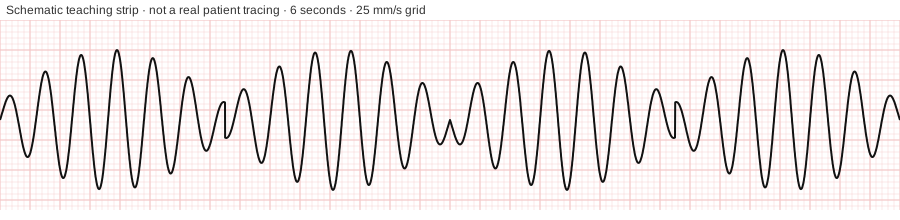
Schematic teaching strip, not a real patient tracing. Text description: Schematic 6-second rhythm strip: rapid, wide complexes at roughly 250 per minute whose height and shape keep changing, growing taller and then shorter in a repeating twisting pattern. No P waves. This is a fast polymorphic ventricular rhythm.
Choose one.
Show answer
Answer and explanation
Answer: A. Immediate defibrillation (an unsynchronized shock)
The strip shows polymorphic ventricular tachycardia, and the patient has collapsed. The 2025 AHA guidelines say polymorphic VT is always unstable and should be treated immediately with defibrillation, because delays in shock delivery worsen outcomes. B: with constantly changing QRS shapes, the monitor can't reliably time a synchronized shock, and waiting for it delays treatment. D: pacing treats slow rhythms. C: adenosine has no role here and only delays the shock.
Source: AHA 2025 Guidelines, Part 9: Adult Advanced Life Support, Top 10 Take-Home Messages, item 8; §16 Polymorphic Ventricular Tachycardia, recommendation 1 and supportive text 1.
Question 10
Medical direction has ordered an infusion of 8 mcg/min. The prepared bag contains 4 mg of the drug in a final volume of 250 mL. At what rate should you set the pump? (This is a math item; the drug and order are fictional and not a dosing recommendation.)
Choose one.
Show answer
Answer and explanation
Answer: B. 30 mL/hour
Convert first: 4 mg = 4,000 mcg. Concentration: 4,000 mcg ÷ 250 mL = 16 mcg/mL. Volume per minute: 8 mcg/min ÷ 16 mcg/mL = 0.5 mL/min. Per hour: 0.5 mL/min × 60 = 30 mL/hour. A: halves the answer, for example, from dividing by 32. C: doubles it, for example, from using 8 mcg/mL. D: 120 mL/hour would deliver 32 mcg/min, four times the ordered rate. Write the units at every step and they'll catch most of these errors.
Source: worked calculation; no outside source needed.
Case 1: An allergic reaction at a restaurant
Fictional patient for practice. A 34-year-old woman (about 70 kg) developed itching, hives, lip swelling, throat tightness, and wheezing about 10 minutes after eating shrimp. She is anxious and lightheaded. HR 124, BP 82/50, RR 28, SpO₂ 91% on room air, glucose 104 mg/dL. No known allergies, no medications, no autoinjector.
Each case follows a fixed course. New information appears at the question that uses it, so answer in order.
Question 11
Which three findings matter most right now?
Select 3.
Show answer
Answer and explanation
Answer: B, D, E. Hives and lip swelling soon after eating shrimp; BP 82/50; Throat tightness and wheezing
Skin and lip involvement after a likely allergen, plus airway and breathing symptoms and low blood pressure, are the cues that define how sick she is. A normal glucose helps rule out a mimic, "no known allergies" doesn't exclude a first reaction, and anxiety is expected. None of those changes what you do next.
Source: World Allergy Organization, Anaphylaxis Guidelines poster (2021; based on 2020 guidance), Single-page poster, diagnostic criterion 1; AAAAI/ACAAI, Anaphylaxis: A 2023 Practice Parameter Update, Box 1, item 1 (PDF p. 9).
Question 12
What best explains her presentation?
Choose one.
Show answer
Answer and explanation
Answer: B. Anaphylaxis with shock
Rapid onset after an allergen with skin, airway, and circulation involvement is anaphylaxis, and the hypotension makes it severe. D: she takes no ACE inhibitor, and the rapid food-associated hives with respiratory and circulatory compromise strongly support anaphylaxis. C: anxiety doesn't cause hives, lip swelling, or BP 82/50. A: wheezing is one piece; asthma doesn't explain the skin findings or the shock.
Source: World Allergy Organization, Anaphylaxis Guidelines poster (2021; based on 2020 guidance), Single-page poster, diagnostic criterion 1; AAAAI/ACAAI, Anaphylaxis: A 2023 Practice Parameter Update, Box 1, item 1 (PDF p. 9).
Question 13
What is the first medication and dose?
Choose one.
Show answer
Answer and explanation
Answer: B. Epinephrine 0.5 mg (1 mg/mL) IM in the mid-anterolateral thigh
IM epinephrine is first-line. The weight-based dose is 0.01 mg/kg of the 1 mg/mL solution, capped at 0.5 mg for an adult, injected into the mid-anterolateral thigh. D: the arithmetic is right, but it ignores the adult maximum. C: a 0.5 mg rapid IV bolus is an unsafe initial treatment for this patient; the indicated initial route is IM. A: antihistamines don't treat airway swelling or shock and must never delay epinephrine.
Source: World Allergy Organization, Anaphylaxis Guidelines poster (2021; based on 2020 guidance), Single-page poster, treatment step 5; AAAAI/ACAAI, Anaphylaxis: A 2023 Practice Parameter Update, PDF pp. 4 and 19, epinephrine dosing; PDF p. 31, Dosage and Needle Length and Pressure; Resuscitation Council UK, Emergency Treatment of Anaphylaxis (May 2021), §5.1.2, IV adrenaline, p. 30; §5.4, Antihistamines, p. 32.
Question 14
Sort each action into the correct group.
Sort every item.
Show answer
Answer and explanation
Answer:
- Immediate priorities: B, C, E, F
- Not initial lifesaving treatment: A, D
Epinephrine, positioning, oxygen, and fluid for shock address what threatens her life. The WAO guideline warns that sudden standing or sitting can be fatal in anaphylactic shock. Antihistamines may relieve persistent skin symptoms after stabilization. Corticosteroid benefit in anaphylaxis is unproven, and they must not replace epinephrine or be presented as reliable prevention of biphasic reactions. Every entry must be in the right group to score.
Source: World Allergy Organization, Anaphylaxis Guidelines poster (2021; based on 2020 guidance), Single-page poster, treatment steps 5–8; AAAAI/ACAAI, Anaphylaxis: A 2020 Practice Parameter Update, Question 2, printed p. 1086 (PDF p. 5); detailed recommendation, printed p. 1115 (PDF p. 34); ASCIA Guidelines: Acute Management of Anaphylaxis (content updated September 2026), Adjunct Medications for the Treatment of Anaphylaxis.
Question 15
Five minutes after the first dose she is still wheezing, and BP is 84/52. What now?
Choose one.
Show answer
Answer and explanation
Answer: B. Repeat IM epinephrine
When the response is inadequate, IM epinephrine can be repeated every 5–15 minutes; most patients respond to one or two doses. C: waiting with ongoing hypotension and wheezing is the error. D: a corticosteroid cannot replace repeat epinephrine for persistent anaphylaxis. A: she still has respiratory symptoms and shock.
Source: World Allergy Organization, Anaphylaxis Guidelines poster (2021; based on 2020 guidance), Single-page poster, treatment step 5; ASCIA Guidelines: Acute Management of Anaphylaxis (content updated September 2026), Adjunct Medications for the Treatment of Anaphylaxis.
Question 16
Update: After the second dose her wheezing stops, BP is 112/70, and the hives are fading. She's alert and says, "I feel fine now. I don't want to go to the hospital."
What is the best response?
Choose one.
Show answer
Answer and explanation
Answer: D. Warn that symptoms can return, urge transport, and if she refuses with capacity, document it and advise calling back
Symptoms can recur after apparent recovery. Her severe initial reaction and need for two epinephrine doses increase concern for recurrence, so urge transport for further evaluation and observation. Reassess decision-making capacity; alertness alone does not establish it. If she refuses with capacity, the model guideline calls for explaining the risks, telling her she can re-engage EMS, and documenting the discussion. Follow local refusal policy and consult medical direction when required or when capacity is uncertain. B: a signature without the recurrence warning isn't an informed refusal. C: having received treatment doesn't remove capacity. A: leaving medication isn't a substitute for evaluation, and there's no documented refusal.
Source: AAAAI/ACAAI, Anaphylaxis: A 2023 Practice Parameter Update, Box 1, item 5 (PDF p. 9); Recommendation 26 (PDF p. 27); NASEMSO National Model EMS Clinical Guidelines, Version 3.0 (March 2022), pp. 23–24, Patient Refusals: Assessment 1, Decision-Making Capacity; Treatment and Interventions 1–5; Key Considerations 1–4.
More practice questions
Question 17
Sort each presentation to its most likely cause.
Sort every item.
Show answer
Answer and explanation
Answer:
- Pyelonephritis: C, D
- Kidney stone: A
- Acute cholecystitis: B
Fever plus urinary symptoms and flank (CVA) tenderness points to a kidney infection. Isolated one-sided flank pain with blood in the urine and no fever points to a stone. Right upper quadrant pain with fever and known gallstones points to the gallbladder.
Source: NASEMSO National Model EMS Clinical Guidelines, Version 3.0 (March 2022), p. 52, Abdominal Pain: Assessment 6.e–f and 8.a.
Question 18
During CPR on an adult, your partner has placed an endotracheal tube. How should ventilations be given now?
Choose one.
Show answer
Answer and explanation
Answer: C. 1 breath every 6 seconds while compressions continue without pausing
With an advanced airway in place, the AHA recommends 1 breath every 6 seconds (10 per minute) during continuous compressions. D: the 30:2 pause is for CPR before an advanced airway. A, B: overventilation raises pressure in the chest and reduces blood return to the heart.
Source: AHA 2025 Guidelines, Part 9: Adult Advanced Life Support, §14 Advanced Airway Placement During Resuscitation, recommendation 9; NASEMSO National Model EMS Clinical Guidelines, Version 3.0 (March 2022), p. 182, Airway Management: Patient Safety Considerations 2.
Question 19
You stick yourself with a used IV catheter. Which two actions are correct?
Select 2.
Show answer
Answer and explanation
Answer: A, C. Report the exposure right away so post-exposure evaluation can start; Wash the site with soap and water
CDC guidance: wash needlesticks with soap and water. There's no evidence that squeezing the wound lowers the risk, and caustic agents like bleach aren't recommended. Report promptly and seek immediate medical evaluation so any indicated post-exposure prophylaxis can start without delay.
Source: CDC, Exposure to Blood: What Healthcare Personnel Need to Know (updated July 2003), Printed p. 2 (PDF p. 4), If an Exposure Occurs: immediate care, no squeezing or caustic agents; CDC/NIOSH, Bloodborne Infectious Disease Risk Factors (February 13, 2025), Treatment; Post-exposure prophylaxis; Prevention, Reporting.
Question 20
A 66-year-old dialysis patient missed his last two sessions. He is weak and lightheaded. The monitor shows HR 38 with wide QRS complexes and tall, peaked T waves. Which problem should you suspect first?
Choose one.
Show answer
Answer and explanation
Answer: A. Hyperkalemia
Missed dialysis, a slow wide-complex rhythm, and peaked T waves all point to high potassium. The model guideline specifically says to consider hyperkalemia in a wide-complex bradycardia, and the AHA lists peaked T waves among its ECG signs. D: the missed dialysis and peaked T waves favor potassium excess. B: check glucose, but hypoglycemia is a less fitting explanation for this history and ECG pattern. C: nothing suggests cold exposure. Treatment, such as IV calcium, follows your protocol.
Source: NASEMSO National Model EMS Clinical Guidelines, Version 3.0 (March 2022), p. 37, Bradycardia: Key Considerations 5; AHA 2025 Guidelines, Part 10: Adult and Pediatric Special Circumstances of Resuscitation, §15 Hyperkalemia, Synopsis: ECG findings; UK Kidney Association, Management of Hyperkalaemia in Adults (updated July 2026), §16.2a–b, p. 76: IV calcium for hyperkalemia with ECG changes.
Question 21
An adult is in cardiac arrest. Asystole is confirmed, good CPR is underway, and IO access is in place. What is the next drug step?
Choose one.
Show answer
Answer and explanation
Answer: B. Epinephrine 1 mg IO as soon as feasible, then every 3–5 minutes
For nonshockable rhythms, it's reasonable to give epinephrine as soon as feasible, 1 mg every 3–5 minutes. C: asystole isn't shockable. D: amiodarone or lidocaine is considered for VF or pulseless VT that doesn't respond to shocks. A: routine sodium bicarbonate isn't recommended.
Source: AHA 2025 Guidelines, Part 9: Adult Advanced Life Support, §10 Vasopressors, recommendations 1–3; §11 Nonvasopressor Medications, recommendations 1 and 5.
Question 22
A tourniquet on a lower-leg wound is properly positioned and fully tightened, but bright red bleeding continues. What is the best next step?
Choose one.
Show answer
Answer and explanation
Answer: A. Apply a second tourniquet on the skin, side by side and just above the first, avoiding a joint
TCCC guidance: if the first tourniquet doesn't control the bleeding, apply a second one side by side with the first. Tourniquets go directly on the skin, 2–3 inches above the bleeding site. B, D: do not loosen or remove the tourniquet while severe bleeding is uncontrolled. C: elevation doesn't control arterial bleeding.
Source: Committee on TCCC, Tactical Combat Casualty Care Guidelines (1 May 2026), Tactical Field Care, §3.a, Massive Hemorrhage: second tourniquet adjacent to the first; NASEMSO National Model EMS Clinical Guidelines, Version 3.0 (March 2022), pp. 225–226, Extremity Trauma/External Hemorrhage Management: Treatment 1.b–c.
Question 23
A farmworker exposed to an organophosphate pesticide has pinpoint pupils, heavy airway secretions, wheezing, and trouble breathing. You are giving atropine per protocol. What is the endpoint for repeating it?
Choose one.
Show answer
Answer and explanation
Answer: A. Airway secretions diminish and ventilation improves
Atropine is repeated until secretions diminish and breathing is comfortable, because the flooded airway and bronchospasm are what kill. B: normalizing pupil size is not the primary treatment endpoint. D: a heart-rate threshold of 120/min is not the endpoint; reassess perfusion as well as secretions and ventilation. C: atropine does not reverse nicotinic muscle weakness or paralysis. Pralidoxime may help in organophosphate poisoning, but its effectiveness depends on the agent and timing.
Source: AHA 2025 Guidelines, Part 10: Adult and Pediatric Special Circumstances of Resuscitation, §21.12, Organophosphates and Carbamates: Synopsis; recommendation-specific supportive text 1 and 7–8; EPA, Recognition and Management of Pesticide Poisonings, Sixth Edition (2013), Chapter 5, Organophosphates: Treatment items 2 and 5, printed pp. 48–51.
Question 24
A man has a deep stab wound in the left groin with steady, heavy bleeding. The wound is too high on the leg for a limb tourniquet, and you have no junctional tourniquet. What is the best way to control the bleeding?
Choose one.
Show answer
Answer and explanation
Answer: D. Pack the wound with hemostatic gauze and hold firm pressure for at least 3 minutes
For compressible bleeding that a limb tourniquet can't control, TCCC calls for a hemostatic dressing packed into the wound with at least 3 minutes of direct pressure, or a junctional tourniquet if one is available. Continue pressure until bleeding is controlled and follow the dressing's instructions. B: a tourniquet below the bleeding point won't stop flow from a vessel above it. A: packing plus sustained pressure is the more appropriate measure for this deep junctional wound; surface pressure alone may not control it. C: elevation and cold don't stop major hemorrhage.
Source: Committee on TCCC, Tactical Combat Casualty Care Guidelines (1 May 2026), Tactical Field Care, §3.b, Massive Hemorrhage: hemostatic dressings, at least 3 minutes of direct pressure, and junctional tourniquets; NASEMSO National Model EMS Clinical Guidelines, Version 3.0 (March 2022), p. 226, Extremity Trauma/External Hemorrhage Management: Treatment 1.c.ii–iii and 1.d.
Case 2: An 8-month-old with a racing heart
Fictional patient for practice. An 8-month-old (about 9 kg) has been fussy and feeding poorly for 2 hours. The parent says the heart "started racing all at once." HR 260, regular, and it doesn't change when the baby cries. RR 36, SpO₂ 97%, temperature 37.2 °C (99 °F), capillary refill 2 seconds, alert and crying. The monitor shows the strip below.
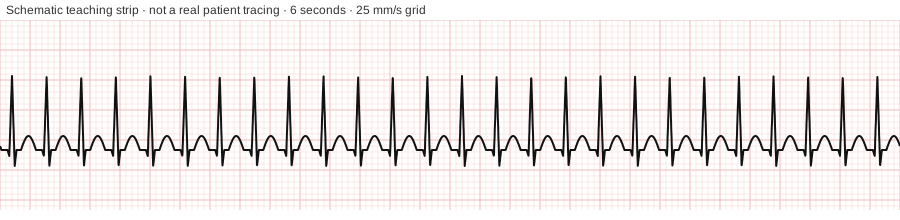
Schematic teaching strip, not a real patient tracing. Text description: Schematic 6-second rhythm strip: regular, narrow QRS complexes at 260 per minute (about 0.23 seconds apart), QRS about 0.06 seconds wide, no visible P waves, identical spacing throughout.
Each case follows a fixed course. New information appears at the question that uses it, so answer in order.
Question 25
Which three findings point toward the heart rhythm being the problem?
Select 3.
Show answer
Answer and explanation
Answer: C, E, F. The rate "started racing all at once"; No visible P waves on the strip; HR 260 that doesn't change when the baby cries
A fixed rate at or above 220 in an infant, absent P waves, and an abrupt onset are the features the AHA uses to separate supraventricular tachycardia from sinus tachycardia. The temperature is essentially normal, so there's no fever driving a sinus tachycardia, and RR 36 is within the normal infant range of 30–60.
Source: AHA 2025 Pediatric Tachyarrhythmia With a Pulse Algorithm (text version), pp. 1–2, sinus-tachycardia and probable-SVT features; p. 1, QRS duration assessment; NASEMSO National Model EMS Clinical Guidelines, Version 3.0 (March 2022), p. 16, Table 1, Normal Vital Signs.
Question 26
What rhythm is most likely?
Choose one.
Show answer
Answer and explanation
Answer: C. Supraventricular tachycardia
An infant rate of 220 or more, no rate variability, no P waves, and an abrupt start add up to SVT. D: sinus tachycardia has P waves, varies with activity, and usually stays below 220 in infants. B: the QRS complexes are narrow. A: the rhythm is regular.
Source: AHA 2025 Pediatric Tachyarrhythmia With a Pulse Algorithm (text version), pp. 1–2, probable-SVT features and QRS duration assessment.
Question 27
Update: Vagal maneuvers didn't convert the rhythm. An IV is in place, and the infant still has good perfusion.
What first adenosine dose do you give?
Choose one.
Show answer
Answer and explanation
Answer: B. 0.9 mg rapid push, then flush
The first dose is 0.1 mg/kg (maximum 6 mg): 0.1 mg/kg × 9 kg = 0.9 mg, pushed rapidly with an immediate flush. A: a decimal error (0.01 mg/kg). C: that's the 0.2 mg/kg second dose. D: the adult first dose, far too much for 9 kg.
Source: AHA 2025 Pediatric Tachyarrhythmia With a Pulse Algorithm (text version), p. 2, Adenosine IV/IO Dose; NASEMSO National Model EMS Clinical Guidelines, Version 3.0 (March 2022), p. 44, Pediatric Management 2.f.i.
Question 28
You tell your partner, "Give 0.9 milligrams of adenosine, rapid push, then flush." Which response best closes the loop before the drug is given?
Choose one.
Show answer
Answer and explanation
Answer: A. Your partner repeats "0.9 milligrams adenosine, rapid push, then flush," and you say "Correct"
A check-back (repeat-back) is closed-loop communication: the receiver repeats the information, and the sender confirms it. With a tenfold decimal error one slip away in a 9-kg infant, the repeat-back is how a wrong number gets caught before it's given. D: acknowledges without confirming the content. C: leaves no chance to catch a mishearing. B: abandons team communication and adds task overload.
Source: AHRQ TeamSTEPPS, Check-Back, definition and example.
Question 29
Update: After two adenosine doses, the rhythm remains regular and narrow-complex at 260, and a pulse is present. The infant is now gray and lethargic, with a capillary refill of 5 seconds.
What next?
Choose one.
Show answer
Answer and explanation
Answer: B. Synchronized cardioversion at 0.5–1 J/kg (about 4.5–9 J)
SVT with signs of poor perfusion calls for synchronized cardioversion starting at 0.5–1 J/kg, increased to 2 J/kg if it isn't effective; sedate if you can, but don't delay. For 9 kg that's 4.5–9 J. D: the algorithm has no third, larger adenosine dose. A: this is a regular narrow-complex rhythm with a pulse, so synchronized cardioversion is appropriate. C: the infant is now unstable.
Source: AHA 2025 Pediatric Tachyarrhythmia With a Pulse Algorithm (text version), p. 1, cardiopulmonary compromise and narrow-complex treatment; p. 2, Synchronized Cardioversion; NASEMSO National Model EMS Clinical Guidelines, Version 3.0 (March 2022), p. 44, Pediatric Management 2.f.ii.
More practice questions
Question 30
Which patient is the best candidate for CPAP?
Choose one.
Show answer
Answer and explanation
Answer: C. An alert 70-year-old with crackles, pink frothy sputum, SpO₂ 86%, and BP 170/100
Noninvasive ventilation is recommended for selected patients with prehospital respiratory failure, and acute cardiogenic pulmonary edema is a well-established use. This patient is alert and has blood pressure to spare. A: NIV isn't for unresponsive patients; he needs ventilations given directly. B: positive pressure may worsen a pneumothorax. D: NIV calls for caution in cardiogenic or hypovolemic shock, because positive pressure can drop the blood pressure further.
Source: NAEMSP, EMS Subspecialty Certification Review: Respiratory (2025), PDF pp. 6–7, slides 18–20: NIV uses, patient selection and reduced venous return; PDF p. 10, pneumothorax physiology; NASEMSO National Model EMS Clinical Guidelines, Version 3.0 (March 2022), pp. 180–182, Airway Management, Treatment and Interventions 4–5 and Patient Safety Considerations 2 and 10.
Question 31
Ten minutes into CPAP for pulmonary edema, your patient stops responding to voice and vomits into the mask. Suction and a bag-valve mask are ready. What should you do?
Choose one.
Show answer
Answer and explanation
Answer: D. Remove CPAP, suction the airway, and ventilate with the bag-valve mask
CPAP depends on a patient who can protect their own airway. Reduced consciousness and vomiting are contraindications, and a sealed mask over vomit invites aspiration. Take it off, clear the airway, and ventilate. A, B, C: each leaves a sealed mask on an unprotected, vomiting airway.
Source: NASEMSO National Model EMS Clinical Guidelines, Version 3.0 (March 2022), pp. 180–182, Airway Management, Treatment and Interventions 3.b/4 and Patient Safety Consideration 10; NAEMSP, EMS Subspecialty Certification Review: Respiratory (2025), PDF pp. 6–7, slides 18–20: patient cooperation, intact respiratory drive, airway reflexes and mental status.
Question 32
A 23-year-old fainted while sitting at her desk and now feels fine. Which three 12-lead findings raise concern for a high-risk cause?
Select 3.
Show answer
Answer and explanation
Answer: A, D, F. Corrected QT (QTc) of about 520 ms; Incomplete right bundle branch block pattern in V1–V2 with ST-segment elevation; Short PR interval with a delta wave
QT prolongation (generally over 500 ms), delta waves (pre-excitation), and the Brugada pattern are named high-risk ECG features in syncope. A normal ECG, respiratory sinus arrhythmia, and artifact aren't. A normal ECG still doesn't make syncope low risk on its own.
Source: NASEMSO National Model EMS Clinical Guidelines, Version 3.0 (March 2022), p. 28, Syncope Key Considerations 4.
Question 33
Four patients have abdominal pain with normal vital signs. Whose pain should concern you most for serious illness?
Choose one.
Show answer
Answer and explanation
Answer: D. An 81-year-old taking apixaban with new, vague abdominal pain
Abdominal pain in older adults and in patients on anticoagulants (also children under 2 and immunocompromised patients) may signal severe illness. Normal vital signs don't rule out bleeding, ischemia, or perforation. A, B, C: none has the combined age-related and anticoagulation risks given in D; those histories still require assessment.
Source: NASEMSO National Model EMS Clinical Guidelines, Version 3.0 (March 2022), p. 52, Abdominal Pain, Patient Safety Considerations.
Question 34
At the emergency department, you give the nurse a report including the patient's history and the medications you gave. The patient didn't sign anything. Under HIPAA, this disclosure is:
Choose one.
Show answer
Answer and explanation
Answer: B. Permitted, because sharing information with another provider for treatment needs no authorization
HHS states that the Privacy Rule permits an ambulance service to disclose protected health information to another health care provider, such as a hospital, for that provider's treatment of the patient, without the patient's authorization. A, C, D add conditions the rule doesn't impose on treatment disclosures.
Source: HHS HIPAA FAQ 273: ambulance reporting to a hospital, FAQ answer.
Question 35
Twenty minutes after an uncomplicated home birth, the placenta has delivered and the mother is bleeding heavily. Her uterus feels soft and boggy. Which two actions are appropriate?
Select 2.
Show answer
Answer and explanation
Answer: C, E. Tranexamic acid 1 g IV over 10 minutes, if it's in your protocols (recommended within 3 hours of birth); Firm uterine (fundal) massage
WHO recommends uterine massage to treat postpartum hemorrhage, and early IV tranexamic acid (1 g over 10 minutes) within 3 hours of birth. The placenta has already delivered; pulling on the cord is not a treatment for the bleeding described. Vaginal packing is not an appropriate treatment here, and delaying transport for a hemorrhaging patient is dangerous.
Source: WHO, FIGO and ICM, Consolidated guidelines for the prevention, diagnosis and treatment of postpartum haemorrhage (2025), pp. 44–45, Recommendations 26–27: uterine massage and IV tranexamic acid treatment; p. 34, Recommendation 16: controlled cord traction context.
Question 36
At a bus crash, you're the first paramedic doing adult START triage. Put START's assessment steps in order, first to last.
Put in order.
Show answer
Answer and explanation
Answer: B → D → E → A → C.
- Direct everyone who can walk to a collection area (minor)
- Check breathing; reposition the airway of anyone not breathing (breathing resumes → immediate; still not breathing → dead/expectant)
- Check the respiratory rate: above 30 → immediate
- Check perfusion: no radial pulse → immediate
- Check mental status: can they follow a simple command? If not → immediate
START moves from the fastest sort (walking) through respirations, perfusion, and mental status so one rescuer can triage many patients quickly. Anyone who doesn't fall into minor, immediate, or dead is delayed. Once an immediate criterion is met, tag the patient and move to the next patient; continue to the next assessment step only if that criterion is not met.
Source: HHS CHEMM, START Adult Triage Algorithm (updated September 2, 2026), About START; Algorithm Description: adult scope, categories and clinical parameters; LAFD/CERT-LA, Simple Triage and Rapid Treatment (START), pp. 3–5, initial walking sort and RPM assessment sequence; Northwestern Medicine / MWLC EMS, Paramedic Program Skills Manual (2021–2022), PDF p. 131 (printed p. 128), START PRIMARY TRIAGE: respiratory-status branches, perfusion and mental status.
Question 37
A 2-year-old has a barky cough, stridor that's easily heard at rest, and mild retractions. She's alert and sitting on her mother's lap. Which treatment is most appropriate under your protocols?
Choose one.
Show answer
Answer and explanation
Answer: C. Nebulized epinephrine, with dexamethasone
Stridor easily heard at rest marks at least moderate croup. Nebulized epinephrine is recommended for moderate to severe croup, and corticosteroids (dexamethasone) are recommended across all severities. Keep her calm on the parent's lap. B: nebulized epinephrine works regardless of age and weight. A: croup is swelling of the upper airway, not bronchospasm. D: stridor at rest isn't the mild end of croup.
Source: Canadian Paediatric Society, Acute management of croup in the emergency department, severity table; epinephrine and corticosteroid recommendations.
Question 38
An adult with altered mental status opens his eyes when you speak to him, answers questions but is confused about the date and place, and reaches up to push your hand away from a pressure point on his trapezius. What is his Glasgow Coma Scale score?
Choose one.
Show answer
Answer and explanation
Answer: C. 12
Eyes to speech = 3, confused speech = 4, localizes pain = 5, for a total of 12. A, B: usually come from scoring the motor response as withdrawal (4) or the verbal response too low. D: scores eye opening as spontaneous. The model guideline notes that the motor score alone can be as useful as the full GCS, and that a sternal rub is a discouraged stimulus.
Source: NASEMSO National Model EMS Clinical Guidelines, Version 3.0 (March 2022), p. 11, 8.a.i–ii; p. 17, Table 2.
Question 39
A 68-year-old has severe abdominal pain that worsens with any movement, a distended abdomen that sounds hollow (tympanic) when tapped, vomiting, and no stool or gas for 2 days. Which problem fits best?
Choose one.
Show answer
Answer and explanation
Answer: B. Ischemic, perforated, or obstructed bowel
Pain with motion, distension with tympany, vomiting, and no passage of stool or gas are the model guideline's warning signs for ischemic, necrotic, or perforated bowel, a surgical emergency. C: uncomplicated gastritis does not explain this combination of distension, obstipation, and pain with movement. D: no flank or urinary findings are given, and a ureteral stone does not explain the full pattern. A: no urinary symptoms are described, and cystitis does not explain the full pattern.
Source: NASEMSO National Model EMS Clinical Guidelines, Version 3.0 (March 2022), p. 51, Abdominal Pain: Assessment 6.a.
Question 40
A woman with chest pain speaks only Vietnamese. Her 9-year-old grandson offers to interpret. What is the best way to get her allergy and medication history?
Choose one.
Show answer
Answer and explanation
Answer: B. Use a phone or video interpreter and confirm allergies with a second source, such as family or medical records
The model guideline lists telephone interpreter services among the tools for language barriers, and recommends confirming key information such as allergies from a second source (family, interpreters, or records). D: a child relaying medical terms is a weak single source for high-stakes information. A, C: skip or degrade the history instead of solving the barrier.
Source: NASEMSO National Model EMS Clinical Guidelines, Version 3.0 (March 2022), pp. 19–20, Functional Needs: Safety Considerations; Key Considerations 1.a.iv.
Question 41
A roofer working on a hot afternoon is confused and slurring his words. His skin is flushed and he is sweating heavily. A coworker says, "It can't be heat stroke. He's still sweating." What is the best response?
Choose one.
Show answer
Answer and explanation
Answer: D. Start rapid cooling with cold water or ice on scene, and transport
CDC/NIOSH lists heat stroke symptoms as confusion or altered mental status, slurred speech, "hot, dry skin or profuse sweating," and a very high body temperature. Sweating doesn't exclude it. Altered mental status in the heat is the warning sign, and the first aid is fast cooling with cold water or ice plus emergency care. B: wrong premise. A: delays cooling, and a confused patient shouldn't be drinking. C: a glucose check is reasonable in altered mental status, but a normal value doesn't explain or clear the confusion.
Source: CDC/NIOSH, Heat-Related Illnesses (Mar. 3, 2026), Heat stroke: symptoms and first aid; NASEMSO National Model EMS Clinical Guidelines, Version 3.0 (March 2022), p. 10, Universal Care 5.d.iii.
Question 42
At a large incident with an established incident command structure, you've been assigned to the treatment area under the treatment supervisor. An officer from another agency tells you to leave and help at the triage area. What should you do?
Choose one.
Show answer
Answer and explanation
Answer: D. Stay put and route the request through your treatment supervisor
Under unity of command, each person on an incident reports to only one supervisor, and formal communication follows the lines of authority. That's what prevents conflicting orders from scattering resources. Raise the request with your supervisor, who can reassign you if that's the right call. A, C: create exactly the conflicting-directive confusion the structure is designed to prevent. B: the request may matter; it needs to reach the right person.
Source: FEMA IS-200.c, Chain of Command and Unity of Command, Chain of Command and Unity of Command; Formal Communication.
Question 43
During CPR on an intubated adult, the end-tidal CO₂ has been 14 mmHg. With no change in compressions, it abruptly rises to 42 mmHg. What is the most likely explanation?
Choose one.
Show answer
Answer and explanation
Answer: C. Return of spontaneous circulation
An abrupt rise in EtCO₂ during compressions can signal return of spontaneous circulation, so check for a pulse at the next opportunity. B: an esophageal tube drops EtCO₂ toward zero. D: fatigue lowers EtCO₂. A: overventilation lowers it too.
Source: AHA 2025 Guidelines, Part 9: Adult Advanced Life Support, §12 Adjuncts to CPR.
Case 3: Chest trauma and a head injury
Fictional patient for practice. A 34-year-old unrestrained driver hit a pole. He has a large bruise over the right chest. GCS 9 (eyes open to pain, inappropriate words, withdraws from pain). HR 118, BP 112/70, RR 28 with shallow breaths and poor chest rise, SpO₂ 88% on room air. Breath sounds are initially present on both sides. Your partner starts bag-mask ventilation with oxygen while you prepare for transport.
Six minutes later: right-sided breath sounds are absent, SpO₂ is 82%, HR 136, BP 76/50, and the skin is pale and cool.
Each case follows a fixed course. New information appears at the question that uses it, so answer in order.
Question 44
Which three changes most strongly suggest a new, immediately life-threatening chest problem?
Select 3.
Show answer
Answer and explanation
Answer: C, D, F. Absent breath sounds on the right; SpO₂ falling from 88% to 82% despite ventilation; New shock: BP 76/50, HR 136, pale and cool skin
In a patient with torso trauma, absent or markedly decreased breath sounds on one side, SpO₂ below 90%, and shock are findings TCCC lists for suspecting tension pneumothorax. The important changes are the new unilateral breath-sound loss, worsening hypoxemia, and shock. The bruise and the first respiratory rate were already known, and the unchanged GCS doesn't explain the collapse.
Source: Committee on TCCC, Tactical Combat Casualty Care Guidelines (1 May 2026), Tactical Field Care §5, Respiration/Breathing: suspected tension-pneumothorax findings and initial treatment; NASEMSO National Model EMS Clinical Guidelines, Version 3.0 (March 2022), p. 209, General Trauma, Treatment and Interventions 3.a: suspected tension pneumothorax and affected-side decompression.
Question 45
What is the most likely cause of his deterioration?
Choose one.
Show answer
Answer and explanation
Answer: B. Right tension pneumothorax
Chest trauma, then positive-pressure ventilation, then absent breath sounds on one side, falling SpO₂, and shock. A, C, D: none of these explains breath sounds disappearing on one side. Neurogenic shock and the head injury don't change lung findings, and tamponade affects the heart, not one lung field.
Source: Committee on TCCC, Tactical Combat Casualty Care Guidelines (1 May 2026), Tactical Field Care §5, Respiration/Breathing: suspected tension-pneumothorax findings and initial treatment; NASEMSO National Model EMS Clinical Guidelines, Version 3.0 (March 2022), p. 209, General Trauma, Treatment and Interventions 3.a: suspected tension pneumothorax and affected-side decompression.
Question 46
Which site is appropriate for needle decompression?
Choose one.
Show answer
Answer and explanation
Answer: A. Right 5th intercostal space, anterior axillary line
TCCC lists two sites on the affected side: the 5th intercostal space at the anterior axillary line, or the 2nd intercostal space at the midclavicular line. It warns never to insert medial to the nipple line. C, D: too medial, risking the heart and great vessels. B: a correct landmark on the wrong side.
Source: Committee on TCCC, Tactical Combat Casualty Care Guidelines (1 May 2026), Tactical Field Care §5, Respiration/Breathing: initial treatment of suspected tension pneumothorax, needle-site note and insertion precautions.
Question 47
Update: Your team performed right needle decompression at the 5th intercostal space, anterior axillary line. After decompression, BP is 118/72 and SpO₂ 95%. He still doesn't respond to voice. You are still on scene.
Where should he go? The highest-level trauma center is 50 minutes away by ground. A non-trauma emergency department is 10 minutes away. An air medical unit can reach you in 10 minutes and get him to the trauma center well before ground could. His airway is being managed effectively with the bag-valve mask.
Choose one.
Show answer
Answer and explanation
Answer: C. Request air medical transport to the highest-level trauma center
His motor response (unable to follow commands) and his shock put him in the red field-triage category, which means the highest-level trauma center available. The model guideline suggests considering air medical transport for time-critical patients when ground transport exceeds 30 minutes and air saves significant time. D: the closer ED does not provide the definitive trauma care he needs, and nothing in the stem requires stopping there first for immediate stabilization. B: a 50-minute ground transport gives up a much faster option for a critical patient. A: waiting on scene delays definitive care; local protocols set exact destination and air-medical rules.
Source: National Guideline for the Field Triage of Injured Patients: 2021 update (published 2022), PDF p. 27, Transport Recommendations; PDF pp. 48–49, Table 2, high-risk criteria and destination recommendations; NASEMSO National Model EMS Clinical Guidelines, Version 3.0 (March 2022), pp. 13–14, Universal Care: Safety 7 and Key Considerations 7.
Question 48
Update: The aircraft is on the way. There are no signs of brain herniation.
While you wait, what ventilation target fits his head injury?
Choose one.
Show answer
Answer and explanation
Answer: A. About 10 breaths/min, keeping EtCO₂ 35–45 mmHg
Prehospital TBI guidelines target EtCO₂ of 35–45 mmHg (about 10 breaths a minute), keep SpO₂ above 90%, and keep systolic BP at 110 mmHg or higher for a patient his age. D: hyperventilation should be avoided unless there are signs of active herniation. B: hypoxia below 90% must be corrected right away. C: oxygenation and ventilation both matter for the injured brain.
Source: Brain Trauma Foundation, Guidelines for Prehospital Management of Traumatic Brain Injury, 3rd edition (2023), PDF pp. 4–5, oxygenation and blood-pressure assessment recommendations; PDF p. 13, Airway/Oxygenation/Ventilation recommendation F.
Question 49
Update: Before the aircraft lands, his right pupil becomes fixed and dilated, and he develops extensor posturing.
What is the most appropriate change?
Choose one.
Show answer
Answer and explanation
Answer: D. Hyperventilate to an EtCO₂ target of 30–35 mmHg
With signs of active brain herniation, the prehospital TBI guidelines allow hyperventilation targeting EtCO₂ of 30–35 mmHg. It's a narrow, temporary measure, not open-ended overbreathing. B: goes beyond the target, further reducing blood flow to the brain. C: ignores the new herniation signs; also tell the receiving team about the change. A: stopping ventilation is dangerous in a patient who needs support.
Source: Brain Trauma Foundation, Guidelines for Prehospital Management of Traumatic Brain Injury, 3rd edition (2023), PDF p. 18, Hyperventilation and Hyperosmolar Therapy recommendations A–C: active or imminent herniation signs and EtCO₂ 30–35 mmHg.
Question 50
Update: The team increased ventilation and is maintaining an EtCO₂ of 30–35 mmHg while continuing oxygenation, blood-pressure, and neurologic monitoring. The flight crew is ready for handoff.
When the flight crew takes over, which three statements belong in an accurate handoff report?
Select 3.
Show answer
Answer and explanation
Answer: A, D, F. "34-year-old unrestrained driver versus a pole, bruising over the right chest"; "Right pupil became fixed and dilated with extensor posturing on scene; we increased ventilations to an EtCO₂ target of 30–35"; "Right needle decompression at the 5th intercostal space, anterior axillary line; afterward BP went from 76/50 to 118/72 and SpO₂ from 82% to 95%"
A good handoff covers the mechanism, the interventions with their timing, and how the patient responded, including changes in his condition. The model guideline lists exactly these elements. C states a diagnosis nobody has made yet. B misstates his GCS (9). E claims a procedure that never happened; he was ventilated with a bag-valve mask.
Source: NASEMSO National Model EMS Clinical Guidelines, Version 3.0 (March 2022), pp. 12–13, Universal Care: Transfer of Care 4.
Score your practice run
Give yourself one point only when your first answer, made before you opened the explanation, matches the whole key. Multiple-response questions need the exact set, and ordering, sorting, and row-by-row questions need every part right. That matches the real exam's all-or-nothing scoring of scored items, with no partial credit.
If you opened an explanation before answering, mark that question "reviewed before answering" and leave it out of your score. Write your result as X correct out of Y answered before revealing, plus R reviewed first and Z not yet answered or reviewed. The three item counts Y + R + Z should total 50. To try again, start a fresh run rather than changing old answers.
Your percentage here is practice feedback. It is not a scaled score, and it doesn't predict whether you'll pass. The real exam adapts to you, so the share you answer correctly there doesn't mean the same thing as a share here.
How to review a miss
- Find the one clue in the question that should have decided it.
- Say in a sentence why the option you picked fails.
- Open the source link under the explanation and reread that section.
Domain counts on a 50-question set are small, so one or two misses can swing a domain a lot. Treat a weak domain as a place to look, not a verdict.
Answer key
| Q | Answer | Domain | Topic |
|---|---|---|---|
| 1 | D | Cardiology & Resuscitation | Defibrillation sequence and minimizing pauses |
| 2 | 1: Indicated; 2: Not indicated; 3: Indicated; 4: Indicated; 5: Not indicated | Medical/Obstetrics/Gynecology | Prehospital stroke care: what to do and what not to treat |
| 3 | C | EMS Operations | When lights and siren are justified |
| 4 | C → E → A → B → D | Medical/Obstetrics/Gynecology | Neonatal resuscitation sequence |
| 5 | A | Airway, Respiration & Ventilation | Monitoring an endotracheal tube |
| 6 | 1: Red; 2: Red; 3: Red; 4: Yellow; 5: Yellow; 6: Red | Trauma | Field triage physiologic criteria by age |
| 7 | C | Cardiology & Resuscitation | High-risk features of syncope |
| 8 | A | Medical/Obstetrics/Gynecology | Eclampsia, including postpartum eclampsia |
| 9 | A | Cardiology & Resuscitation | Polymorphic VT: why it gets an unsynchronized shock |
| 10 | B | Medical/Obstetrics/Gynecology | Infusion rate math: mg to mcg, concentration, mL/hour |
| 11 | B, D, E | Clinical Judgment | Recognizing severe anaphylaxis |
| 12 | B | Clinical Judgment | Anaphylaxis versus its mimics |
| 13 | B | Clinical Judgment | IM epinephrine dose, route, and site |
| 14 | Immediate priorities: B, C, E, F; Not initial lifesaving treatment: A, D | Clinical Judgment | Anaphylaxis priorities versus adjuncts |
| 15 | B | Clinical Judgment | Reassessing after epinephrine |
| 16 | D | Clinical Judgment | Recurrent anaphylaxis and informed refusal |
| 17 | Pyelonephritis: C, D; Kidney stone: A; Acute cholecystitis: B | Medical/Obstetrics/Gynecology | Sorting abdominal and flank pain |
| 18 | C | Airway, Respiration & Ventilation | Ventilation rate with an advanced airway |
| 19 | A, C | EMS Operations | Needlestick first steps |
| 20 | A | Medical/Obstetrics/Gynecology | Recognizing hyperkalemia on the monitor |
| 21 | B | Cardiology & Resuscitation | Drugs in nonshockable arrest |
| 22 | A | Trauma | When one tourniquet isn't enough |
| 23 | A | Medical/Obstetrics/Gynecology | Atropine endpoint in cholinergic poisoning |
| 24 | D | Trauma | Junctional bleeding control |
| 25 | C, E, F | Clinical Judgment | SVT versus sinus tachycardia in infants |
| 26 | C | Clinical Judgment | Naming pediatric SVT |
| 27 | B | Clinical Judgment | Pediatric adenosine dosing |
| 28 | A | Clinical Judgment | Closed-loop communication for medication orders |
| 29 | B | Clinical Judgment | Unstable pediatric SVT |
| 30 | C | Airway, Respiration & Ventilation | Choosing patients for CPAP |
| 31 | D | Airway, Respiration & Ventilation | When to stop CPAP |
| 32 | A, D, F | Cardiology & Resuscitation | High-risk ECG findings after syncope |
| 33 | D | Medical/Obstetrics/Gynecology | High-risk abdominal pain |
| 34 | B | EMS Operations | HIPAA and the hospital handoff |
| 35 | C, E | Medical/Obstetrics/Gynecology | Postpartum hemorrhage first steps |
| 36 | B → D → E → A → C | Trauma | START triage sequence |
| 37 | C | Airway, Respiration & Ventilation | Croup severity and treatment |
| 38 | C | Medical/Obstetrics/Gynecology | Scoring the GCS |
| 39 | B | Medical/Obstetrics/Gynecology | Signs of a surgical abdomen |
| 40 | B | EMS Operations | Working across a language barrier |
| 41 | D | Medical/Obstetrics/Gynecology | Heat stroke recognition |
| 42 | D | EMS Operations | Unity of command at an incident |
| 43 | C | Cardiology & Resuscitation | Using EtCO₂ during CPR |
| 44 | C, D, F | Clinical Judgment | Cues of tension pneumothorax |
| 45 | B | Clinical Judgment | Tension pneumothorax versus other shock causes |
| 46 | A | Clinical Judgment | Needle decompression landmarks |
| 47 | C | Clinical Judgment | Trauma destination and air medical decisions |
| 48 | A | Clinical Judgment | Ventilation targets in TBI |
| 49 | D | Clinical Judgment | Herniation signs and ventilation |
| 50 | A, D, F | Clinical Judgment | Building an accurate handoff |
How this practice set compares with the real exam
| Item | This practice set | NREMT Paramedic exam |
|---|---|---|
| Questions | 50, the same for everyone | 110–150, chosen adaptively; 20 are unscored pilot items you can't identify |
| Time | Untimed; work at your own pace | Up to 3½ hours |
| How it ends | When you finish | After at least 110 questions, when the CAT reaches 95% confidence that you're at or above the passing standard or below it; it also ends at the maximum questions or time |
| Scoring | Your count of fully correct answers | Scored items right or wrong, no partial credit |
| Results | Your own tally | Passers get no score; if you don't pass, you get a scaled score from 100 to 1500, where 950 passes |
| Formats | Single answer, multiple response, ordering, sorting, row-by-row grid, rhythm strips, unfolding cases | Multiple choice, multiple response, build list, drag-and-drop, and options box; items may include graphics or a shared scenario |
| Where | Anywhere | A Pearson VUE test center |
Sources: Paramedic Candidate Handbook, About the Examination; Examinations Content; Paramedic test plan.
A useful pacing reference: 210 minutes divided by 150 questions is about 1.4 minutes per question if your exam runs to the maximum.
Domain weights and this set
| Domain | Share of the real exam | Questions here |
|---|---|---|
| Airway, Respiration & Ventilation | 8–12% | 5 (10%) |
| Cardiology & Resuscitation | 10–14% | 6 (12%) |
| Trauma | 6–10% | 4 (8%) |
| Medical/Obstetrics/Gynecology | 24–28% | 12 (24%) |
| EMS Operations | 8–12% | 5 (10%) |
| Clinical Judgment | 34–38% | 18 (36%) |
Pediatric questions are mixed into every clinical domain on the real exam rather than tested as their own section; eight questions here involve infants or children. Weights describe the share of questions, not how many hours to study each topic. Source: Paramedic Examination Specifications, July 1, 2024.
What Clinical Judgment questions test
Clinical Judgment is the largest domain, at 34–38% of the exam. The cases in this set follow one patient as things change and ask you to work through a cycle: recognize cues, analyze them, form a hypothesis, generate solutions, take action, and evaluate the result. Communication and leadership run through all of it. The three cases above walk through that cycle, from spotting the cues that matter to checking whether your treatment worked and handing the patient off.
To practice this reasoning, read every update as new evidence. Ask what changed, whether it confirms or breaks your working diagnosis, and what that means for the next action. Source: National Registry Clinical Judgment Domain Sample Packet.
Which CPR guidelines these questions follow
On October 27, 2025, the National Registry said it was removing live questions that conflict with the 2025 American Heart Association Guidelines and expected new 2025-aligned questions to be in use within 12 to 15 months (National Registry notice). The resuscitation questions use the cited 2025 AHA material. This set avoids questions about the choking sequence, infant compression technique, and atrial fibrillation cardioversion energy. The Registry notice gives an estimated rollout window, not a guaranteed switch date for every question.
Clinical answers are based on the sources linked under each explanation. Your authorized scope of practice, local protocols, and medical direction govern care in the field.
Official samples and next steps
- Try the National Registry's own interactive Paramedic sample items to see the real item formats on screen.
- Work through the Clinical Judgment Domain Sample Packet.
- Read the Paramedic test plan to see the content areas and item formats.
- Ready to schedule? See how NREMT exam registration works. The Paramedic exam fee is $175 per attempt (Paramedic Candidate Handbook, Application Fees).
- After the exam, here's how NREMT results are reported.
- If you don't pass, the NREMT retake policy explains the 15-day wait, the six-attempt limit, and the remedial training required after a third unsuccessful attempt.
- Need extra time or another change? Read about NREMT exam accommodations.
- Once certified, plan ahead for NREMT recertification.
National Registry certification and a state license are separate. Your state's EMS office decides licensure (Paramedic Candidate Handbook, Overview).
Sources
National Registry
- National Registry, Paramedic Candidate Handbook, Part 4: About the Examination
- National Registry, Paramedic Candidate Handbook, Application Fees
- National Registry Paramedic Examination Specifications (July 1, 2024)
- National Registry, Examinations Content
- National Registry, AEMT and Paramedic Certification Examinations
- National Registry, How the 2025 AHA Guidelines Impact National Registry Certification Examinations (Oct. 27, 2025)
- National Registry official interactive Paramedic sample items
- National Registry Clinical Judgment Domain Sample Packet
Clinical and operational sources
- NASEMSO National Model EMS Clinical Guidelines, Version 3.0 (March 2022)
- AHA 2025 Guidelines, Part 9: Adult Advanced Life Support
- AHA 2025 Pediatric Tachyarrhythmia With a Pulse Algorithm (text version)
- AHA/AAP 2025 Guidelines, Part 5: Neonatal Resuscitation
- ACOG Eclampsia EMS Model Guideline (2025)
- WHO, FIGO and ICM, Consolidated guidelines for the prevention, diagnosis and treatment of postpartum haemorrhage (2025)
- EPA, Recognition and Management of Pesticide Poisonings, Sixth Edition (2013)
- HHS HIPAA FAQ 273: ambulance reporting to a hospital
- CDC, Exposure to Blood: What Healthcare Personnel Need to Know (updated July 2003)
- CDC/NIOSH, Bloodborne Infectious Disease Risk Factors (February 13, 2025)
- Joint Statement on Lights & Siren Vehicle Operations on EMS Responses (2022)
- Brain Trauma Foundation, Guidelines for Prehospital Management of Traumatic Brain Injury, 3rd edition (2023)
- Committee on TCCC, Tactical Combat Casualty Care Guidelines (1 May 2026)
- National Guideline for the Field Triage of Injured Patients: 2021 update (published 2022)
- HHS CHEMM, START Adult Triage Algorithm (updated September 2, 2026)
- LAFD/CERT-LA, Simple Triage and Rapid Treatment (START)
- Northwestern Medicine / MWLC EMS, Paramedic Program Skills Manual (2021–2022)
- World Allergy Organization, Anaphylaxis Guidelines poster (2021; based on 2020 guidance)
- AAAAI/ACAAI, Anaphylaxis: A 2023 Practice Parameter Update
- AAAAI/ACAAI, Anaphylaxis: A 2020 Practice Parameter Update
- ASCIA Guidelines: Acute Management of Anaphylaxis (content updated September 2026)
- Resuscitation Council UK, Emergency Treatment of Anaphylaxis (May 2021)
- NAEMSP, EMS Subspecialty Certification Review: Respiratory (2025)
- Canadian Paediatric Society, Acute management of croup in the emergency department
- AHA 2025 Guidelines, Part 10: Adult and Pediatric Special Circumstances of Resuscitation
- AHRQ TeamSTEPPS, Check-Back
- FEMA IS-200.c, Chain of Command and Unity of Command
- CDC/NIOSH, Heat-Related Illnesses (Mar. 3, 2026)
- AHA/ASA 2026 Acute Ischemic Stroke Guideline: Top Things to Know (January 26, 2026)
- UK Kidney Association, Management of Hyperkalaemia in Adults (updated July 2026)
All sources were checked on October 20, 2026.
About this page
Castleport Test Prep Editorial Team · Last verified October 20, 2026
Written by the Castleport Test Prep Editorial Team with AI-assisted research and drafting. Every question was solved independently and checked against the sources linked under it. The questions have not been reviewed by a practicing paramedic or physician, and they are study material, not clinical guidance.
Castleport Test Prep is an independent exam prep publisher, not affiliated with, endorsed by, or approved by the National Registry of Emergency Medical Technicians. NREMT and other exam names identify their subjects; trademarks belong to their owners. These questions are original and are not official or recalled exam items.